Jungle Safaris and Haunted Forts: Why Sariska is Your Next Luxury Eco-Vacation
Author : Chokhiwadi Forest Retreat | Published On : 27 May 2026
Some places change the pace the moment you arrive. No grand announcement — just a shift in how slowly you move, how little your phone matters, how clearly you breathe.
Sariska does that.
Tucked into the Aravalli foothills of Rajasthan’s Alwar district, Sariska Tiger Reserve spans over 800 square kilometres of protected forest. It layers wild jungle, centuries-old ruins, Mughal-era forts, and ancient temples into one landscape — and remains quietly underrated while Ranthambore takes all the headlines.
A Sariska Jungle Safari Unlike Any Other Tiger Reserve in India
Sariska’s tiger story is one of Indian conservation’s most remarkable comebacks. After losing its entire tiger population to poaching in the early 2000s, the reserve made history in 2008 with the world’s first successful large-scale tiger relocation. Today, an estimated 14 tigers roam these forests — a population still growing.
When you spot a tiger at Sariska, you are watching a recovery in progress. That changes the experience entirely.
Safaris run twice daily — morning (6–10 AM) and evening (2–6 PM) — in either a private Jeep (up to 6 people) or shared Canter. Book through the Rajasthan Forest Department’s OBMS portal at least two to four weeks ahead during peak season. At Chokhiwadi, a resort in Sariska we handle all safari bookings for guests, including custom night drives to spot hyenas, foxes, and nocturnal predators along forest roads.
Bhangarh Fort: India’s Most Haunted Heritage Site Is 30 km Away
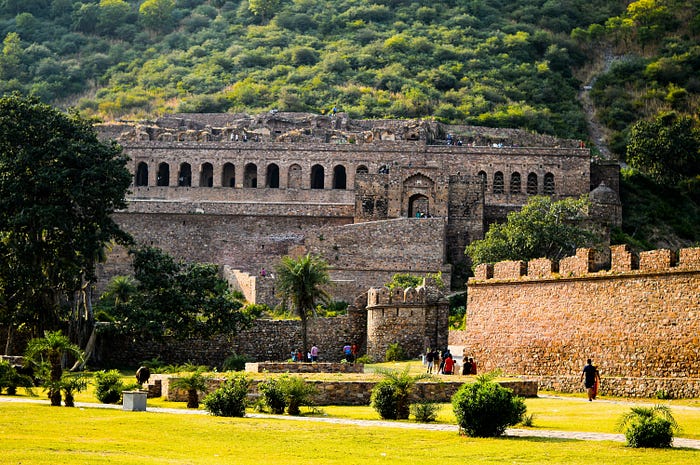
No Sariska itinerary is complete without Bhangarh. Built in the 17th century, this fort-turned-ruin carries enough atmosphere to earn an official ASI notice prohibiting entry after sunset — one of the few such warnings in India.
What remains is hauntingly beautiful: carved sandstone doorways framing open sky, crumbling palace walls draped in wildflowers, and a silence that feels weighted with something you can’t quite name. The legends — a sorcerer’s curse, a city that disappeared overnight — are centuries old and stubbornly persistent.
Whether you believe them or not, Bhangarh stays with you.
Our guides at Chokhiwadi pair a morning safari with an afternoon Bhangarh visit for one of the most complete days possible in this region.
Kankwari Fort and Ancient Temples: Heritage Hidden Inside the Reserve
Kankwari Fort sits inside the reserve itself — and it is where Mughal Emperor Aurangzeb imprisoned his brother Dara Shikoh before having him executed in 1659. Accessible via safari route, with views across the Aravalli valleys that justify the detour.
Also within the reserve: Pandupol Temple, believed to be where the Pandavas rested during their forest exile, and Neelkanth Temple, a complex of thousand-year-old Shiva temples with intricate carvings that most visitors never find.
Sariska is not just a wildlife destination. It is a layered place — forest, mythology, and Mughal history all occupying the same terrain.
Stay at Chokhiwadi: A Luxury Eco-Resort Built Around the Forest
Chokhiwadi Forest Retreat, a luxury resort in Sariska sits at the edge of Sariska Tiger Reserve in the Aravalli foothills. When our founders arrived at this 9.5-acre plot in 2022, they planted over 20,000 native trees before opening a single room. The forest you see here was grown, not inherited.
We follow Rajasthan’s Eco-Tourism policy — solar power, rainwater harvesting, composting, and a kitchen that grows much of what it serves. Our staff come almost entirely from villages within 5 km. The mud villas are painted by local women using traditional Mandana art. The milk at breakfast is sourced from nearby families.
Three ways to stay:
- Luxury Glamping Tent — Aravalli views, peacock parades. From ₹5,999/night
- Mud Villa — Hand-painted Mandana art, earthy and beautiful. From ₹7,999/night
- Stone Cottage — Royal comfort deep in the wild. From ₹12,999/night
Dinners happen under the stars at our Baori stepwell, around open-air bonfires, or inside Spice Aangan — our 40-seat restaurant under a Maharaja-styled tent serving farm-to-table Rajasthani cuisine.
When to Visit Sariska Tiger Reserve
- October–February: Best weather, reliable tiger sightings, peak season
- March–May: Highest chance of tiger sightings as animals concentrate around waterholes
- July–September: Monsoon green, quieter safaris in buffer zones
Sariska is just over an hour from Jaipur and roughly 3–4 hours from Delhi — one of the most accessible wildlife destinations in India.
At last
Sariska gives you the tiger safari, the haunted fort, the Mughal prison, the ancient temples, and a luxury eco-stay that was built to belong here. Not many places can offer all five.
