ISO 27701 Consultant: Common Challenges and How to Solve Them
Author : John Mills | Published On : 03 Nov 2026
Protecting personal information is an important responsibility for businesses that collect, process, or store customer and employee data. ISO/IEC 27701:2025 provides requirements for establishing, implementing, maintaining, and continually improving a Privacy Information Management System (PIMS).
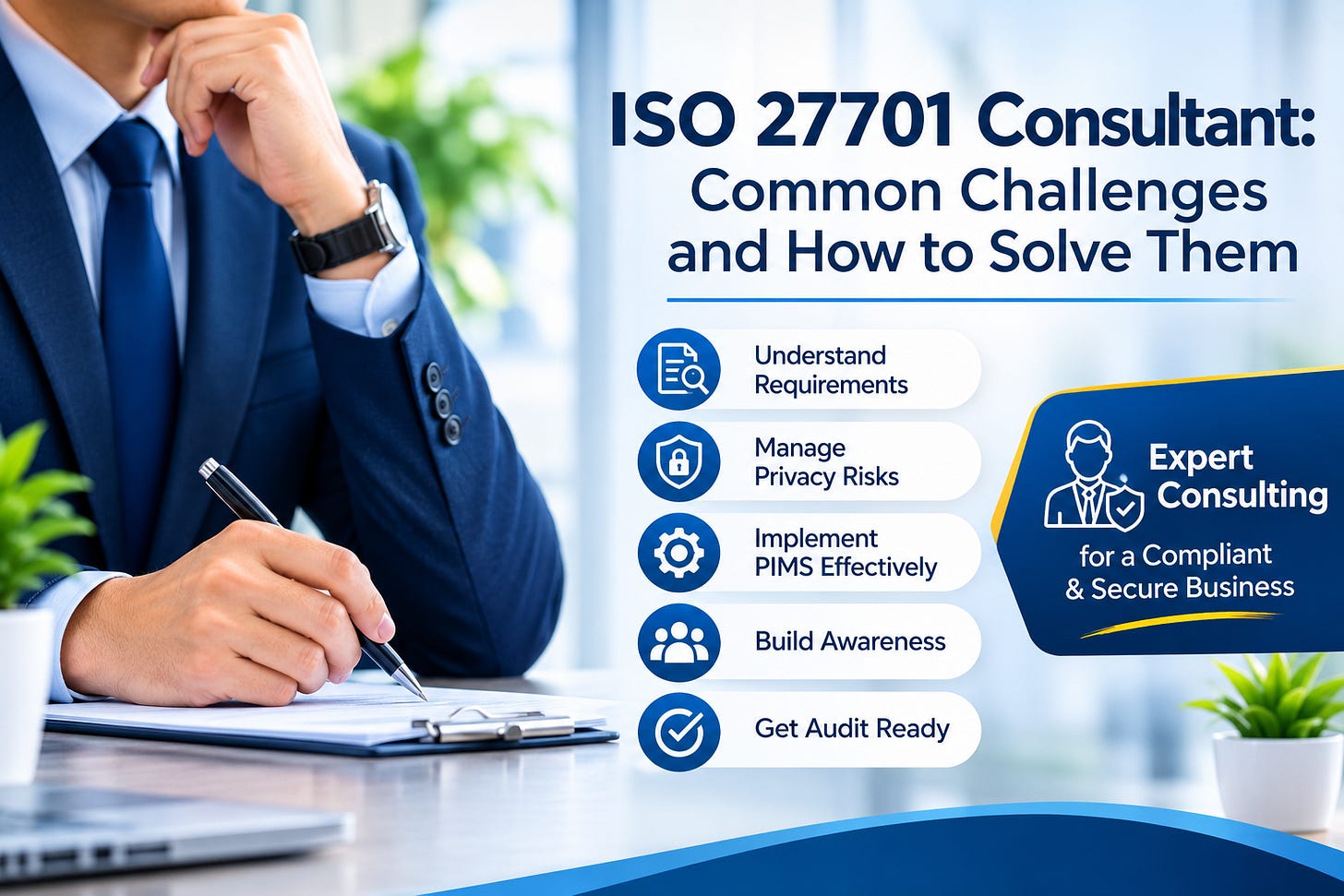
However, organizations may face several difficulties while putting these requirements into practice. Working with an experienced ISO 27701 Consultant can help businesses understand these challenges and develop effective solutions.
Understanding the Role of an ISO 27701 Consultant
An ISO 27701 Consultant guides organizations through the different stages of PIMS implementation. Their responsibilities include conducting gap assessments, identifying privacy risks, preparing documentation, and supporting employee awareness activities. They also help businesses establish appropriate privacy controls and prepare for internal and certification audits. Professional guidance makes the implementation process more structured and manageable.
Common ISO 27701 Implementation Challenges and Their Solutions
Organizations may encounter various obstacles when establishing an effective privacy management system. Understanding these problems helps businesses take appropriate corrective measures.
1. Difficulty Understanding Standard Requirements
Challenge: Businesses may struggle to interpret ISO 27701 requirements and understand how they apply to existing operations. This can create confusion when establishing privacy management processes.
Solution: A consultant explains the applicable requirements and helps translate them into practical policies, procedures, and operational activities.
2. Defining the PIMS Scope
Challenge: Identifying relevant departments, information systems, business activities, and personal data processing operations can be difficult. An unclear scope may leave important privacy activities uncovered.
Solution: Conduct a detailed assessment of organizational activities, identify relevant boundaries, and establish a clearly documented PIMS scope.
3. Identifying and Managing Privacy Risks
Challenge: Organizations may overlook risks associated with unauthorized access, information sharing, data retention, and third-party processing.
Solution: Perform structured privacy risk assessments, evaluate potential threats, and establish suitable controls to reduce identified risks.
4. Preparing ISO 27701 Documentation
Challenge: Developing privacy policies, procedures, records, and supporting documents requires time and a clear understanding of organizational processes.
Solution: Prepare relevant documentation based on actual business activities and applicable requirements. Ensure that employees understand how to follow documented procedures.
5. Employee Awareness and Responsibility
Challenge: Employees may not understand their responsibilities when handling personal information, increasing the possibility of accidental disclosures and privacy incidents.
Solution: Provide regular awareness sessions, role-based training, and clear responsibility assignments to encourage consistent privacy practices.
6. Preparing for Internal and Certification Audits
Challenge: Missing records, ineffective controls, and unresolved nonconformities can affect an organization’s audit readiness.
Solution: Conduct internal audits, review implementation evidence, identify weaknesses, and implement corrective actions to address identified nonconformities.
How to Choose the Right ISO 27701 Consultant
Selecting an experienced consultant is important for effective PIMS implementation. Businesses should consider the following factors:
- Practical experience: Look for experience in privacy management system implementation.
- Standard knowledge: Ensure familiarity with ISO/IEC 27701:2025 requirements.
- Implementation support: Evaluate their approach to gap analysis, documentation, risk assessment, and employee training.
- Business understanding: Choose a consultant who can recommend solutions according to organizational activities and privacy risks.
The right consultant should provide practical guidance rather than simply offering generic documentation.
Conclusion
Implementing ISO 27701 requires proper planning, effective privacy controls, employee participation, and continuous improvement. Addressing common challenges early can make the process more manageable and strengthen personal information protection. Working with an experienced consultant helps organizations understand applicable requirements, establish an effective PIMS, and prepare for certification audits through a structured implementation approach.
