Instacart vs Amazon Fresh: Data-Driven Platform Comparison 2026
Author : Actowiz Solutions | Published On : 23 Apr 2026
Introduction: The Battle for Online Grocery Dominance
Instacart and Amazon Fresh represent two fundamentally different approaches to online grocery delivery. Instacart is a marketplace connecting customers with shoppers at existing retailers. Amazon Fresh is an integrated retail operation with its own inventory and fulfillment. Both are fighting for the same customer dollar, but their models create different pricing dynamics, availability patterns, and customer experiences.
For grocery retailers, FMCG brands, and investors, understanding these differences at the data level provides critical strategic intelligence. This analysis is based on 100,000+ product listings scraped from both platforms across 15 major US metro areas over 90 days.
Pricing: Who Is Actually Cheaper?
The pricing comparison between Instacart and Amazon Fresh is more nuanced than a simple price check suggests. Instacart does not set its own prices — it reflects the prices of its partner retailers (Costco, Kroger, Safeway, etc.) plus a markup and service fee. Amazon Fresh sets its own prices as a retailer.
Basket-Level Comparison
We compared a standard 40-item grocery basket (dairy, produce, meat, pantry staples, beverages) across both platforms in all 15 metro areas:
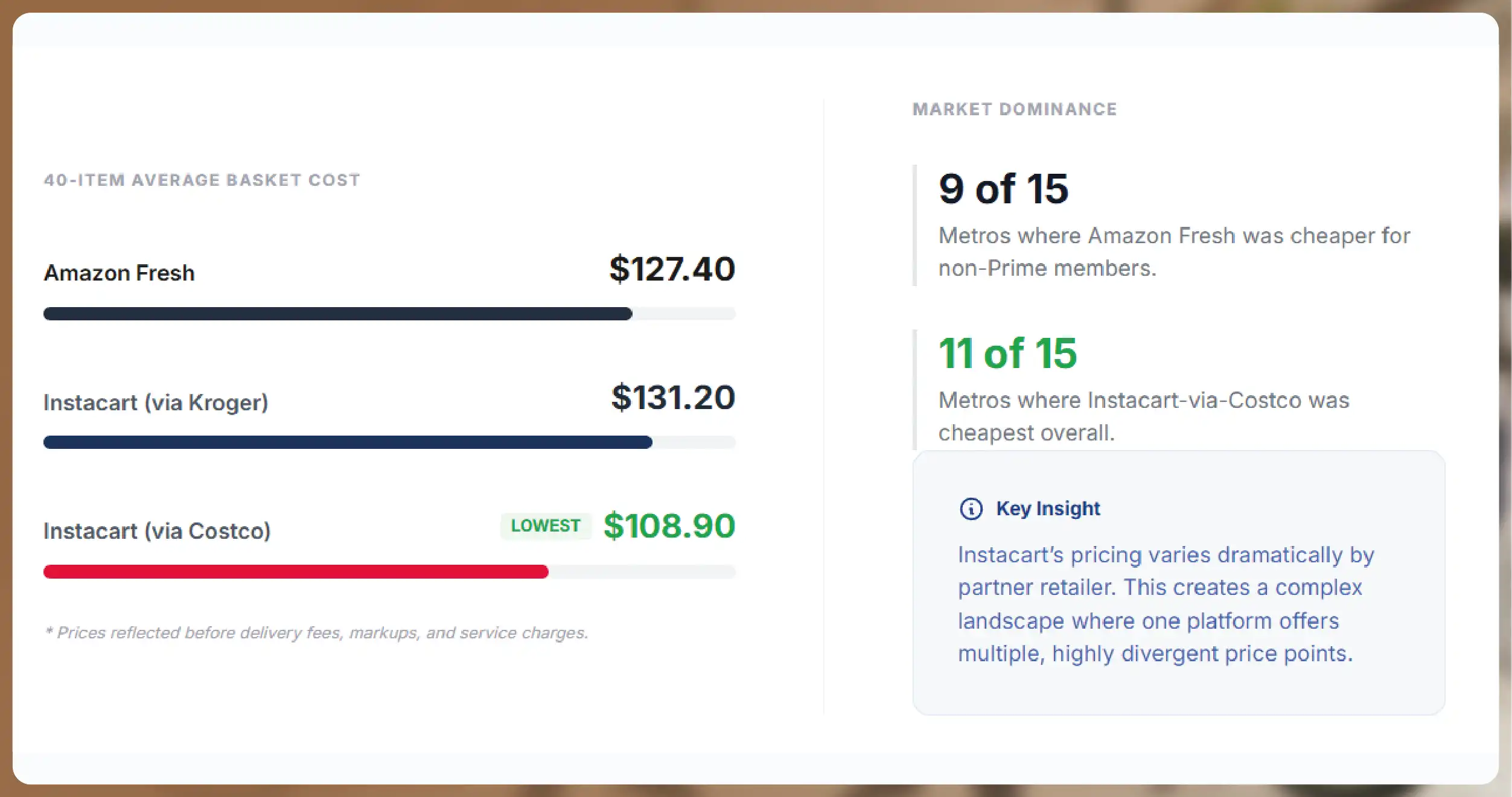
- Average basket cost on Amazon Fresh: $127.40 (before delivery fees)
- Average basket cost on Instacart (via Kroger): $131.20 (before markup and fees)
- Average basket cost on Instacart (via Costco): $108.90 (before markup and fees)
- After including all fees and markups, Amazon Fresh was cheaper in 9 of 15 metros for non-Prime members, but Instacart-via-Costco was cheapest overall in 11 of 15 metros.
The key insight: Instacart’s pricing varies dramatically depending on which partner retailer the customer uses. This creates a complex competitive landscape where a single platform offers multiple price points.
Category-Level Price Differences
| Category | Amazon Fresh Avg | Instacart (Kroger) Avg | Cheaper Platform |
|---|---|---|---|
| Dairy & Eggs | $4.89 | $5.12 | Amazon Fresh |
| Fresh Produce | $3.45 | $3.28 | Instacart |
| Meat & Seafood | $9.87 | $10.43 | Amazon Fresh |
| Pantry Staples | $4.21 | $4.15 | Instacart |
| Beverages | $5.67 | $5.89 | Amazon Fresh |
| Snacks & Confectionery | $4.78 | $4.52 | Instacart |
| Household Essentials | $8.34 | $8.91 | Amazon Fresh |
Amazon Fresh tends to be more competitive on branded products and household essentials, while Instacart (through its retail partners) often offers better prices on fresh produce and pantry staples.
Product Range and Availability
Product availability is where the two platforms diverge most significantly:
- Amazon Fresh average product range: 12,000-15,000 unique products per metro area.
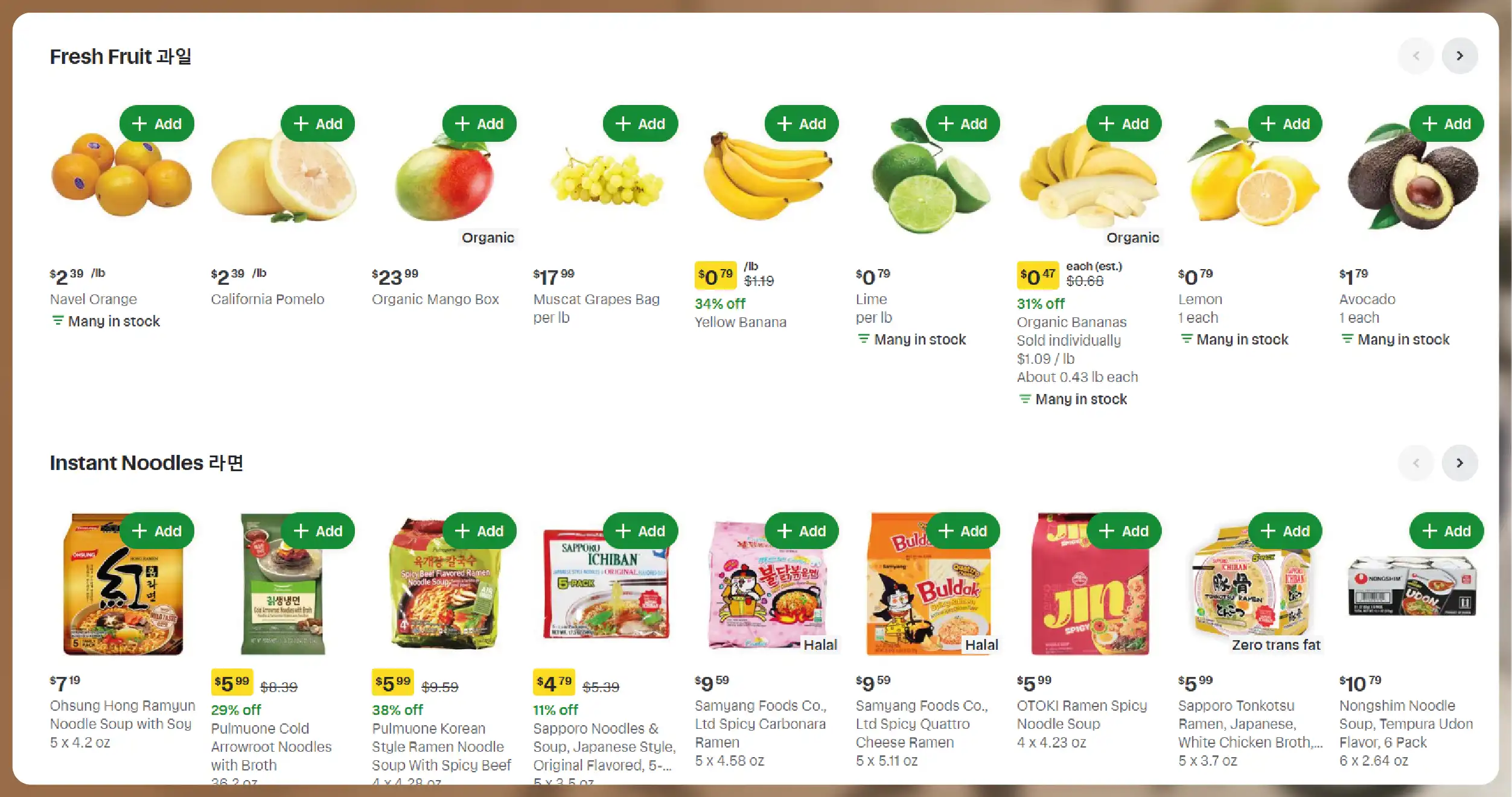
- Instacart average product range (via Kroger): 35,000-45,000 unique products per metro area.
- Instacart total range (across all partner retailers): 80,000+ unique products in major metros.
Instacart’s marketplace model gives it a significant assortment advantage. Customers can shop across multiple retailers in a single order, accessing products that Amazon Fresh simply does not carry. For specialty items, organic products, and local brands, Instacart typically offers more options.
Delivery Speed and Slot Availability
Our monitoring of delivery slot availability over 90 days revealed:
- Amazon Fresh average delivery window: 2-hour scheduled slots available 94% of the time in covered areas. Same-day delivery available in most metros.
- Instacart average delivery window: 1-hour scheduled slots with “as fast as 30 minutes” option in most areas. Express delivery available 89% of the time.
- During peak hours (5-8 PM), Instacart showed 15% more slot availability than Amazon Fresh, likely due to its larger network of independent shoppers.
Get Platform-Specific Pricing Data for Your Category
See exactly how your products are priced on Instacart vs Amazon Fresh across all major metros. Includes partner retailer comparison and fee analysis.
What This Means for Different Stakeholders
For Grocery Retailers
If you partner with Instacart, understand that your pricing (plus Instacart’s markup) competes directly with Amazon Fresh’s own pricing. Monitor the total cost to consumer across both platforms to ensure your products remain competitive through the Instacart channel.
For FMCG Brands
Your products may be priced and positioned differently on each platform. Amazon Fresh sets its own retail prices, while Instacart reflects your retail partners’ pricing. Monitor both to ensure consistent brand pricing and identify where promotional investment has the most impact.
For Food-Tech Startups
The pricing and availability data from both platforms provides valuable benchmarks for your own pricing strategy, delivery coverage planning, and assortment decisions. Understanding where each platform is strong and weak helps you find your competitive niche.
FAQs
1. How often do you update Instacart and Amazon Fresh data?
Daily for pricing and availability. Hourly for delivery slot monitoring during peak periods. Weekly for full catalog comparisons.
2. Can you separate Instacart pricing by retail partner?
Yes. We track pricing separately for each Instacart retail partner (Kroger, Costco, Safeway, etc.) so you can see how the same product is priced through different retailers on the platform.
3. Do you track Instacart markups and service fees?
Yes. We capture the base product price, any Instacart markup, service fees, and delivery fees. This provides the true total cost to consumer for accurate competitive comparison.
4. Can I get this data via API for my own analysis?
Absolutely. Our Grocery Data API provides programmatic access to pricing, availability, and delivery data from both platforms. Full documentation and SDKs available.
Learn More >> https://www.actowizsolutions.com/instacart-vs-amazon-fresh-grocery-delivery-comparison.php
Originally published at https://www.actowizsolutions.com
