Human-in-Loop Automation Model: Why AI Needs Human Oversight in Precision Machining
Author : Ayesha Diaz | Published On : 14 Sep 2026
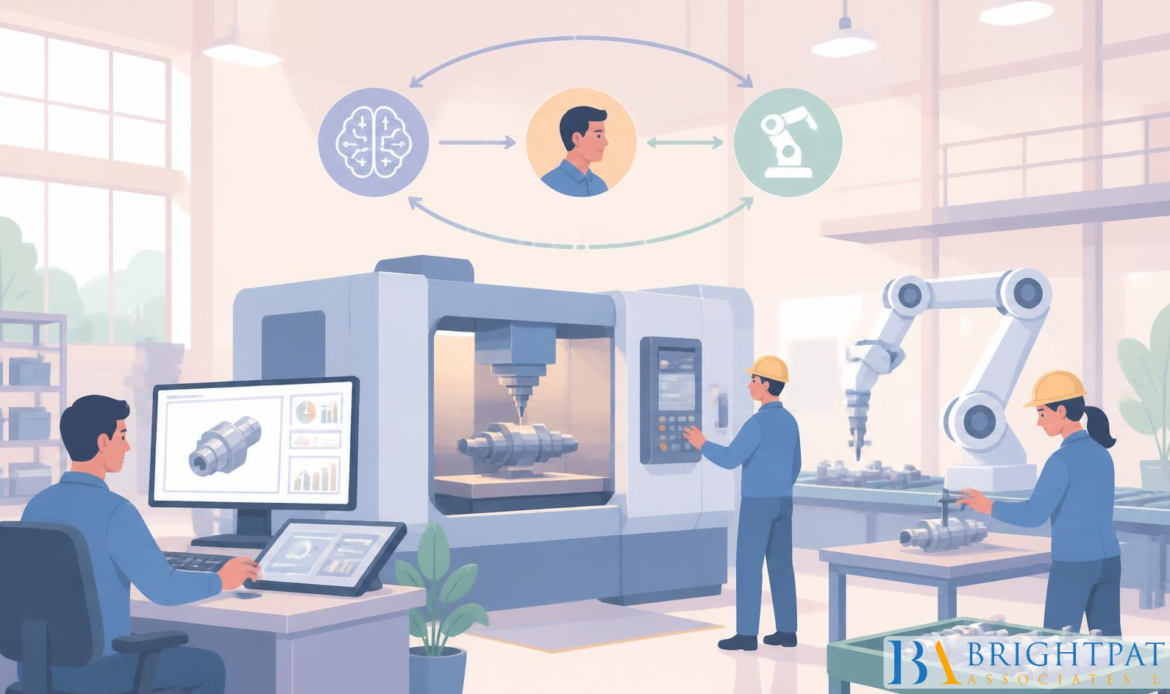
Precision machining is undergoing a fundamental transformation. Artificial intelligence, machine vision, connected equipment, robotics, and advanced analytics are giving manufacturers unprecedented visibility into their production environments. Machines can now process enormous volumes of operational data, identify patterns, predict potential failures, and recommend adjustments that would be difficult for humans to detect manually.
For small and mid-sized manufacturers, the answer may be more nuanced. The future of precision machining is unlikely to be defined by machines replacing experienced professionals. Instead, competitive advantage may come from creating production environments where artificial intelligence and human expertise continuously reinforce one another.
This shift toward collaborative automation is particularly important for companies operating in the Machinery Industry, where quality, reliability, production efficiency, and workforce capabilities directly influence profitability and customer relationships.
The Limits of Autonomous Decision-Making
Precision machining operates in an environment where extremely small deviations can have significant consequences. A variation in material characteristics, unexpected tool wear, machine vibration, thermal changes, or fixture instability can affect the final component.
AI systems are highly effective at recognizing patterns across large datasets. They can analyze spindle loads, temperatures, vibration, dimensional measurements, tool conditions, and cycle times far faster than a human operator could.
An algorithm may recommend changing cutting parameters because production data indicates a deviation from historical performance. An experienced machinist, however, may recognize that the real issue is a fixture problem, a material inconsistency, or an unusual tool condition.
This distinction matters. Manufacturing decisions cannot always be reduced to historical patterns. Real production environments contain exceptions, unexpected conditions, and variables that may not exist in an AI model's training data. That is why human oversight remains an important part of intelligent manufacturing.
Human-in-the-Loop Automation Creates a Stronger Production Model
The human-in-the-loop approach does not reject automation. Instead, it determines where human judgment adds the greatest value. In this model, AI continuously collects and analyzes production information. It identifies anomalies, predicts potential problems, and recommends possible actions. Skilled professionals then validate important decisions or intervene when circumstances fall outside expected conditions.
Consider a CNC machining operation. An AI system may identify increasing vibration and recommend a maintenance inspection. Rather than automatically stopping production, the system can alert a manufacturing engineer who evaluates the situation alongside production schedules, tool conditions, machine history, and customer requirements.
Machines provide speed and analytical capacity. Professionals provide context, accountability, and judgment. This combination can be particularly valuable for manufacturers pursuing greater manufacturing efficiency without sacrificing flexibility.
Quality Control Becomes More Intelligent, Not Less Human
Quality control represents one of the clearest opportunities for human-machine collaboration. Modern machine vision systems can inspect components rapidly and identify surface imperfections, dimensional variations, and unusual geometries. AI can compare these observations against historical data and classify potential defects.
A component may differ slightly from historical examples while remaining completely acceptable according to engineering specifications. Conversely, an apparently minor deviation could indicate a deeper process problem that requires investigation.
Human quality professionals can therefore act as the final layer of interpretation. This approach transforms quality control from a purely automated inspection process into a collaborative intelligence system. AI delivers speed and consistency, while experienced professionals determine significance and appropriate action.
Predictive Maintenance Still Needs Experienced Professionals
The same principle applies to machinery maintenance. Connected equipment can continuously monitor vibration, temperature, pressure, energy consumption, lubrication conditions, and other indicators of machine health. AI can identify early warning signals and estimate when intervention may be necessary.
But maintenance is rarely isolated from the broader production environment. A maintenance engineer may know that a machine is scheduled for a major changeover next week. A replacement component may already be on order. A particular vibration pattern may be normal for that machine under specific operating conditions.
Human validation can therefore reduce false alarms, prevent unnecessary maintenance, and ensure that genuinely critical problems receive immediate attention. For machinery companies, the objective should not simply be to predict failures. It should be to make better maintenance decisions.
Building the Talent Behind Intelligent Manufacturing
Technology alone cannot create a future-ready machinery company. Manufacturers need leaders and professionals capable of connecting advanced technology with practical manufacturing knowledge.
That makes strategic workforce planning and specialized executive recruitment increasingly important. Companies need leaders who can manage automation investments while developing employees, protecting quality, improving operational efficiency, and maintaining a clear connection between technology and business strategy.
BrightPath Associates LLC works with companies seeking leadership and talent solutions within the machinery sector, helping organizations strengthen the people's side of technological transformation. The central question for machinery executives is no longer whether AI belongs on the shop floor. It is how effectively AI and human expertise can work together.
The manufacturers that answer that question successfully will be better positioned to improve precision, reliability, efficiency, and resilience—without losing the experience and judgment that made their operations successful in the first place.
Exploring that distinction could be the first step toward building a smarter, more resilient manufacturing operation. Learn more about the human-in-the-loop approach in BrightPath Associates' original analysis, Human-in-Loop Automation Model: Why AI Needs Human Oversight in Precision Machining.
