How to Source High-Quality Sugarcane Bagasse Bowls for Your Food Service Business?
Author : HitokaCece HitokaCece | Published On : 13 Aug 2026
Introduction
Over the years in the molded fiber tableware business, I have watched too many buyers focus solely on unit price when sourcing sugarcane bagasse bowls, only to discover later that the bowls collapse under hot soup or leak through the base. A good bowl is not just about shape—it is about fiber quality, molding precision, and how the product performs when it actually reaches the customer's table. The global bagasse tableware market stood at USD 2.9 billion in 2025 and is projected to reach USD 6.4 billion by 2036. With demand rising fast, knowing how to separate reliable suppliers from the rest has never been more important. Let me share what I have learned about sourcing sugarcane bagasse bowls that truly deliver.
Understanding the Manufacturing Process of Sugarcane Bagasse Bowls
To source smart, you must understand how sugarcane bagasse bowls are made. The process begins with bagasse—the fibrous residue left after sugarcane juice extraction. This material contains approximately 50% cellulose, 25% hemicellulose, and 25% lignin, which gives it excellent structural rigidity. The production involves pulping, where bagasse fibers are mixed with water to create a uniform slurry. Next comes molding, where the pulp is formed into bowl shapes using vacuum suction and forming pressure. Hot pressing and drying then improve rigidity, surface finish, and dimensional stability. Finally, edges are trimmed and products are inspected for cracks, deformation, or uneven molding. A supplier who cannot explain this process clearly likely lacks the production control needed for consistent quality.
Key Quality Indicators for Sugarcane Bagasse Bowls
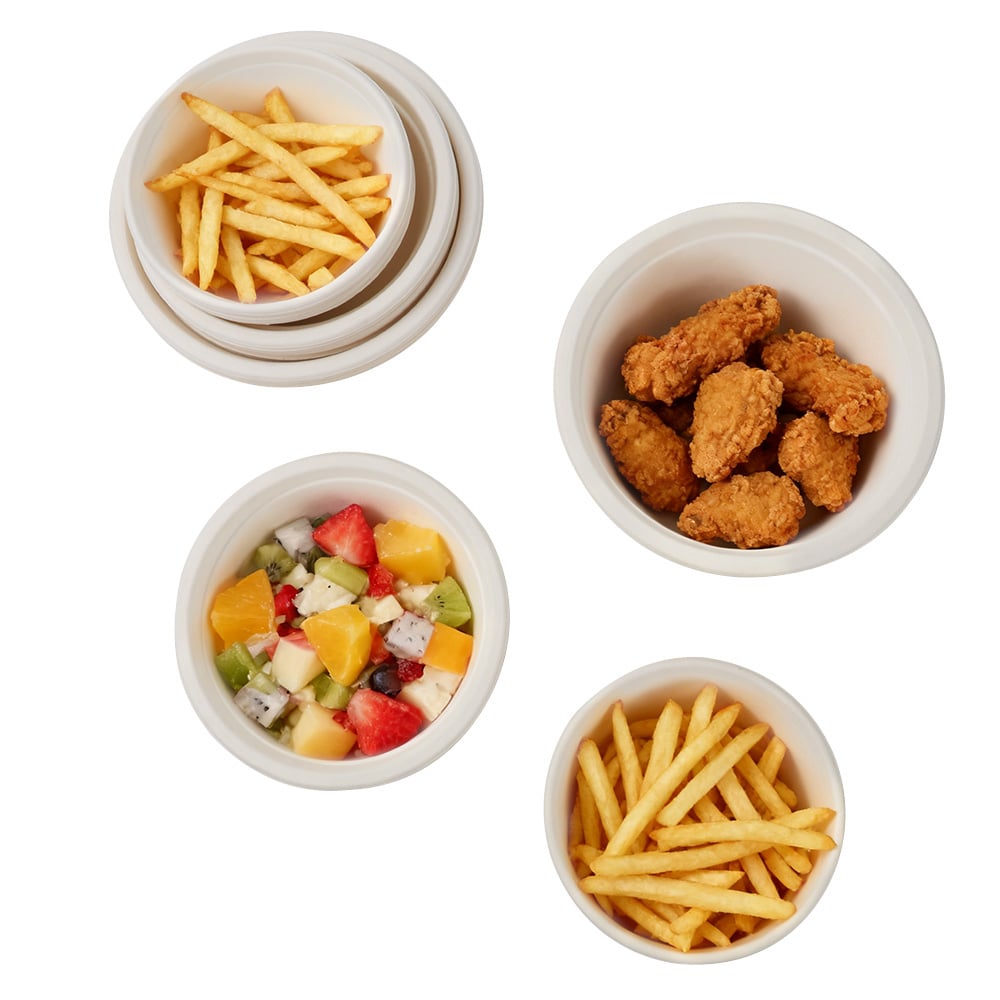
When evaluating sugarcane bagasse bowls, I always check a few non-negotiable quality indicators. First is heat resistance—quality bowls should withstand temperatures up to 120°C without warping or leaking. Second is oil resistance, essential for greasy foods like fried chicken or pasta with sauce. Third is structural strength—the bowl must hold its shape under the weight of food without bending or breaking. Fourth is edge finish—rough or uneven rims indicate poor trimming and can lead to customer complaints. Also verify that the bowls are PFAS-free, as many markets now require this documentation. A reliable supplier will provide test reports for these performance metrics without hesitation.
Evaluating Supplier Capabilities for Sugarcane Bagasse Bowls
Beyond the product itself, the supplier matters enormously. I recommend requesting food-contact documentation for your intended market, PFAS-free test reports, and compostability evidence such as BPI or EN13432 certifications. Also ask about production capacity and lead times—can the supplier handle your order volume consistently? Visit the facility if possible, or request a virtual tour. Look for ISO 9001 quality management systems, which indicate standardized production and repeatability. A supplier who is transparent about their process, materials, and certifications is far more likely to deliver consistent sugarcane bagasse bowls than one who offers vague assurances.
Conclusion
Sourcing sugarcane bagasse bowls is about more than finding the lowest price—it is about finding a partner who understands quality, consistency, and compliance. By understanding the manufacturing process, checking key quality indicators, and thoroughly evaluating supplier capabilities, you can secure a reliable supply that protects your brand and satisfies your customers. The market is growing fast, and the buyers who do their homework will be the ones who thrive.
