How to Select the Right Thread Mill for Thread Size and Pitch
Author : Surya makeyoueasy | Published On : 28 Sep 2026
Introduction
Selecting the correct thread mill for CNC machining requires more than matching the tool to the nominal thread diameter. Thread size, pitch, thread form, internal or external application, cutter diameter, thread depth, material, and machine capability all affect the result. Choosing the correct combination helps produce accurate threads, good surface finish, reliable tool life, and stable machining.
1. Start With the Thread Size
The first step is to identify the exact thread specification.
For a metric thread such as M20 × 2.5:
-
M20 = nominal thread diameter of 20 mm
-
2.5 mm = thread pitch
For inch threads, the specification may be expressed using the nominal diameter and threads per inch (TPI).
Before selecting a thread mill, confirm:
-
Nominal thread diameter
-
Pitch or TPI
-
Internal or external thread
-
Right-hand or left-hand thread
-
Thread standard
-
Required thread depth
-
Required tolerance
A thread mill must produce the correct thread profile and pitch through its tool geometry and CNC tool path.
2. Match the Thread Form
The thread mill must match the required thread form.
Common thread types include:
-
Metric ISO threads
-
Unified threads such as UNC and UNF
-
NPT/NPTF threads
-
Special or application-specific thread forms
Single-form thread mills can provide flexibility across different thread sizes when the tool geometry supports the required profile. Multi-form thread mills are designed around specific thread sizes or pitch ranges and can provide higher productivity in suitable applications.
Do not assume that two thread mills with the same diameter can produce the same thread.
3. Understand Thread Pitch
Pitch is the distance from one thread crest to the next.
For metric threads, pitch is expressed in millimetres. For inch threads, TPI indicates the number of threads per inch.
Pitch affects:
-
Thread profile
-
Tool selection
-
Helical tool path
-
Feed calculation
-
Thread depth
-
Clearance requirements
For multi-start threads, the lead is greater than the pitch because the tool must advance farther for each revolution. The thread mill must also have sufficient relief for the resulting lead angle.
4. Choose the Correct Thread Mill Diameter
Cutter diameter is one of the most important selection factors.
For an internal thread, the thread mill must be small enough to enter the pre-machined hole while providing sufficient clearance from the thread profile.
A smaller cutter can also reduce thread-profile deviation. Sandvik Coromant recommends keeping the cutter diameter at no more than about 70% of the threading diameter for internal thread milling to minimize profile deviation.
For example, when machining an M30 internal thread, a cutter that is too large can produce greater deviation at the thread root.
However, going unnecessarily small can reduce tool rigidity. The practical choice therefore balances thread accuracy, tool strength, hole diameter, and machining stability.
5. Select Single-Form or Multi-Form
Single-Form Thread Mill
A single-form cutter machines one thread profile at a time.
It can be useful when:
-
Different thread sizes need to be produced
-
Flexibility is important
-
Low production quantities are involved
-
Several pitches need to be machined with one tool type
Multi-Form Thread Mill
A multi-form cutter machines multiple thread teeth during the interpolation cycle.
It can be advantageous for:
-
Higher production quantities
-
Repetitive thread sizes
-
Faster machining
-
Consistent production
The correct choice depends on production volume, thread specification, and the available tool range.
6. Check Thread Depth
Thread depth must be considered before choosing the tool.
The thread mill needs enough effective cutting length to machine the required thread depth without interference.
Check:
-
Maximum thread depth
-
Cutting length
-
Shank diameter
-
Tool reach
-
Hole depth
-
Required clearance
A tool that has the correct diameter but insufficient cutting length will not be suitable for a deep thread.
7. Consider Internal vs External Threading
Thread mills can be used for both internal and external threads, but the required tool path and cutter engagement are different.
For internal threading, the cutter must fit inside the hole and maintain sufficient clearance.
For external threading, the tool must have enough clearance around the outside diameter of the component.
The programmed tool path also determines the direction of cutting and must be selected correctly for right-hand or left-hand threads.
8. Match the Tool to the Workpiece Material
The thread mill grade and coating should match the workpiece.
Consider whether you are machining:
-
Mild or alloy steel
-
Stainless steel
-
Cast iron
-
Aluminium
-
Hardened steel
-
Titanium or other difficult materials
Material hardness, abrasiveness, heat generation, and chip evacuation can all influence thread mill performance.
For difficult materials, multiple radial passes can reduce cutting load and tool deflection while improving thread accuracy.
9. Check Machine and Toolholder Compatibility
The thread mill must also match the CNC machine and toolholding system.
Before ordering, verify:
-
Shank diameter
-
Toolholder type
-
Maximum spindle speed
-
Machine interpolation capability
-
Available coolant
-
Tool reach
-
Machine rigidity
A short and rigid tool assembly is generally preferred, especially when machining hard materials or deep threads.
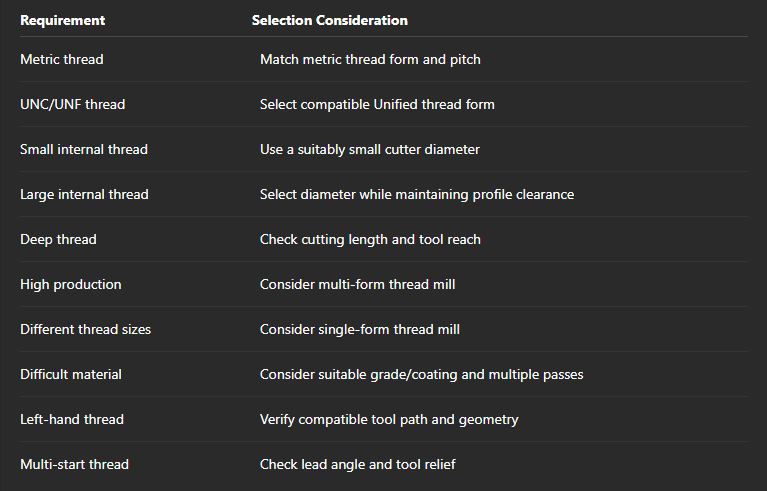
Thread Mill Selection Guide
Common Thread Mill Selection Mistakes
Choosing the Cutter Only by Thread Diameter
Thread diameter alone does not determine the correct tool. Pitch, thread form, depth, and cutter diameter must also be checked.
Using an Oversized Cutter
An excessively large cutter can increase radial engagement and contribute to thread-profile deviation, particularly in internal threads.
Ignoring Pitch
A tool selected for the wrong pitch or thread form will not produce the required thread geometry.
Using Excessive Tool Overhang
Long tool assemblies can increase deflection and vibration, affecting thread accuracy and tool life.
Using One Radial Pass for Difficult Materials
Multiple radial passes can reduce tool load and deflection in difficult applications and can improve thread quality.
Why Choose MakeYouEasy?
At MakeYouEasy, you can explore CNC thread mills, milling cutters, inserts, holders, drills, and other machining tools for different applications.
When selecting a thread mill, verify the thread size, pitch, thread form, cutter diameter, cutting length, shank size, workpiece material, and machine compatibility before ordering.
Conclusion
Choosing the right thread mill requires a complete understanding of the thread specification and machining conditions. Start with the thread diameter and pitch, then confirm the thread form, internal or external application, cutter diameter, cutting length, material compatibility, and toolholder requirements.
For internal thread milling, cutter diameter is particularly important because an oversized cutter can increase profile deviation. A smaller cutter can improve thread quality, but it must still provide enough rigidity for the application. Following the tool manufacturer’s recommendations for cutter diameter, cutting parameters, tool path, and number of passes can help achieve accurate and consistent threads.
Frequently Asked Questions
1. How do I choose a thread mill size?
Choose the thread mill based on thread diameter, pitch, thread form, cutting depth, cutter diameter, and application type.
2. Can one thread mill cut different thread sizes?
Yes, single-form thread mills can often machine multiple compatible thread sizes when the tool geometry and programming allow it.
3. Should a thread mill be smaller than the thread diameter?
For internal threads, the cutter must be smaller than the finished thread diameter, and a smaller cutter can help reduce profile deviation.
4. Does thread pitch affect thread mill selection?
Yes, pitch determines the thread profile and tool path and must match the selected thread mill’s specifications.
5. Are multiple passes necessary for thread milling?
Not always, but multiple radial passes can reduce cutting load and tool deflection and can improve thread quality in difficult applications.
Popular Search Keywords
thread mill selection, CNC thread mill selection, thread milling cutter size, thread mill for metric threads, thread mill for UNC threads, thread mill pitch selection, CNC thread milling tools, internal thread mill selection, external thread milling cutter, thread milling cutter diameter
