How to Program RFID Tags: Complete Guide for Accurate RFID Tag Writing
Author : Jaming Wong | Published On : 30 Jul 2026
Understanding How to Program RFID Tags in Real Industrial Applications
RFID tag programming is the process of writing digital information into an RFID chip before the tag is deployed in a warehouse, library, hospital, manufacturing line, or asset management system.
In practical projects, programming is not simply “putting data into a tag.” The difficult part is maintaining accuracy when thousands of tags must be created with unique identities.
During RFID deployment projects, I have worked with engineering teams integrating RFID workstations, fixed rfid readers, and tag management software for enterprise customers. One common scene appears repeatedly: hundreds of blank UHF RFID labels arrive from suppliers, and every single label must receive a correct EPC number before being attached to equipment or documents.
A single incorrect EPC assignment can create problems months later during inventory checks. That is why professional RFID programming focuses on three factors:
- Stable writing performance
- Accurate data management
- Reliable database association
Cykeo RFID programming platforms are designed around this workflow, combining RFID reading, writing, and software interaction into one controlled environment.
What Is RFID Tag Programming?
RFID tag programming means writing electronic information into the memory area of an RFID chip using an RFID reader/writer.
A typical RFID tag contains:
| Memory Area | Purpose |
|---|---|
| EPC Memory | Stores unique electronic product codes |
| TID Memory | Contains chip identification information |
| User Memory | Stores additional application data |
| Reserved Memory | Stores security-related information |
For industrial UHF RFID systems, EPC encoding is usually the first step.
The international standard commonly used for UHF RFID communication is ISO/IEC 18000-63 (formerly ISO 18000-6C / EPC Class 1 Gen 2). The standard defines communication methods between RFID readers and tags, helping different manufacturers maintain compatibility.
According to GS1, EPC-based identification enables organizations to uniquely identify physical objects worldwide through standardized coding systems. GS1 manages EPC standards used across global supply chains.
How to Program RFID Tags Step by Step
1. Prepare RFID Tags and Programming Equipment
Before writing data, engineers normally confirm:
- RFID frequency type
- Chip compatibility
- Memory structure
- Required EPC format
- Reader/writer communication method
For example, UHF RFID tags commonly operate around 860–960 MHz depending on regional regulations.
The RFID programming equipment needs stable RF output because writing requires more precision than simple tag reading.
Cykeo RFID desktop programming systems use near-field antenna designs to control the writing area, reducing accidental programming of nearby tags.
2. Connect RFID Writer Software
A professional RFID writing workflow usually includes:
- RFID reader driver installation
- Software connection
- Database configuration
- EPC generation rules
- Writing verification
For enterprise applications, manual input is rarely practical.
A library, hospital, or archive center may need thousands of RFID labels. The software normally generates EPC sequences automatically and links each EPC number with item information.
Example:
| EPC Code | Item Information |
|---|---|
| 300833B2DDD901400000001 | Medical Device A |
| 300833B2DDD901400000002 | Archive Box B |
| 300833B2DDD901400000003 | Tool Set C |
This creates a digital relationship between the physical object and database record.
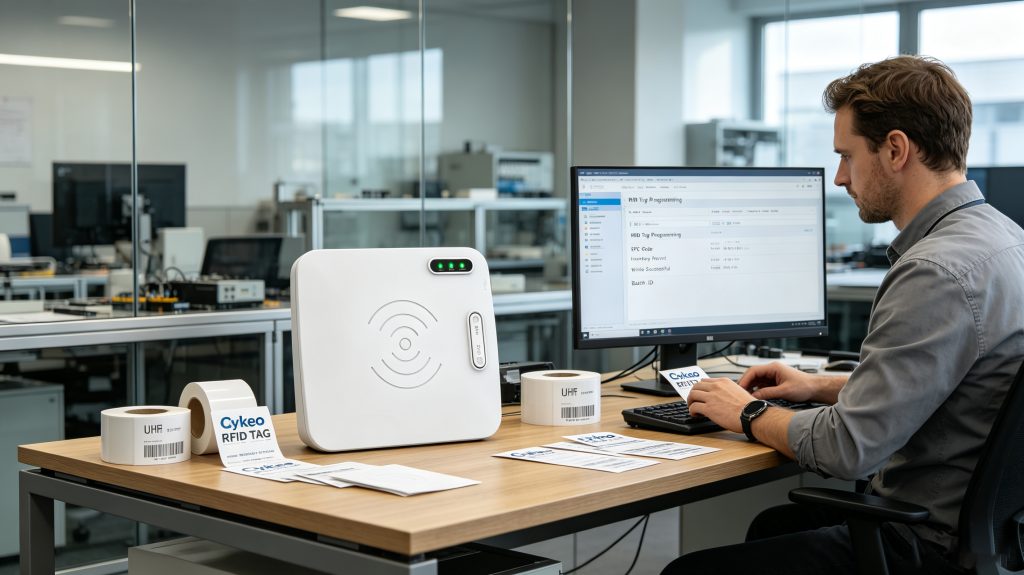
Professional RFID operators use a controlled workstation to write unique EPC codes into RFID tags before deployment.
How RFID Tag Writing Works Technically
When programming RFID tags, the RFID reader sends radio frequency energy and communication commands to the chip.
The process normally follows this sequence:
- Reader sends RF signal
- RFID tag receives energy through its antenna
- Chip wakes up and communicates
- Reader sends write command
- Chip stores information
- Reader verifies written data
Unlike barcode labels, RFID does not require direct visual alignment.
This is one reason RFID has become widely used in logistics and asset management.
A report from the AIM Global notes that RFID technology improves automatic identification processes by enabling wireless data capture without line-of-sight scanning.
Choosing the Right RFID Tag Programmer
Not every RFID reader can provide reliable writing performance.
When selecting equipment for RFID programming, experienced engineers usually evaluate:
| Requirement | Why It Matters |
|---|---|
| Writing stability | Prevents failed tag initialization |
| Antenna control | Avoids programming nearby tags |
| Software support | Enables batch processing |
| SDK availability | Helps system integration |
| Verification function | Confirms successful writing |
In real deployments, writing reliability is often more important than maximum reading distance.
A reader that can detect a tag from several meters away may not be ideal for a desktop programming station because uncontrolled RF range can cause incorrect writes.
Cykeo Experience: Building Reliable RFID Programming Workflows
At Cykeo, RFID programming solutions are designed for scenarios where accuracy matters more than simple tag reading.
The RFID intelligent workstation combines:
- Controlled RFID writing area
- Batch tag identification
- EPC data management
- Database connection
- Touchscreen operation
- Optional document camera and barcode scanning
For example, in an archive center project, operators can place documents on the workstation, capture document information, write the RFID EPC code, and associate the record with management software in one operation.
The workstation supports ISO18000-6C (EPC C1G2) protocol and can identify multiple RFID tags efficiently.
The practical advantage is not only speed. It is reducing human mistakes during repetitive registration work.
Common Questions About RFID Tag Programming
Can RFID tags be programmed more than once?
Yes. Many RFID tags support rewriting depending on chip type and memory protection settings. However, production environments usually lock EPC data after final verification to prevent unauthorized modification.
Do RFID tags need software to be programmed?
Yes. Professional RFID programming normally requires software to send writing commands, generate EPC numbers, and verify results.
How many RFID tags can be programmed at once?
It depends on the reader, antenna design, tag spacing, and software. Controlled RFID workstations can support batch identification and programming workflows.
Can RFID tags store product information?
Yes. RFID chips can store identification data and additional information depending on available memory. Many systems store detailed information in databases while keeping only the unique identifier inside the RFID tag.
Final Thoughts
How to program rfid tags is not only a technical writing process; it is the foundation of reliable RFID identification systems. From EPC generation to database connection, every step influences future tracking accuracy.
In professional RFID deployments, the most valuable improvement often comes from controlling the writing environment. A stable workstation, accurate software workflow, and verified programming process help companies build dependable asset identification systems.
Cykeo focuses on providing practical RFID solutions where tag programming becomes faster, safer, and easier to integrate into real business operations.
