How to Choose XNEX080608TR-M13 Milling Inserts for Steel
Author : Surya makeyoueasy | Published On : 23 Sep 2026

Introduction
Choosing the right XNEX080608TR-M13 milling insert for steel requires more than matching the insert code. The correct grade, cutter compatibility, cutting geometry, machining conditions, and workpiece material all affect tool life and surface finish. The XNEX080608TR-M13 is a double-sided, six-cutting-edge insert used with Seco Square 6 milling systems, making it suitable for square-shoulder and general milling applications. Seco lists the insert in multiple grades, including MK2050, MP2501, MP3000, and others, allowing selection according to the workpiece and cutting conditions.
What Is the XNEX080608TR-M13?
The XNEX080608TR-M13 is an insert designed for the Square 6 milling system.
According to Seco’s current product data, the insert has:
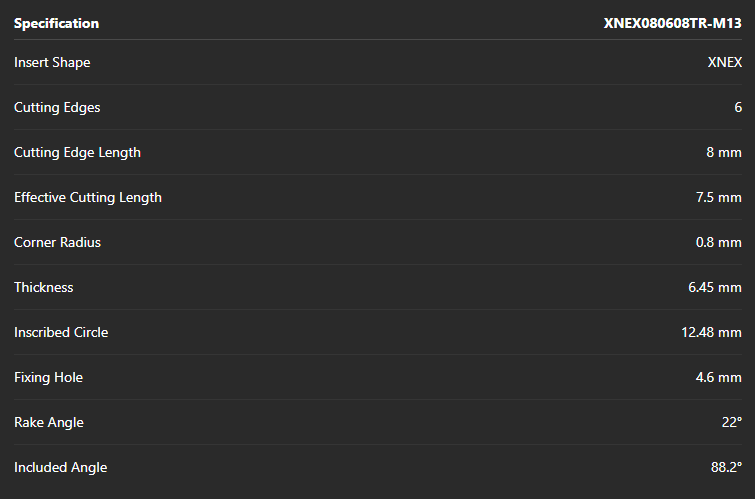
The insert uses a center screw system and is designed for the corresponding XN.X0806 cutter pocket.
1. Start With the Steel Grade
Steel is not a single machining category. Low-carbon steel, alloy steel, tool steel, and hardened steel can require different insert grades and cutting conditions.
Before selecting the insert grade, identify:
-
Carbon and alloy content
-
Material hardness
-
Continuous or interrupted cutting
-
Roughing or finishing requirement
-
Machine rigidity
-
Cutting speed and feed requirements
Seco’s Square 6 cutting data maps different insert grades to different material groups, showing why the grade should be selected according to the actual workpiece rather than the insert geometry alone.
2. Understand the M13 Geometry
The M13 designation identifies the technical cutting geometry.
The XNEX080608TR-M13 has a 22° rake angle, 0° major clearance angle, 0.8 mm corner radius, and 1.3 mm wiper-edge length specification.
This geometry is intended for the Square 6 system and should be paired with the correct cutter body and insert seat.
Do not substitute an insert simply because its dimensions appear similar. The pocket geometry, screw location, orientation, and cutting geometry must match the cutter.
3. Choose the Correct Grade
The same XNEX080608TR-M13 geometry is available in multiple grades.
For example:
-
MK2050: PVD-coated carbide grade
-
MP2501: CVD-coated carbide grade
-
MP3000: PVD-coated carbide grade
-
MS3501: CVD-coated carbide grade
Seco currently lists these grades with the same XNEX080608TR-M13 designation but different material and coating configurations.
This is important because insert geometry and insert grade perform different jobs. The M13 geometry determines cutting characteristics, while the grade is selected according to the workpiece material and machining conditions.
4. Consider Roughing vs Finishing
Your machining objective also affects insert selection.
Roughing
For roughing, prioritize:
-
Edge strength
-
Wear resistance
-
Stable cutting
-
Higher material-removal capability
Finishing
For finishing, consider:
-
Surface finish
-
Dimensional accuracy
-
Stable edge geometry
-
Appropriate feed per tooth
-
Machine and workpiece rigidity
The 0.8 mm corner radius and wiper-edge specification of the M13 geometry can influence the resulting surface finish and cutting behavior.
5. Check Cutter Compatibility
The XNEX080608TR-M13 is designed for Square 6 cutters using the XN.X0806 pocket.
Before purchasing, verify:
✓ Square 6 cutter compatibility
✓ XNEX08 insert seat
✓ Correct center-screw system
✓ Insert orientation
✓ Correct screw and clamping components
A dimensionally similar insert is not necessarily a safe replacement.
Seco identifies the XNEX080608TR-M13 as a Square 6 insert with a specific XN.X0806 pocket-seat designation.
6. Consider Cutting Engagement
Cutting engagement has a major effect on insert load.
Full-width milling creates substantially different cutting conditions from lighter radial engagement.
Seco’s published Square 6 data provides recommended feed-per-tooth ranges for different material groups at 100% radial engagement, demonstrating that feed selection should be linked to both material group and engagement.
For demanding operations, follow the manufacturer’s recommended cutting data rather than using one feed value for every steel grade.
XNEX080608TR-M13 Grade Selection
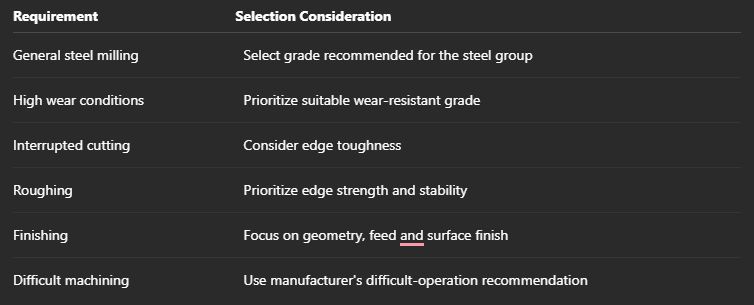
The exact grade should always be confirmed against the current Seco material-group and cutting-data recommendations.
7. Maintain a Rigid Setup
Even the correct insert can perform poorly with an unstable setup.
For better results:
-
Minimize cutter overhang
-
Use a rigid toolholder
-
Secure the workpiece properly
-
Check spindle runout
-
Keep the insert pocket clean
-
Tighten the insert correctly
-
Avoid unnecessary vibration
Vibration can cause edge chipping, poor surface finish, uneven wear, and reduced tool life.
Common Selection Mistakes
Avoid these mistakes when buying XNEX080608TR-M13 inserts:
-
Choosing only by insert size
-
Ignoring the steel grade
-
Selecting the wrong carbide grade
-
Using an incompatible Square 6 cutter
-
Mixing different insert geometries
-
Copying cutting parameters from another insert
-
Ignoring radial engagement
-
Using excessive cutter overhang
-
Continuing to use an insert after significant edge damage
Why Choose MakeYouEasy?
At MakeYouEasy, you can explore CNC cutting tools and machining accessories for milling, turning, boring, threading, and other industrial applications.
When selecting XNEX080608TR-M13 milling inserts, verify the complete designation, grade, cutter compatibility, workpiece material, and recommended cutting parameters before ordering.
Conclusion
Choosing the right XNEX080608TR-M13 milling insert for steel starts with understanding the insert geometry, grade, cutter compatibility, and machining conditions. The M13 version is a six-edge, double-sided Square 6 insert with an 8 mm cutting-edge length, 0.8 mm corner radius, and 22° rake angle.
For reliable results, match the insert grade to the steel material group and machining condition, then optimize feed, cutting speed, engagement, and setup rigidity. Selecting the complete insert system rather than focusing only on the insert code can help achieve better tool life, productivity, and surface finish.
Frequently Asked Questions
1. What is the XNEX080608TR-M13 insert used for?
It is a Square 6 milling insert used for square-shoulder and general milling applications.
2. How many cutting edges does XNEX080608TR-M13 have?
The insert has six usable cutting edges.
3. What is the corner radius of XNEX080608TR-M13?
The specified corner radius is 0.8 mm.
4. Can XNEX080608TR-M13 be used for steel?
Yes, the appropriate grade should be selected according to the specific steel material group and machining conditions.
5. Is every XNEX080608TR-M13 grade the same?
No, the same geometry is available in different grades designed for different machining requirements.
Popular Search Keywords
XNEX080608TR-M13 Milling Inserts, XNEX080608TR M13 Inserts, XNEX080608TR Steel Inserts, Square 6 Milling Inserts, Seco XNEX080608TR, XNEX M13 Milling Insert, Square Shoulder Milling Inserts, XNEX0806 Inserts, Milling Inserts for Steel, Buy XNEX080608TR Inserts
