How to Choose the Right Nichrome Wire Size for a Heating Element
Author : lzy globalzhitui | Published On : 23 Sep 2026
Key Takeaways
- AWG nichrome wire provides a standard way to specify round wire diameter.
- Wire diameter affects resistance per unit length and the amount of wire required.
- Thin nichrome wire has higher resistance per unit length.
- Thick nichrome wire has lower resistance per unit length.
- The right nichrome wire for heating element applications depends on voltage, power, resistance, and element dimensions.
Introduction
Nichrome wire is widely used in electric heating elements because it converts electrical energy into heat through electrical resistance.
Choosing the right wire size involves more than selecting a Nichrome grade. Wire diameter affects resistance per unit length, required wire length, and the overall element dimensions.
This guide explains how to choose Nichrome wire size based on electrical requirements, operating conditions, and heating element design.
Why Nichrome Wire Size Matters in a Heating Element
Wire Diameter and Electrical Resistance
For the same alloy, resistance depends on wire length and cross-sectional area. A smaller wire has a smaller cross-sectional area, so its resistance per unit length is higher.
The basic relationship is:
R = ρL/A
where:
- R is resistance
- ρ is electrical resistivity
- L is wire length
- A is cross-sectional area
For example, Cr20Ni80 has a resistivity of 1.09 Ω·mm²/m at 20°C. As wire diameter increases, its cross-sectional area also increases. Therefore, resistance per meter decreases.
Wire Size and Heating Power
Heating power can be calculated from voltage and resistance:
P = V²/R
When the supply voltage is fixed, the target resistance determines the electrical power. Wire diameter then determines how much wire is needed to reach that resistance.
For buyers comparing nichrome wire wattage, it is important to consider more than the wire diameter alone. The actual power also depends on the applied voltage and total resistance of the heating element.
A smaller wire provides more resistance per unit length, while a larger wire provides less. The selected diameter must also fit the available element space.
How to Choose Between Thin and Thick Nichrome Wire
| Nichrome Wire Size | Resistance per Unit Length | Typical Design Consideration |
| Thin wire | Higher | Useful when higher resistance is needed within a shorter wire length |
| Thick wire | Lower | Useful when a longer wire length or larger wire section is required |
Thin Nichrome Wire
Thin nichrome wire provides higher resistance per unit length. Therefore, less wire may be needed to reach a specific resistance.
Fine wire can also be formed into small coils, which is useful when installation space is limited. However, the diameter must still match the required power and operating conditions.
For example, 0.1mm nichrome wire has a much higher resistance per meter than a larger wire made from the same alloy. Its suitability still depends on the target resistance, operating temperature, and element design.
Thick Nichrome Wire
Thick nichrome wire provides lower resistance per unit length. More wire may therefore be required to reach the same target resistance.
A larger diameter can be suitable when a longer conductive path or larger wire section is needed. It may also provide greater mechanical strength during forming and installation.
Before choosing the final size, check the available installation space and the required operating conditions.
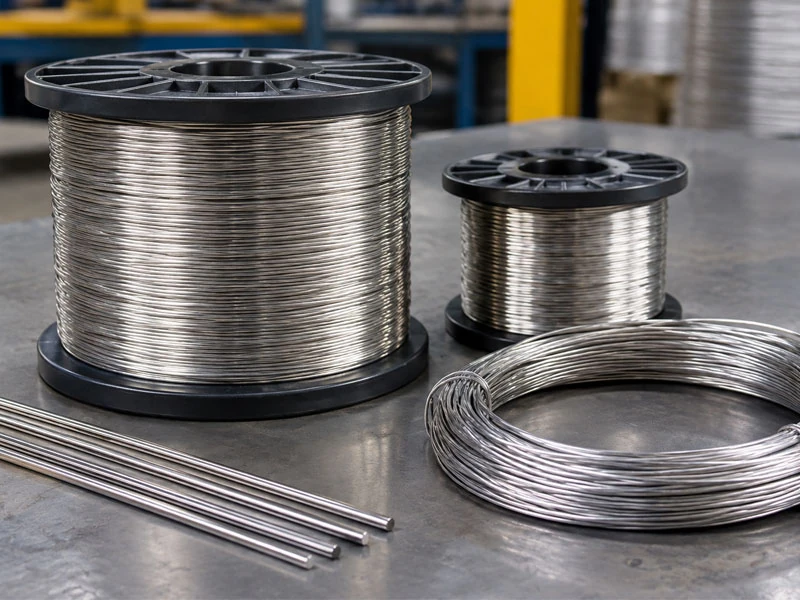
How to Choose the Right AWG Nichrome Wire
What Does AWG Mean for Nichrome Wire?
AWG stands for American Wire Gauge. It is used to specify the nominal diameter of solid round wire.
In the AWG system, a higher gauge number means a smaller wire diameter. A lower number indicates a larger diameter.
When buying AWG nichrome wire, check the nominal diameter as well. This helps prevent confusion between AWG sizes and metric dimensions.
Common Nichrome Wire Sizes
Common searches include 0.1 mm, 0.2 mm, 0.5 mm, and 1.0 mm Nichrome wire. AWG sizes such as 22, 24, 26, 28, 32, and 36 are also commonly used.
These sizes are not interchangeable because each diameter has a different resistance per unit length.
The final size should be selected according to the required resistance, available element space, and operating conditions.
How to Calculate Nichrome Wire Resistance
Calculate Resistance from Wire Size and Length
Once the alloy and wire diameter are known, resistance can be estimated using:
R = ρL/A
This formula provides an initial estimate. For greater accuracy, use the resistivity data supplied for the specific alloy.
Resistance also changes with temperature. As a result, room-temperature resistance may differ from the resistance during operation.
Why Operating Temperature Matters
Nichrome wire does not have the same resistance at all temperatures. As the wire heats up, its electrical resistance changes.
The working temperature should therefore be considered during element design, especially in high-temperature applications.
When an accurate operating value is required, use the supplier’s technical data rather than relying only on room-temperature calculations.
Round Nichrome Wire vs. Nichrome Ribbon
Round Nichrome wire and Nichrome ribbon have different cross-sectional shapes. This affects how they are sized, how resistance is calculated, and how they are formed into heating elements.
| Feature | Round Nichrome Wire | Nichrome Ribbon / Flat Wire |
| Cross-section | Circular | Rectangular / flat |
| Size specification | Diameter or AWG | Width × thickness |
| Resistance calculation | Based on diameter, length, and resistivity | Based on width, thickness, length, and resistivity |
| Forming | Easy to wind into coils | Suitable for flat or strip-shaped heating paths |
| Heat transfer | Depends on wire diameter and exposed surface area | The wider surface provides a different surface-to-volume relationship |
The choice between round wire and ribbon depends on the heating element design. Electrical requirements, available space, and the forming method should also be considered.
How to Match Nichrome Wire to a Heating Element
Coil and Custom Heating Elements
A coiled heating element requires more than the correct wire resistance. The finished coil must also fit the available installation space.
During design, check the wire diameter, coil diameter, pitch, and active length. These dimensions determine the final element size.
For a custom nichrome wire for heating element application, provide the target resistance, wire size, element dimensions, or a technical drawing. With these details, the manufacturer can evaluate the specification more accurately.
The required wire length can then be calculated from the target resistance and the resistance per unit length of the selected alloy and wire size.
Choose the Right Nichrome Wire with GITANE
An Experienced Nichrome Wire Manufacturer
GITANE has specialized in electric heating alloys since 1956. The company develops and manufactures FeCrAl and NiCr heating alloys for industrial heating applications.
Its quality management system is certified to ISO 9001. GITANE also supports customers with material selection and custom specifications.
NiCr Alloys for Different Applications
GITANE supplies several NiCr grades, including Cr20Ni80, Cr20Ni80S, Cr20Ni40, Cr15Ni60, and Cr30Ni70.
Different grades are suitable for different working temperatures. For example, Cr20Ni80 has a resistivity of 1.09 Ω·mm²/m at 20°C and a maximum continuous operating temperature in air of 1200°C. Cr30Ni70 can be used at temperatures up to 1250°C.
NiCr materials are available as round wire, flat wire, strip, rod, and bar. This allows buyers to select a form that matches their heating element design.
Custom Nichrome Wire for Your Heating Element
The right wire size depends on the heating element design. If you already know the target resistance or wire diameter, include these details when requesting a quote.
A technical drawing is also useful for custom elements. GITANE can review the application requirements and recommend a suitable NiCr grade and wire specification.
If you are unsure which wire size or alloy fits your application, send GITANE your heating requirements. Request a custom Nichrome wire specification for your heating element.
FAQ
Q1. How do I choose the right Nichrome wire size for a heating element?
Start with the required voltage, power, and target resistance. Then select a wire diameter that meets the electrical and dimensional requirements.
Q2. Should I choose thin or thick Nichrome wire?
Thin wire provides higher resistance per unit length, while thick wire provides lower resistance. The choice depends on the required resistance, wire length, and available space.
Q3. What information should I provide when buying Nichrome wire?
Provide the alloy grade, wire diameter or AWG, resistance, length, operating temperature, voltage, and power. A technical drawing is also useful for custom elements.
Q4. Should I buy round Nichrome wire or Nichrome ribbon?
Round wire is commonly used for coiled heating elements, while ribbon is suitable for flat or strip-shaped heating paths. The choice depends on the element design and installation requirements.
Q5. Can a Nichrome manufacturer recommend the right wire size?
Yes. Provide the electrical requirements, operating temperature, dimensions, and application details. A manufacturer can then recommend a suitable wire size and NiCr grade.
Conclusion
Choosing the right Nichrome wire size requires a balance between electrical requirements and element dimensions. Start with the required voltage and power, calculate the target resistance, then determine the suitable wire diameter, length, and element geometry.
Operating temperature and alloy grade should also be considered for custom heating elements. If you are unsure which wire size or NiCr grade fits your application, contact GITANE with your heating requirements or technical drawing to discuss a suitable Nichrome wire specification.
