How to Choose the Right Head-Changeable Drill Body for CNC Machining
Author : Surya makeyoueasy | Published On : 03 Oct 2026
Introduction
A head-changeable drill system combines a reusable drill body with a replaceable cutting head, allowing the cutting head to be changed without replacing the complete tool. This can reduce setup time and simplify tooling management, while providing drilling performance closer to dedicated carbide tooling in suitable applications. The correct drill body, however, must match the drill head, hole diameter, depth, machine, coolant system, and machining conditions.
What Is a Head-Changeable Drill Body?
A head-changeable drill body is the reusable portion of a modular drilling system. The cutting head attaches to the body through a dedicated connection or clamping system.
Instead of replacing the complete drill when the cutting head wears, the operator can replace the head while keeping the body in the toolholder in compatible systems. This helps reduce tool replacement time and can eliminate repeated re-setting of the complete drill assembly.
1. Start With the Required Drill Diameter
The first step is to determine the required hole diameter.
Head-changeable drill systems are normally designed around specific diameter ranges, and the body must be compatible with the selected head diameter. For example, Tungaloy’s DrillMeister range includes different body and head combinations across specific diameter ranges rather than using one universal body for every hole size.
Before ordering, verify:
-
Required hole diameter
-
Available head diameter
-
Compatible body series
-
Head-to-body connection
-
Recommended cutting conditions
Never select a body based only on the drill diameter. The head and body must belong to the same compatible system.
2. Select the Correct Drilling Depth
Hole depth is another major factor.
Drill bodies are available in different length-to-diameter ratios such as 3×D, 5×D, 8×D, or higher depending on the system. Tungaloy, for example, offers specific long bodies for deep-hole applications, including 12×D configurations in selected DrillMeister sizes.
Application | Body Selection ConsiderationShallow holeShort body for higher rigidityMedium-depth holeMatch body to required L/DDeep holeUse a dedicated deep-hole body Very deep drilling Verify coolant, chip evacuation, and machine capability
Avoid choosing a longer body than necessary. Excessive tool projection can increase deflection and vibration.
3. Check Head and Body Compatibility
This is one of the most important checks before purchasing.
A head-changeable system is not simply a collection of interchangeable drill heads. The head must match the body connection, diameter range, seat/interface, and manufacturer-specific system.
Some systems use self-clamping connections, while others use dedicated mechanical interfaces. Tungaloy’s DrillMeister, for example, uses a self-locking interface designed for quick head exchange.
Check:
Drill Head → Connection → Body → Shank → Toolholder
If any of these components are incompatible, the assembly may not perform correctly.
4. Consider the Workpiece Material
The drill head geometry and grade should match the material being machined.
Common material groups include:
-
Steel
-
Stainless steel
-
Cast iron
-
Aluminium and non-ferrous materials
-
High-strength or difficult-to-machine alloys
Head-changeable systems can offer different geometries and grades for different applications. Tungaloy, for example, describes multiple drilling geometries and grade options for different drilling conditions.
Do not select the head only by diameter. Material + hole requirement + cutting condition should determine the head selection.
5. Check Internal Coolant Capability
Coolant delivery becomes increasingly important as hole depth increases.
A suitable internal coolant system helps deliver coolant toward the cutting area and supports chip evacuation and heat control. Head-changeable drill bodies may incorporate dedicated coolant channels or holes designed for this purpose.
Before purchasing, check:
-
Through-coolant availability on the machine
-
Required coolant pressure
-
Coolant flow
-
Body coolant connection
-
Hole depth
-
Chip evacuation requirements
For deep drilling, coolant capability should be considered part of the tooling selection, not an afterthought.
6. Evaluate Machine and Toolholding Rigidity
A high-performance drill cannot compensate for an unstable setup.
Check:
-
CNC machine spindle condition
-
Toolholder type
-
Toolholder runout
-
Workholding rigidity
-
Tool projection
-
Machine power
-
Spindle speed capability
Shorter and more rigid setups generally provide better stability. For demanding drilling, the complete system should be considered rather than evaluating the drill body alone.
7. Look at the Head-Changing Mechanism
One of the main advantages of a head-changeable drill is fast replacement.
A good system should provide a secure and repeatable connection while allowing the cutting head to be replaced efficiently. Some systems are specifically designed so that the head can be changed without removing the drill body from the holder.
Look for:
-
Secure head locking
-
Repeatable positioning
-
Easy head replacement
-
Dedicated changing tool
-
Reliable clamping
-
Minimal setup interruption
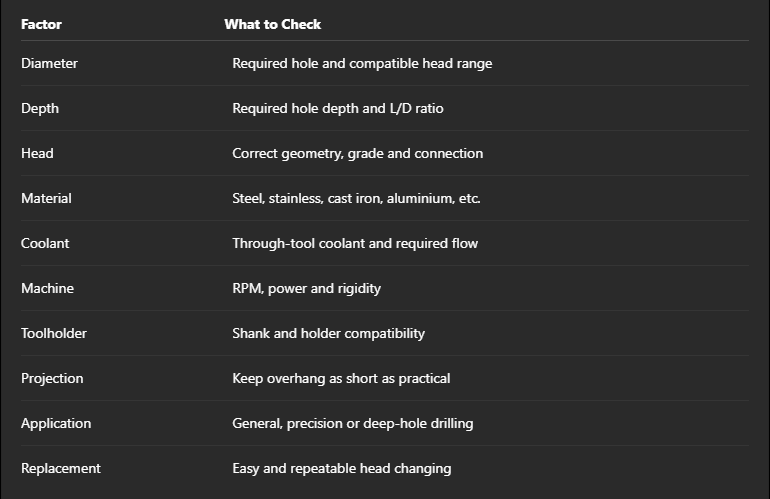
Head-Changeable Drill Body Selection Checklist
Common Mistakes to Avoid
Choosing Only by Diameter
A matching diameter does not guarantee that the body is suitable for the required depth or application.
Mixing Incompatible Heads and Bodies
Always confirm the complete manufacturer’s compatibility system before ordering.
Ignoring Coolant Requirements
Poor coolant delivery can negatively affect chip evacuation and drilling performance, especially in deeper holes.
Using Excessive Tool Projection
Longer-than-necessary setups can increase vibration and reduce drilling stability.
Selecting the Head Without Considering Material
The correct diameter with the wrong geometry or grade can still produce poor tool life and hole quality.
Why Choose MakeYouEasy?
MakeYouEasy helps simplify CNC tooling procurement by bringing different machining tools and accessories together in one place.
When selecting a head-changeable drill body, having access to the correct body, compatible drill head, tooling accessories, and technical specifications makes the purchasing process easier.
Conclusion
Choosing the right head-changeable drill body requires more than matching the hole diameter. Consider the drill diameter, hole depth, head compatibility, workpiece material, coolant capability, machine rigidity, toolholder, and required drilling performance together.
A correctly matched body and head can provide a practical combination of reusable tooling, quick head replacement, reliable drilling, and simplified tool management.
Frequently Asked Questions
1. What is a head-changeable drill body?
It is the reusable body of a modular drilling system designed to accept a compatible replaceable cutting head.
2. Can any drill head be used with any drill body?
No, the head must match the specific body connection, diameter range, and tooling system.
3. How do I choose the body length?
Choose a body that provides the required drilling depth while avoiding unnecessary tool projection.
4. Is through-tool coolant important for head-changeable drills?
Yes, internal coolant can be particularly important for chip evacuation and heat control during deeper drilling.
5. What information should I provide when buying a drill body?
Provide the hole diameter, depth, workpiece material, machine type, toolholder, coolant capability, and required drill head specification.
Popular Search Keywords
head changeable drill body, head-changeable drill, CNC drill body, interchangeable head drill, replaceable head drill, modular drill body, CNC drilling tools, head changeable drill for CNC, CNC drill body supplier, deep hole drill body, carbide drill head, CNC drilling solutions
