How to Choose the Right Face Milling Cutter Diameter: 50, 63, 80, 100 & 125 mm
Author : Surya makeyoueasy | Published On : 28 Oct 2026
Introduction
Choosing the correct face milling cutter diameter is essential for efficient material removal, stable machining, and good surface finish. A cutter that is too small may require multiple passes, while an unnecessarily large cutter can increase spindle load, cutting forces, and tooling costs.
Common face milling cutter diameters include 50 mm, 63 mm, 80 mm, 100 mm, and 125 mm. The right choice depends on the workpiece width, available machine power, required cutting depth, insert geometry, and machining strategy.
This guide explains how to select the right cutter diameter for your CNC milling application.
What Is a Face Milling Cutter?
A face milling cutter is a rotating cutting tool used to machine flat surfaces. Indexable face mills commonly use replaceable carbide inserts mounted around the cutter body.
During machining, the inserts remove material from the workpiece surface to achieve the required flatness, dimensions, and finish.
Face milling cutters are used for:
-
Machining flat faces on steel and cast-iron components.
-
Removing excess stock from workpiece surfaces.
-
Preparing surfaces for subsequent machining operations.
-
Producing consistent finishes in batch and production machining.
Face Milling Cutter Diameter Selection Guide
A useful starting point for many face milling operations is a cutter diameter approximately 20% to 50% larger than the width being machined. The exact choice depends on the cutting strategy, machine capability, and manufacturer’s recommendations.
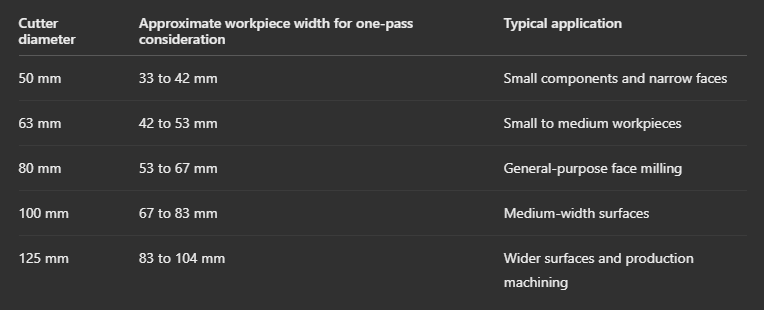
These are illustrative starting ranges based on a cutter diameter around 1.2 to 1.5 times the cutting width. They are not universal limits. Verify cutter engagement, machine power, and the tool manufacturer’s guidance before machining.
How to Choose Between 50, 63, 80, 100 and 125 mm
1. 50 mm Face Milling Cutter
A 50 mm cutter suits small components and narrow surfaces where a compact tool is preferred.
Best suited for:
-
Small CNC milling jobs.
-
Narrow faces and limited machining areas.
-
Machines or setups where a smaller cutter is advantageous.
Selection tip: Make sure the cutter provides enough coverage for the intended pass without excessive tool overhang.
2. 63 mm Face Milling Cutter
A 63 mm cutter offers a step up in cutting width while remaining suitable for many small and medium-sized parts.
Best suited for:
-
General machining of compact components.
-
Small production batches.
-
Surface milling, where a 50 mm cutter would require additional passes.
Selection tip: Confirm the insert arrangement and spindle interface, especially when upgrading from a smaller cutter.
3. 80 mm Face Milling Cutter
An 80 mm cutter is a versatile option for general-purpose milling where the workpiece width and machine capacity support its use.
Best suited for:
-
Medium-sized components.
-
General steel and cast-iron machining.
-
Roughing and finishing with suitable inserts.
Selection tip: Consider spindle power, insert pitch, and required material removal rate before selecting cutting parameters.
4. 100 mm Face Milling Cutter
A 100 mm cutter can cover a wider surface in one pass, potentially reducing the number of passes required.
Best suited for:
-
Medium-width workpieces.
-
Production machining.
-
Applications where fewer passes improve cycle time.
Selection tip: A larger diameter does not automatically mean higher productivity. The machine must provide sufficient power, torque, and rigidity.
5. 125 mm Face Milling Cutter
A 125 mm cutter is suitable for wider surfaces when the machine and tool-holding system can handle the increased cutting load.
Best suited for:
-
Wider workpiece faces.
-
Higher-volume machining operations.
-
Applications requiring broad surface coverage.
Selection tip: Check spindle power, cutter mounting, insert pitch, cutting depth and workpiece clamping. If the machine is underpowered, a smaller cutter may deliver more stable results.
Key Factors That Affect Cutter Diameter Selection
Workpiece Width
Workpiece width is the first factor to consider. For a single-pass operation, a cutter around 1.2 to 1.5 times the cutting width is a useful starting point in many applications.
For example, for a surface approximately 60 mm wide, an 80 mm cutter may be a suitable starting option. The final choice depends on the required engagement and machine setup.
Machine Power and Rigidity
Larger cutters may engage more inserts and increase spindle load. Check the machine’s available power and torque at the intended spindle speed, as well as the rigidity of the spindle, arbor, and workholding arrangement.
Cutting Depth and Workpiece Material
Heavy roughing, hard materials, and large depths of cut can demand more power and cutting-edge strength. Follow the insert manufacturer’s recommendations for cutting speed, feed per tooth, and maximum depth of cut.
Surface Finish Requirements
The cutter body, insert geometry, insert condition, feed rate, and machine stability all influence surface finish. For finishing operations, suitable wiper inserts or dedicated finishing geometries may help achieve the required result.
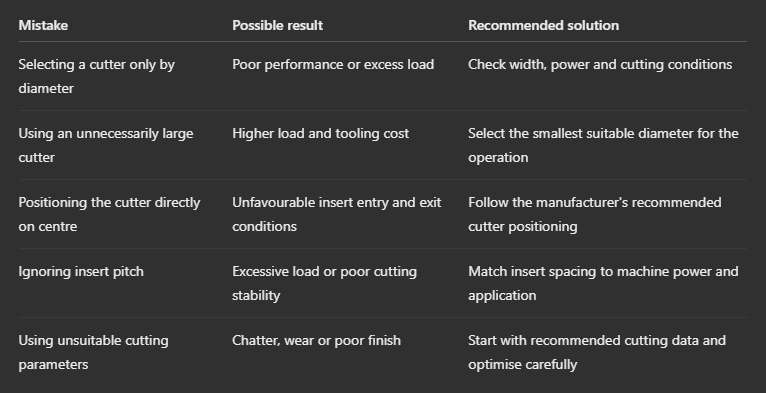
Common Face Milling Cutter Selection Mistakes
Why Choose MakeYouEasy?
MakeYouEasy provides CNC tooling information and machining resources to help manufacturing professionals understand cutting tools and make informed tooling decisions.
Understanding cutter diameter, insert geometry, and machine requirements helps machinists plan stable operations, reduce avoidable setup errors, and improve productivity.
Explore machining resources at MakeYouEasy.com.
Conclusion
The correct face milling cutter diameter depends on workpiece width, machine power, cutting depth, insert configuration, and surface finish requirements.
-
50 mm: Small components and narrow faces.
-
63 mm: Small to medium machining applications.
-
80 mm: Versatile general-purpose milling.
-
100 mm: Medium-width surfaces and production work.
-
125 mm: Wider surfaces on sufficiently capable machines.
Use the diameter ranges as a starting point, then confirm cutter engagement and cutting data with the tool manufacturer’s recommendations.
FAQs
1. How do I choose the correct face milling cutter diameter?
Choose a diameter based on workpiece width, machine power, cutting depth, and the manufacturer’s recommended engagement.
2. Is an 80 mm face milling cutter suitable for general machining?
An 80 mm cutter can suit general machining when its diameter, insert configuration, and cutting parameters match the application.
3. Should a face milling cutter be larger than the workpiece width?
For many single-pass operations, a cutter approximately 20% to 50% larger than the cutting width is a useful starting point.
4. Does a larger face milling cutter remove material faster?
Not necessarily, because material removal rate also depends on cutting speed, feed, depth of cut, insert count, and available machine power.
5. Can I use a 125 mm face milling cutter on any CNC milling machine?
No, the machine must support the cutter’s diameter, mounting interface, spindle load, and required cutting conditions.
Popular Search Keywords
face milling cutter diameter, face mill cutter sizes, 50 mm face milling cutter, 63 mm face milling cutter, 80 mm face milling cutter, 100 mm face milling cutter, 125 mm face milling cutter, CNC face milling cutter selection, carbide face milling cutter.
