How to Choose the Correct Cutting Tool Diameter for CNC Milling
Author : Surya makeyoueasy | Published On : 26 Sep 2026
Introduction
Choosing the correct cutting tool diameter for CNC milling is important for achieving stable cutting, good surface finish, efficient material removal, and longer tool life. The right diameter depends on the machining operation, workpiece geometry, depth and width of cut, machine power, tool overhang, and required reach. A larger cutter is not automatically better, and a smaller cutter is not always the right choice.
1. Start With the Machining Operation
The first step is identifying what you are machining.
Common CNC milling operations include:
-
Face milling
-
Shoulder milling
-
Slot milling
-
Pocket milling
-
Profile milling
-
3D contouring
-
High-feed milling
Different operations require different cutter diameters and geometries. For example, face milling often uses larger-diameter cutters to cover a wider surface, while pocketing and profiling may require smaller cutters to reach internal features.
2. Consider the Workpiece Width
For face milling, cutter diameter should be selected according to the width of the surface being machined.
As a general application guideline, Sandvik Coromant recommends a cutter diameter around 20–30% larger than the workpiece width for a single-pass operation. Cutter positioning is also important because the cutter should generally be positioned off-centre rather than directly on the center line.
For example, if a workpiece surface is 50 mm wide, a cutter around 60–65 mm may be considered for a suitable single-pass face-milling setup, subject to machine capability and the specific cutter manufacturer’s recommendations.
3. Match Diameter With Radial Engagement
Radial engagement, commonly called “ae,” is the width of the cutter engaged with the workpiece.
A smaller-diameter cutter can be useful when the machining operation requires low radial engagement, narrow features, or better access. A larger cutter may provide greater rigidity and productivity for wider surfaces.
However, changing cutter diameter changes the relationship between cutter diameter and radial engagement, so the cutting speed and feed may also need adjustment. Sandvik notes that small radial engagement can allow optimized cutting data because of shorter contact length.
4. Check the Required Cutting Depth
The required axial depth of cut, or ap, is another important factor.
A cutter must have enough effective cutting length to perform the required operation safely. For deeper milling, the cutter concept, insert geometry, diameter, and machine stability must all be considered.
Do not select a cutter solely because its diameter fits the workpiece. Check its recommended maximum depth of cut and the relationship between ap and ae for the selected tool. Some milling cutters can achieve deeper cuts at low radial engagement but require reduced depth at higher radial engagement.
5. Consider Machine Power and Spindle Capacity
Large-diameter cutters can require considerable spindle power and torque, particularly at high radial engagement.
Before selecting a large cutter, check:
-
Spindle power
-
Available torque
-
Maximum spindle speed
-
Toolholder compatibility
-
Machine rigidity
-
Maximum cutter diameter
-
Coolant capability
The machine’s spindle and overall capability can limit the cutter diameter and depth of cut that can be used effectively.
6. Think About Tool Overhang
Tool overhang becomes especially important when using long tools to reach deep pockets or cavities.
A long, slender tool assembly can deflect and vibrate during milling. This can result in:
-
Chatter
-
Poor surface finish
-
Dimensional errors
-
Uneven insert wear
-
Reduced tool life
Use the shortest practical tool assembly and select a diameter that provides sufficient rigidity without preventing access to the feature.
7. Select Diameter According to the Feature
Workpiece geometry often determines the maximum practical cutter diameter.
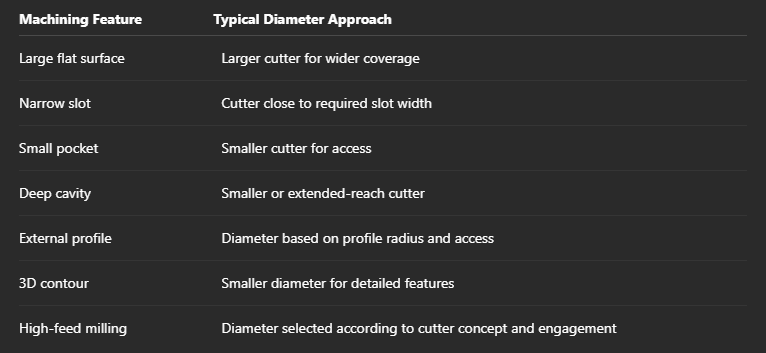
For detailed contours, a smaller cutter can reach tighter areas, while larger cutters are generally preferred where access and geometry allow because they can provide greater rigidity.
8. Consider Cutter Rigidity
Diameter has a direct relationship with tool strength and rigidity.
A larger-diameter cutter generally provides a more robust tool body, while a small cutter may be more suitable for narrow features but can be more sensitive to deflection and cutting conditions.
For long tool assemblies, selecting the appropriate cutter diameter, reducing axial depth when necessary, and maintaining suitable radial engagement can help control vibration. Sandvik’s application guidance specifically highlights the relationship between tool assembly length, radial engagement, axial depth, and vibration.
9. Match the Diameter With Cutter Pitch
For indexable milling, cutter diameter is also related to the number of inserts engaged in the cut.
Cutter pitch should be selected according to machining stability, radial engagement, machine capacity, and material. Coarse-pitch cutters can be useful for difficult conditions and limited machine power, while closer-pitch cutters can provide higher productivity in stable conditions.
Therefore, selecting diameter and pitch together is often more effective than selecting diameter alone.
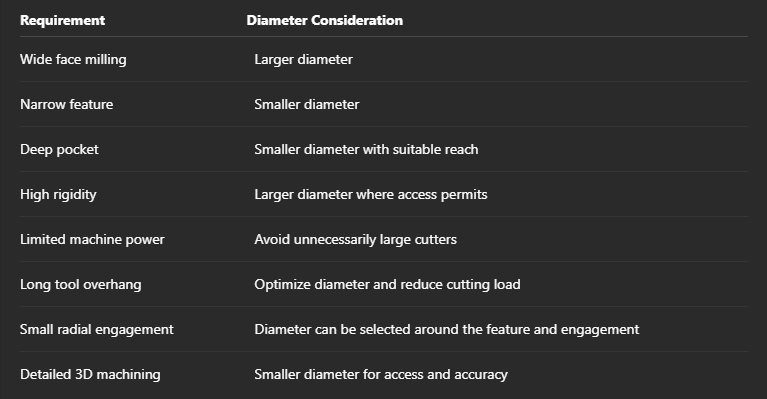
Quick CNC Milling Diameter Selection Guide
Common Mistakes to Avoid
Choosing the Largest Available Cutter
A large cutter may exceed the machine’s power or torque capability and may not fit the workpiece geometry.
Choosing a Cutter Only by Workpiece Width
Width is important, but depth of cut, radial engagement, toolholder, spindle capability, and rigidity must also be checked.
Ignoring Tool Overhang
A suitable cutter diameter cannot compensate for an unnecessarily long and flexible tool assembly.
Using the Same Cutting Data After Changing Diameter
Changing cutter diameter can change cutting conditions and engagement. Cutting parameters should be checked against the manufacturer’s recommendations.
Selecting Diameter Without Considering the Feature
A cutter that works for face milling may be unsuitable for a narrow slot, deep pocket, or tight internal radius.
Why Choose MakeYouEasy?
At MakeYouEasy, you can explore CNC milling cutters, inserts, holders, drills, and other machining tools for different applications.
When selecting a milling cutter, consider the diameter, cutter type, insert geometry, workpiece material, depth of cut, radial engagement, machine capability, and tool overhang together rather than choosing based on diameter alone.
Conclusion
Choosing the correct CNC milling tool diameter is a balance between workpiece coverage, accessibility, rigidity, machine capability, and cutting conditions. Larger cutters can be productive for wide surfaces and stable operations, while smaller cutters are often necessary for pockets, slots, profiles, and detailed features.
Before ordering a cutter, check the required machining feature, ap and ae, spindle power, toolholder, overhang, cutter pitch, and manufacturer’s recommended cutting data. The correct diameter, combined with the right milling strategy, can help improve tool life, surface finish, stability, and machining productivity.
Frequently Asked Questions
1. How do I choose a CNC milling cutter diameter?
Choose the diameter based on the machining feature, workpiece width, cutting depth, radial engagement, machine capability, and required tool access.
2. Is a larger milling cutter always better?
No, larger cutters can provide rigidity and wider coverage, but they may not suit small features or machines with limited power and torque.
3. What cutter diameter is suitable for face milling?
For single-pass face milling, a cutter around 20–30% larger than the workpiece width is a commonly cited guideline, subject to the machine and cutter manufacturer’s recommendations.
4. Does cutter diameter affect cutting speed?
Yes, cutter diameter affects spindle speed for a given cutting speed, so cutting parameters should be recalculated when the diameter changes.
5. Should I use a smaller cutter for deep pockets?
A smaller cutter may provide better access to narrow or deep features, but the tool’s rigidity, reach, effective cutting length, and recommended cutting conditions must also be considered.
Popular Search Keywords
CNC milling cutter diameter selection, how to choose milling cutter diameter, CNC cutting tool diameter, milling cutter size selection, CNC end mill diameter, milling tool diameter guide, face milling cutter diameter, CNC milling tool selection, milling cutter size, CNC milling cutter selection
