How to Choose MITM R25 UN Thread Milling Inserts for CNC Threading
Author : Surya makeyoueasy | Published On : 15 Sep 2026
Introduction
Choosing the right MITM R25 UN thread milling insert is essential for producing accurate Unified threads with reliable tool life and consistent thread quality. The correct insert must match the UN thread pitch, internal or external application, compatible MiTM holder, insert grade, coating, workpiece material, and CNC machining conditions. Selecting only by the R25 size is not enough because different R25 inserts are manufactured for different TPI values and threading applications.
What Are MITM R25 UN Thread Milling Inserts?
MiTM is a multi-flute indexable thread milling system designed around replaceable threading inserts and compatible cutter bodies. R25 refers to the insert size used within this system.
VARGUS documentation lists R25 internal UN inserts in 20, 18, 16, 14, 12, 10, 9, and 8 TPI, with the effective cutting length and number of teeth changing according to pitch.
Commercial R25 UN variants also include external-thread versions such as R25E10UNTM, while internal versions use codes such as R25I18UNTM.
Understand the Insert Code
A typical designation may look like
R25I18UNTM
The code provides important selection information.
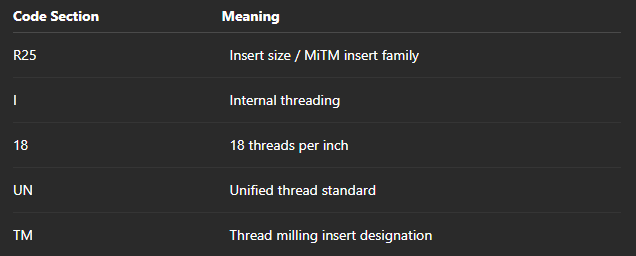
External-thread variants may use E instead of I.
For example, commercially listed R25E10UNTM inserts are designed for external 10 TPI UN thread milling.
Always use the complete ordering code when matching an insert to the job.
1. Match the Correct UN Thread Pitch
The most important selection factor is the required threads per inch (TPI).
R25 UN inserts are available across several pitch options. VARGUS documentation lists internal R25 UN inserts as follows:
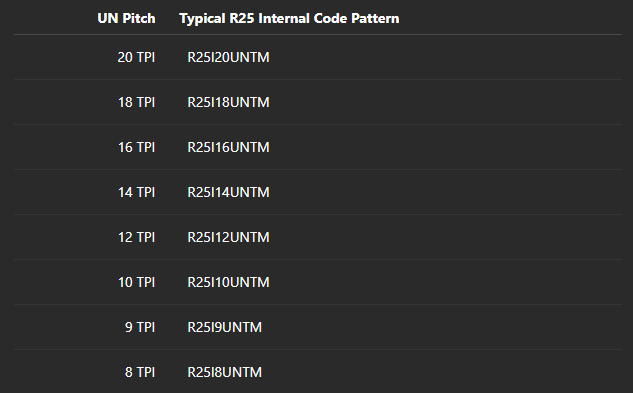
An 18 TPI insert cannot simply be substituted for a 14 TPI insert because the cutting teeth are manufactured for a specific pitch.
Always confirm the component drawing before ordering.
2. Choose Internal or External Threading
Determine whether the thread is being machined:
Internally: Inside a pre-machined bore.
Externally: Around the outside diameter of the component.
For example, R25I18UNTM is listed as an internal UN thread milling insert, while R25E10UNTM is an external UN version.
Do not assume that internal and external inserts are interchangeable even when the TPI is identical.
3. Verify Holder Compatibility
The thread milling insert must fit the correct MiTM cutter body.
VARGUS documentation identifies R25 internal UN inserts for compatible RTMC-series MiTM holders, while some pitch and holder combinations have specific restrictions. In particular, the documented 8 TPI and 9 TPI internal R25 UN inserts are noted as not fitting the RTMC2517 holder.
R25-compatible MiTM holder systems are also available in other configurations. For example, the RTMNC2522-43S3 is specified for R25 inserts and uses a 25 mm shank with multiple insert pockets.
Before ordering, verify the exact insert code against the holder designation.
4. Check the Number of Teeth
One advantage of MiTM multi-flute inserts is that several thread teeth can participate during machining.
The number of teeth varies according to pitch.
For example:
-
R25I20UN is listed with 19 teeth.
-
R25I18UN has 17 teeth.
-
R25I14UN has 13 teeth.
-
R25I10UN has 9 teeth.
-
R25I8UN has 7 teeth.
The insert geometry is designed around its specified pitch, so tooth count should not be treated as an independent selection feature.
5. Choose the Correct Carbide Grade
The same basic R25 UN geometry may be available in different carbide grades and coatings.
Commercially listed variants include:
VTX Grade: Some MiTM R25 inserts are supplied with a TiAlN coating.
VBX Grade: Other R25 UN inserts are listed with a TiCN coating.
The correct grade depends on:
-
Workpiece material
-
Hardness
-
Cutting speed
-
Thread depth
-
Machine rigidity
-
Continuous or interrupted machining
-
Coolant strategy
Do not choose the grade only by coating colour or appearance.
6. Match the Insert to the Workpiece Material
Different materials place different demands on the cutting edge.
Steel
Use a grade that balances wear resistance and toughness for the specific steel grade.
Stainless Steel
Prioritize edge toughness, heat resistance, and stable cutting conditions because stainless steel can generate heat and work-harden.
Cast Iron
Wear resistance is especially important because many cast irons are abrasive.
Aluminium
Sharp cutting geometry and good chip evacuation help reduce material adhesion.
Heat-Resistant Alloys
These applications normally require a grade specifically recommended for higher temperatures and demanding cutting conditions.
Use the tooling manufacturer’s grade recommendations as the starting point.
7. Consider Thread Depth and Effective Cutting Length
The insert’s effective cutting length must suit the thread being produced.
VARGUS lists effective lengths around 22 to 24 mm for many R25 UN internal inserts, depending on pitch. For example, R25I20UN is listed at 24.13 mm, while R25I8UN is listed at 22.22 mm.
However, this does not automatically mean every thread can be machined to that full depth.
Also consider:
-
Cutter-body clearance
-
Bore depth
-
Entry and exit clearance
-
Holder projection
-
Workpiece geometry
-
Machine travel
8. Use a Rigid CNC Setup
Thread milling relies on accurate interpolation between the spindle and machine axes.
Excessive tool deflection can affect:
-
Thread diameter
-
Profile accuracy
-
Surface finish
-
Insert life
For better stability:
-
Keep the cutter projection as short as practical.
-
Use a rigid toolholder.
-
Check spindle and holder runout.
-
Clamp the workpiece securely.
-
Keep insert pockets clean.
-
Tighten inserts according to the tooling manufacturer’s instructions.
-
Avoid using a worn insert for precision finishing.
The insert may carry the thread profile, but the machine setup has to carry the responsibility. ⚙️
9. Optimize Thread Milling Parameters
Correct machining parameters are essential for stable thread production.
Cutting Speed
Select the cutting speed according to the material and carbide grade.
Feed
Use the manufacturer’s recommended feed as the starting point.
Thread Milling Path
The CNC program must produce the correct helical interpolation for the required TPI.
Cutter Compensation
Diameter compensation can be used to fine-tune thread size when appropriate.
Coolant
Use coolant or air according to the insert grade, material, and chip-evacuation requirements.
Avoid copying cutting parameters from a different insert grade without checking suitability.
10. Inspect the Finished UN Thread
Never judge thread accuracy only by appearance.
Use suitable inspection methods such as
-
GO/NO-GO thread gauges
-
Thread plug gauges
-
Thread ring gauges
-
Thread measuring equipment
-
CMM inspection, where appropriate
Inspection is particularly important when cutter compensation has been adjusted.
Common Selection Mistakes
Typical mistakes include choosing the wrong TPI, mixing internal and external insert types, using an incompatible holder, selecting an unsuitable carbide grade, ignoring holder restrictions, and programming an incorrect thread pitch.
Another common mistake is buying only by the words “R25 UN.” That narrows the search, but it does not finish it. The full insert designation matters.
MITM R25 UN Selection Checklist
Before purchasing, confirm the UN thread standard, TPI, internal or external application, complete R25 insert code, compatible holder, effective cutting length, carbide grade, coating, workpiece material, thread depth, cutter clearance, machine capability, and recommended cutting parameters.
This helps ensure that the insert, holder, program, and component specification work as one system.
Why Choose MakeYouEasy?
At MakeYouEasy, you can explore CNC threading and machining tools for different industrial applications.
Relevant tooling categories include MITM thread milling inserts, indexable thread mill cutters, thread milling holders, threading inserts, turning inserts, milling cutters, boring tools, and CNC tool holders.
Before ordering an MITM R25 UN thread milling insert, verify the exact TPI, internal or external configuration, grade, coating, and holder compatibility.
Conclusion
Choosing the right MITM R25 UN thread milling insert for CNC threading begins with identifying the exact UN thread pitch and whether the application is internal or external. The R25 family includes multiple pitch-specific inserts, so the complete designation must match the component drawing and the compatible MiTM cutter system.
After confirming the insert geometry, select the correct carbide grade, coating, holder, cutting parameters, thread depth, and machining setup. A properly matched system can provide accurate thread profiles, stable CNC machining, controlled tool wear, and repeatable thread quality.
Frequently Asked Questions
1. What is an MITM R25 UN thread milling insert?
It is a replaceable multi-flute thread milling insert designed for compatible MiTM cutter systems and Unified thread profiles.
2. Which TPI sizes are available for R25 UN inserts?
Documented internal R25 UN options include 20, 18, 16, 14, 12, 10, 9, and 8 TPI.
3. Can the same R25 insert machine internal and external threads?
Not necessarily, because internal and external UN inserts have different ordering codes and should be selected for the intended application.
4. Which holder is compatible with MITM R25 inserts?
Compatibility depends on the exact insert, with R25 inserts used in specified MiTM holder families such as RTMC and selected RTMNC systems.
5. How do I improve tool life when using R25 thread milling inserts?
Use the correct grade, rigid toolholding, low runout, suitable cutting parameters, proper chip evacuation, and a holder matched to the insert.
