How to Choose CBN RNMN0903 Inserts for Cast Iron Machining
Author : Surya makeyoueasy | Published On : 19 Sep 2026
Introduction
Choosing the right CBN RNMN0903 insert for cast iron machining depends on more than insert size. Cast irons vary in hardness, abrasiveness, graphite structure, and cutting behavior, so the correct CBN grade, insert construction, cutting parameters, and tool holder must work together. RNMN0903-type round CBN inserts are useful for demanding turning because their round geometry provides a strong cutting edge, while CBN offers excellent wear resistance at high cutting temperatures.
What Is a CBN RNMN0903 Insert?
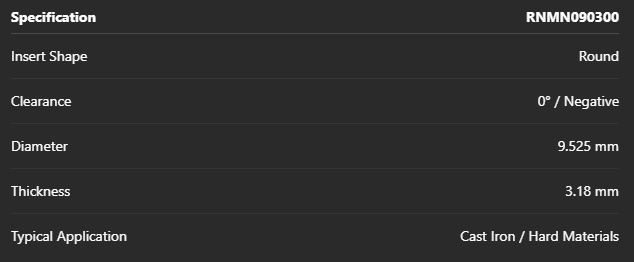
RNMN0903 is commonly used as a shortened reference to RNMN090300. Kyocera currently lists solid CBN RNMN090300 inserts with a 9.525 mm inscribed circle and 3.18 mm thickness for cast iron and hard-material applications.
Always verify the complete insert designation before purchasing.
Why Use CBN for Cast Iron?
CBN, or cubic boron nitride, is a very hard cutting material widely used for machining ferrous materials. Tungaloy lists dedicated CBN grades for both gray and ductile cast iron, with different grades optimized for wear resistance, cutting speed, toughness, and surface quality.
CBN can provide high abrasion resistance, strong hot hardness, stable high-speed machining, consistent dimensional control, and longer tool life. It becomes particularly useful when conventional carbide experiences rapid abrasive wear.
1. Identify the Cast Iron Type
Gray Cast Iron
Gray cast iron is abrasive and generally produces short chips. CBN is well suited to high-speed machining of gray cast iron, but the grade should match the required cutting speed and surface finish.
Ductile Cast Iron
Ductile or nodular iron can generate different cutting forces and wear behavior. Tungaloy publishes different CBN grade and speed recommendations for gray and ductile cast iron, so one grade should not automatically be used for both materials.
Chilled or Alloy Cast Iron
Chilled and high-alloy cast irons can be extremely abrasive. These applications may require a high-CBN-content or application-specific grade.
2. Choose the Correct CBN Grade
CBN grades differ in grain size, CBN content, binder, toughness, and wear resistance.
Choose the grade according to the workpiece hardness, continuous or interrupted cutting, required finish, cutting speed, feed, and depth of cut.
Tungaloy notes that fine-grain CBN can support finer surface quality, while coarse-grain designs can provide strong grain bonding for demanding machining conditions.
The insert code alone does not determine performance. The CBN grade is one of the most important selection factors.
3. Consider Solid CBN Construction
Some RNMN-style inserts are available as solid CBN designs rather than a carbide body with only a small CBN cutting tip.
Solid construction can provide greater usable cutting area, strong edge support, deeper cutting capability, multiple indexing positions, and excellent resistance to abrasive wear.
For example, Tungaloy’s SBN30 is a solid CBN grade developed specifically for cast iron machining and designed to support increased feeds, speeds, and cutting depths.
4. Check Continuous vs Interrupted Cutting
A continuous turning operation places different demands on the cutting edge than a component containing holes, slots, scale, or interrupted surfaces.
For continuous cutting, wear resistance may be the main priority.
For interrupted cutting, edge toughness becomes increasingly important because the insert repeatedly enters and exits the material.
Always choose a CBN grade recommended for the actual interruption level.
5. Verify Toolholder Compatibility
RNMN090300 must be installed in a compatible round-insert toolholder.
Kyocera lists RNMN090300 with compatible CRSNR/L and CRDNN 09-size holders in its CBN tooling system.
Before ordering, verify the insert seat size, holder designation, clamping method, approach angle, shank size, clamp, and shim requirements.
Do not assume every holder designed for a 9-size round insert is identical.
6. Maintain a Rigid Setup
CBN is extremely hard, but machining stability remains critical.
Excessive vibration can contribute to edge chipping, irregular wear, dimensional variation, and poor surface finish.
For better stability, minimize holder overhang, use rigid workholding, keep the insert seat clean, clamp the insert correctly, and avoid unnecessary workpiece projection.
Even an excellent CBN insert cannot negotiate peacefully with a toolholder vibrating like a washing machine. 😄
7. Set Cutting Speed Correctly
One major advantage of CBN is its ability to operate at high cutting speeds in suitable cast iron applications.
Tungaloy’s current cast-iron guidance shows CBN operating at considerably higher cutting-speed ranges than conventional carbide for suitable gray cast iron applications. Ductile cast iron generally uses more moderate conditions.
Do not select cutting speed from the RNMN0903 shape alone. Use the recommendation for the exact CBN grade and cast iron material.
8. Match Feed and Depth of Cut
Feed and depth of cut must also match the CBN construction.
Excessive engagement can overload the cutting edge, while unsuitable light cutting can reduce machining efficiency.
Solid CBN designs can support demanding conditions, but the manufacturer’s recommended operating range should always be the starting point.
9. Dry or Coolant Machining?
Many cast iron CBN operations can be performed dry, but coolant strategy depends on the CBN grade and application.
If coolant is recommended, maintain consistent delivery. Avoid unpredictable heating and cooling around the cutting edge.
Always follow the grade manufacturer’s coolant recommendations.
CBN vs Carbide for Cast Iron
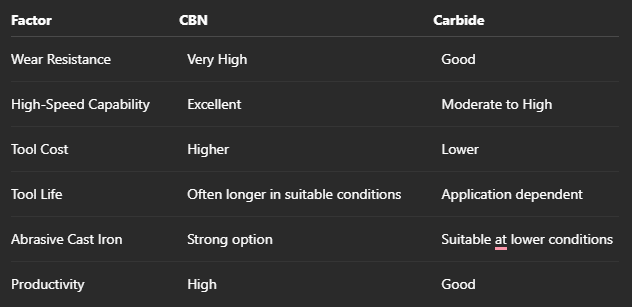
The better economic choice should be based on cost per component, not only the purchase price of the insert.
CBN RNMN0903 Selection Checklist
Before purchasing, confirm the RNMN0903/RNMN090300 designation, cast iron type and hardness, CBN grade, solid or tipped construction, interruption level, compatible toolholder, cutting speed, feed, depth of cut, coolant strategy, and machine rigidity.
Selecting the insert, holder, grade, and cutting conditions as one system provides more reliable results.
Why Choose MakeYouEasy?
At MakeYouEasy, you can explore CNC cutting tools and machining accessories for turning, milling, boring, threading, and other industrial applications.
Before ordering CBN RNMN0903 inserts, verify the exact insert designation, CBN grade, cast iron type, holder compatibility, and recommended machining parameters.
Conclusion
Choosing the right CBN RNMN0903 insert for cast iron machining starts with identifying the type of cast iron and the machining conditions. RNMN090300 is a round, negative-style insert available in solid CBN configurations, providing a strong cutting edge for demanding turning applications.
For reliable performance, match the CBN grade to gray, ductile, chilled, or alloy cast iron, then optimize cutting speed, feed, depth of cut, rigidity, and coolant strategy. A correctly selected CBN insert can improve wear resistance, dimensional consistency, tool life, and machining productivity.
Frequently Asked Questions
1. What is a CBN RNMN0903 insert used for?
It is used for turning cast iron and other suitable hard ferrous materials.
2. What size is RNMN090300?
It is commonly specified with a 9.525 mm diameter and 3.18 mm thickness.
3. Is CBN suitable for gray cast iron?
Yes, CBN is widely used for high-speed gray cast iron machining.
4. Can CBN RNMN0903 machine ductile iron?
Yes, when a CBN grade recommended for ductile cast iron is selected.
5. Why use a round RNMN insert?
The round geometry provides a strong cutting edge and multiple usable indexing positions.
Popular Search Keywords
CBN RNMN0903 Inserts, RNMN090300 CBN Insert, CBN Inserts for Cast Iron, Round CBN Inserts, Cast Iron Turning Inserts, CBN Inserts for Gray Cast Iron, CBN Inserts for Ductile Iron, CNC Cast Iron Turning Tools, Solid CBN Inserts, Buy CBN RNMN0903 Inserts
