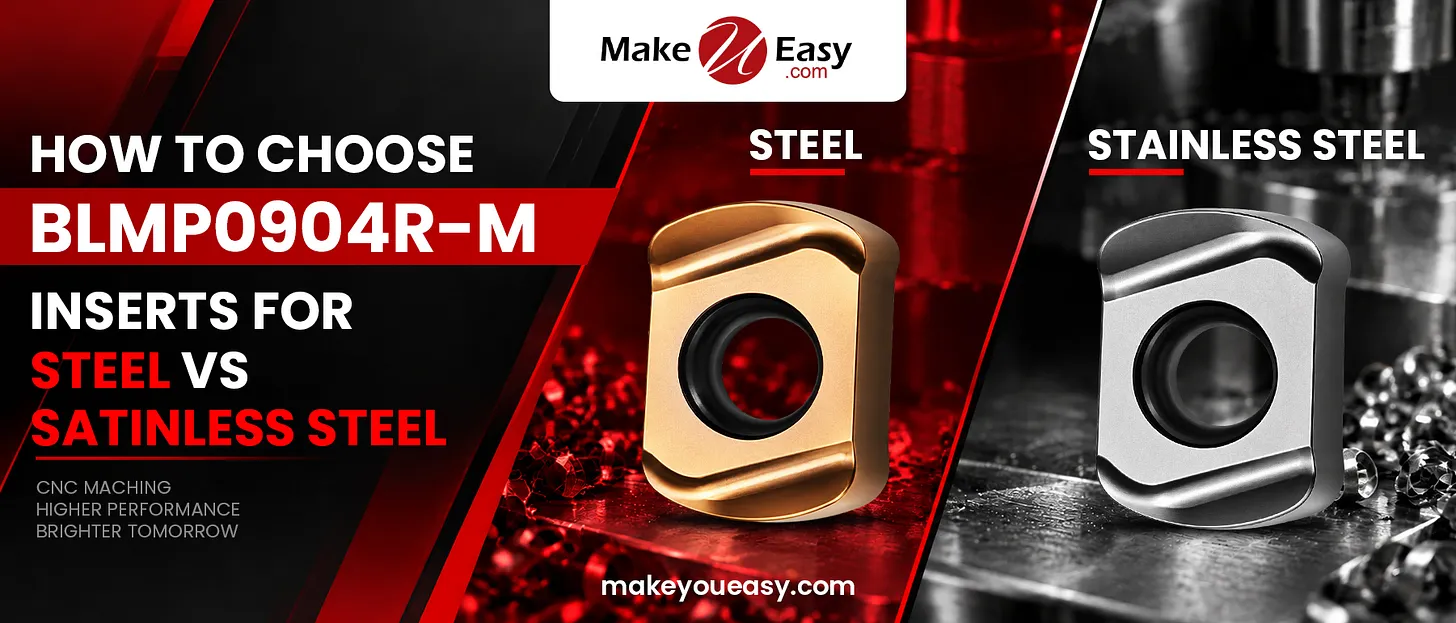
How to Choose BLMP0904R-M Inserts for Steel vs Stainless Steel
Author : Surya makeyoueasy | Published On : 17 Sep 2026
Introduction
Choosing the right BLMP0904R-M insert for steel or stainless steel requires more than matching the insert dimensions to the cutter. Steel and stainless steel behave differently during milling, so the carbide grade, coating, cutting speed, feed, machine rigidity, coolant strategy, and cutting conditions must be selected accordingly. The BLMP0904R-M is a double-sided high-feed milling insert with four cutting edges and is designed for operations such as high-feed milling, facing, profiling, ramping, and helical interpolation. TaeguTec lists BLMP0904R-M variants for both steel and stainless-steel applications, with the preferred grade changing according to the material and machining conditions.
What Is a BLMP0904R-M Insert?
The BLMP0904R-M belongs to TaeguTec’s BLMP 09-M high-feed milling insert family.
Published specifications include:
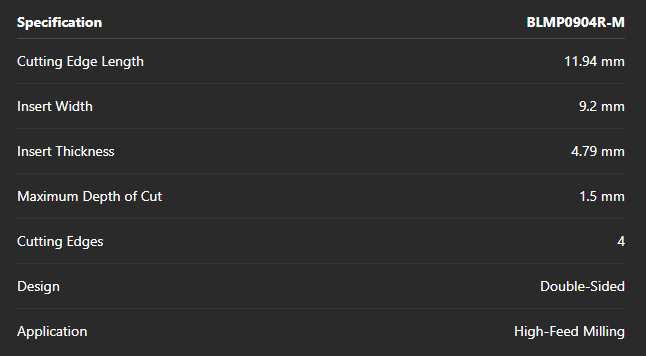
TaeguTec describes the BLMP 09-M family as double-sided inserts with four cutting edges for high-feed milling, with a maximum depth of cut of 1.5 mm.
Steel vs Stainless Steel: Why Grade Selection Matters
Steel and stainless steel may look similar in the workshop, but they create different demands at the cutting edge.
Steel
Steel machining generally requires a balance of:
-
Wear resistance
-
Edge strength
-
Thermal stability
-
Reliable performance at productive cutting speeds
Stainless Steel
Stainless steel can generate more heat around the cutting zone and may be prone to:
-
Work hardening
-
Built-up edge
-
Difficult chip evacuation
-
Higher cutting forces
-
Edge chipping
Because of this, stainless-steel milling often benefits from a tougher grade and cutting conditions designed to control heat and maintain a stable cutting edge.
BLMP0904R-M Grade Comparison
Different carbide grades are available for the same BLMP0904R-M geometry.
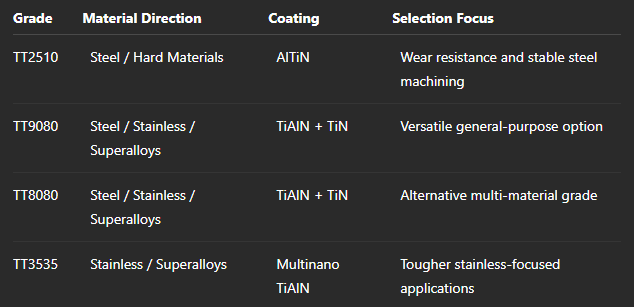
The manufacturer’s current listings identify TT2510 primarily for steel and hard materials, while TT3535 is listed for stainless steel and superalloy applications. TT9080 and TT8080 are listed across both steel and stainless steel.
Choosing BLMP0904R-M for Steel
For steel milling, begin by checking the steel grade, hardness, machining stability, and whether the cut is continuous or interrupted.
Stable Steel Machining
When the machine, workholding, and cutter engagement are stable, a more wear-resistant grade can help maintain cutting performance.
For example, BLMP0904R-M TT2510 is specifically listed for steel and hard-material applications and uses an AlTiN coating.
It can therefore be considered when:
-
Machining carbon or alloy steel
-
Setup rigidity is good
-
Wear resistance is important
-
Cutting conditions are reasonably stable
The exact suitability still depends on material hardness and TaeguTec’s recommended cutting data.
General Steel Machining
For applications that require greater flexibility, TT9080 is listed for steel as well as stainless steel and high-temperature materials.
A general-purpose grade may be useful when:
-
Several workpiece materials are machined
-
Production varies frequently
-
Moderate toughness and wear resistance are both required
Choosing BLMP0904R-M for Stainless Steel
Stainless steel usually places more emphasis on edge toughness and thermal control.
A suitable insert should resist:
-
Edge chipping
-
Thermal wear
-
Adhesion
-
Built-up edge
-
Unstable cutting forces
TT3535 for Stainless Applications
TaeguTec lists BLMP0904R-M TT3535 specifically for stainless steel and superalloy/titanium applications. It uses a Multinano TiAlN coating.
This makes TT3535 a logical grade to evaluate when stainless steel is the primary workpiece material.
TT9080 as a Versatile Option
The TT9080 version is also officially listed for stainless steel as well as steel and superalloys.
It may be suitable when a shop requires a grade that covers several material families, although a more application-specific grade can offer advantages in demanding production.
Steel vs Stainless Steel Selection Guide
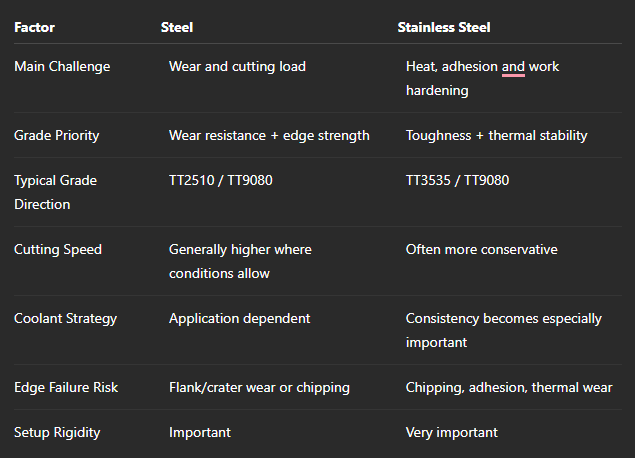
These are general selection directions. Final cutting parameters should come from the specific grade and cutter recommendation.
Use the Correct High-Feed Cutter
The insert must be matched to a compatible cutter body.
TaeguTec lists BLMP0904R-M as the master insert for TFMBL-R-09 high-feed face mills, with these cutters designed around the BLMP 09 insert platform.
Before ordering, verify:
-
Cutter model
-
Insert pocket
-
BLMP09 compatibility
-
Clamping screw
-
Cutter diameter
-
Number of teeth
-
Tool overhang
Do not substitute BLMP0603 and BLMP0904 inserts. Their dimensions and cutter pockets are different.
Control Depth of Cut
High-feed milling works by combining a relatively shallow axial depth with higher feed rates.
The BLMP0904R-M family has a listed maximum depth of cut of 1.5 mm.
Avoid exceeding the manufacturer’s recommended engagement.
For steel and stainless steel alike, excessive depth can increase:
-
Cutting load
-
Tool deflection
-
Insert chipping
-
Spindle load
-
Vibration
The actual working depth should also consider cutter diameter, engagement, material, grade, and machine rigidity.
Set Feed According to the Application
TaeguTec’s BLMP0904R-M product data lists a nominal feed-per-tooth range of approximately 0.3 to 1.3 mm/tooth for the referenced configurations.
This does not mean every steel or stainless-steel application should immediately run at the top of that range.
Start according to the manufacturer's data for the specific:
-
Material
-
Hardness
-
Grade
-
Cutter diameter
-
Radial engagement
-
Machine rigidity
Stainless steel may require a more carefully controlled starting condition because unstable cutting can encourage edge damage or work hardening.
Maintain a Rigid Setup
High-feed milling creates cutting forces that must be managed by the complete machine-tool system.
For better stability:
-
Minimize cutter overhang.
-
Use rigid toolholding.
-
Clamp the workpiece securely.
-
Keep cutter pockets clean.
-
Install inserts correctly.
-
Check spindle and holder runout.
-
Use the correct insert screw and tightening method.
-
Monitor spindle load during initial machining.
A tough insert cannot rescue a cutter that’s wobbling around like it has forgotten where the spindle centerline lives.
Watch the Wear Pattern
Insert wear can tell you whether the selected grade and parameters are suitable.
Rapid Flank Wear
Consider reducing cutting speed or selecting a more wear-resistant grade.
Edge Chipping
Check machine rigidity, feed, insert toughness, interrupted cutting, and cutter runout.
Built-Up Edge
This can become especially problematic in stainless steel. Review cutting speed, coating, coolant strategy, and insert condition.
Thermal Damage
High temperature can accelerate wear. Check speed, coolant consistency, engagement, and carbide grade.
Uneven Insert Wear
Inspect cutter runout and insert seating.
When to Use the Same Grade for Both Materials
A versatile grade such as TT9080 is officially listed for both steel and stainless steel, which can simplify inventory for shops machining multiple materials.
However, one grade covering two materials does not mean it is always the optimum grade for both.
For dedicated high-volume production, it may be better to use:
-
A steel-focused grade for repeated steel machining
-
A stainless-focused tougher grade for repeated stainless machining
This allows the insert to be optimized for the dominant wear mechanism rather than simply maximizing material coverage.
BLMP0904R-M Selection Checklist
Before purchasing, confirm:
-
Exact BLMP0904R-M designation
-
Steel or stainless-steel grade
-
Workpiece hardness
-
Carbide grade
-
Coating
-
Cutter compatibility
-
Maximum depth of cut
-
Feed recommendation
-
Cutting speed
-
Machine rigidity
-
Cutter overhang
-
Coolant strategy
-
Required tool life
Selecting the correct grade + cutter + material combination matters more than simply choosing BLMP0904R-M by insert shape.
Why Choose MakeYouEasy?
At MakeYouEasy, you can explore CNC milling tools and machining accessories for different industrial applications.
Relevant tooling categories include BLMP milling inserts, high-feed milling cutters, carbide milling inserts, face milling cutters, turning inserts, threading tools, boring tools, and CNC tool holders.
Before ordering BLMP0904R-M inserts, verify the carbide grade, coating, workpiece material, cutter model, insert pocket, and recommended cutting parameters.
Conclusion
Choosing BLMP0904R-M inserts for steel vs stainless steel mainly comes down to selecting the carbide grade that matches the material and machining conditions.
For steel, a grade such as TT2510 can be considered when wear resistance and stable cutting are important, while TT9080 provides broader applicability. For stainless steel, TT3535 is specifically listed for stainless and difficult-to-machine applications, while TT9080 can also cover stainless machining.
For the best performance, combine the correct grade with rigid toolholding, suitable cutting speed, controlled high-feed engagement, correct depth of cut, good cutter runout, and consistent chip evacuation.
Frequently Asked Questions
1. Is BLMP0904R-M suitable for both steel and stainless steel?
Yes, the insert family is available in grades covering both materials, but the correct carbide grade must be selected for the application.
2. Which BLMP0904R-M grade is suitable for steel?
TT2510 is specifically listed for steel and hard materials, while TT9080 is another option covering steel applications.
3. Which BLMP0904R-M grade is suitable for stainless steel?
TT3535 is listed for stainless steel and superalloys, while TT9080 also includes stainless-steel applications.
4. What is the maximum depth of cut for BLMP0904R-M?
TaeguTec lists a maximum depth of cut of approximately 1.5 mm for the BLMP 09-M family.
5. How many cutting edges does BLMP0904R-M have?
It is a double-sided high-feed milling insert with four usable cutting edges.
