How to Achieve High Machining Accuracy in CNC Operations
Author : Surya makeyoueasy | Published On : 23 Jul 2026
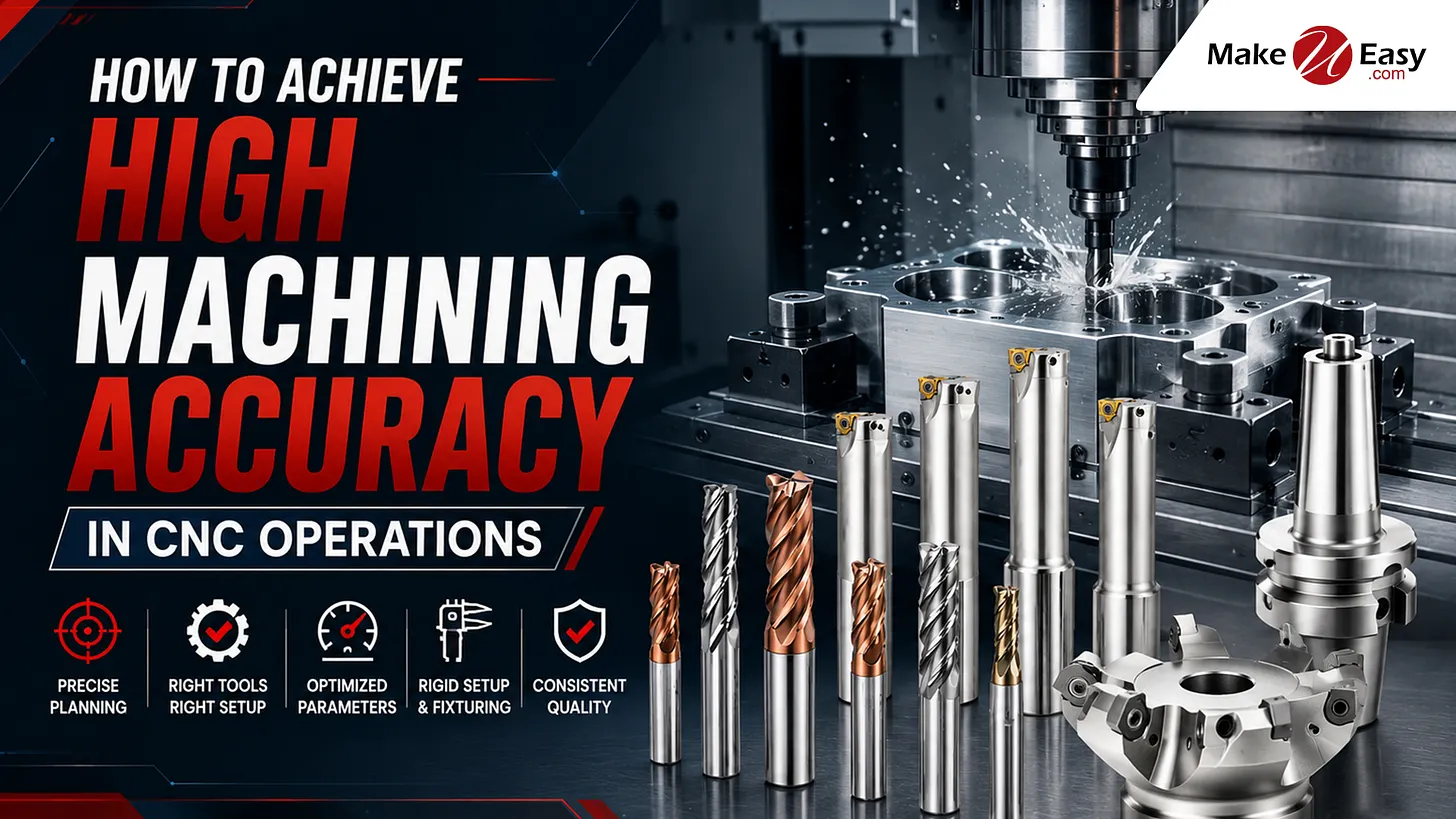
Introduction
High machining accuracy is the foundation of quality CNC manufacturing. Whether you’re producing aerospace components, automotive parts, molds, or precision-engineered products, even a small deviation can lead to assembly issues, rework, and increased production costs.
Achieving high accuracy in CNC operations is not the result of a single factor. It requires the right combination of machine condition, tooling, workholding, programming, cutting parameters, and measurement practices. By controlling these factors, manufacturers can consistently produce parts with tight tolerances and superior surface finishes.
At MakeYouEasy, we provide precision CNC tooling solutions that help machinists improve accuracy, productivity, and machining reliability.
🌐 Website: https://makeyoueasy.com/
1. Use High-Quality Cutting Tools
The quality of the cutting tool directly affects dimensional accuracy.
Choose tools with:
-
Precision-ground geometry
-
Consistent carbide grade
-
Advanced wear-resistant coatings
-
Proper flute design
-
High rigidity
Worn or low-quality tools can cause tool deflection, chatter, and dimensional variation.
Recommended tools:
-
Solid carbide end mills
-
Ball nose end mills
-
Thread milling cutters
-
U drills
-
High-feed milling cutters
2. Select the Correct Tool Holder
A precision tool holder minimizes runout and improves cutting stability.
Common high-accuracy holders:
-
BT40 Tool Holders
-
BT50 Tool Holders
-
ER Collet Chucks
-
Hydraulic Chucks
-
Shrink Fit Holders
Lower runout results in better surface finish and more accurate dimensions.
3. Ensure Proper Workholding
Inaccurate workholding is one of the biggest causes of machining errors.
Use:
-
Precision vises
-
Soft jaws
-
Jaw boring rings
-
Fixture plates
-
Hydraulic chucks
Workpieces must be clamped securely without distortion or movement during machining.
4. Reduce Tool Deflection
Tool deflection occurs when cutting forces bend the tool.
To minimize deflection:
-
Use the shortest possible tool overhang.
-
Select a larger tool diameter when feasible.
-
Reduce depth of cut if necessary.
-
Use rigid tool holders.
-
Optimize feed rates.
5. Optimize Cutting Parameters
Incorrect feeds and speeds can reduce accuracy.
Factor
Effect on Accuracy
Excessive feed
Tool deflection
Low feed
Tool rubbing
Excessive speed
Heat buildup
Low speed
Poor surface finish
Follow the tool manufacturer’s recommended cutting parameters for the best results.
6. Control Thermal Expansion
Heat affects both the machine and the workpiece.
Improve thermal stability by:
-
Using proper coolant flow.
-
Allow the machine to warm up before precision machining.
-
Avoiding sudden temperature changes.
-
Using consistent machining conditions.
7. Verify Machine Calibration
Regular machine calibration is essential.
Check:
-
Axis positioning accuracy
-
Backlash
-
Spindle runout
-
Squareness
-
Linear compensation
A poorly calibrated machine cannot maintain tight tolerances consistently.
8. Use Precision Measuring Instruments
Accurate measurement is just as important as accurate machining.
Recommended instruments:
-
Digital micrometers
-
Vernier calipers
-
Bore gauges
-
Dial indicators
-
Height gauges
-
Edge finders
-
Electronic edge sensors
Measure critical dimensions during and after machining to detect deviations early.
9. Minimize Vibration and Chatter
Chatter can ruin surface finish and dimensional accuracy.
Reduce vibration by:
-
Using rigid fixtures.
-
Reducing tool overhang.
-
Adjusting spindle speed.
-
Using balanced tooling.
-
Selecting the correct insert geometry.
10. Use Proper CNC Programming
Programming errors can introduce dimensional inaccuracies.
Check:
-
Tool offsets
-
Work offsets
-
Cutter compensation
-
Interpolation settings
-
Step-over values
-
Finishing allowances
Simulation software can help identify potential issues before machining begins.
11. Apply Finishing Passes Correctly
Separate roughing and finishing operations whenever possible.
A typical strategy:
-
Roughing: Remove most of the material.
-
Semi-finishing: Leave a small allowance.
-
Finishing: Use a light final pass for maximum accuracy.
This reduces cutting forces during the final pass and improves dimensional consistency.
12. Maintain a Clean Machine Environment
Chip buildup can affect positioning accuracy.
Regularly clean:
-
Machine table
-
Fixtures
-
Tool holders
-
Spindle taper
-
Workholding surfaces
Even small chips trapped under a workpiece can create significant dimensional errors.
Common Causes of Poor CNC Accuracy
Problem
Likely Cause
Oversized dimensions
Tool wear or deflection
Poor surface finish
Vibration or incorrect speed
Inconsistent dimensions
Workpiece movement
Thread inaccuracies
Wrong tool offset
Hole misalignment
Spindle runout or poor setup
Excessive taper
Machine calibration issue
Why Choose MakeYouEasy for Precision CNC Tooling?
At MakeYouEasy, we supply high-performance CNC tooling designed to help manufacturers achieve tighter tolerances and more reliable machining results.
Our product range includes:
-
BT Tool Holders
-
ER Collet Chucks
-
Face Milling Cutters
-
High Feed Milling Cutters
-
Thread Milling Cutters
-
Ball-Nose End Mills
-
U Drills
-
Precision Measuring Instruments
-
Workholding Accessories
Why machinists choose us:
-
Premium-quality tooling
-
Precision-engineered products
-
Competitive pricing
-
Fast Pan-India delivery
-
Technical support
-
Reliable industrial performance
🌐 Explore our complete CNC tooling range: https://makeyoueasy.com/
Conclusion
Achieving high machining accuracy in CNC operations requires a combination of quality tooling, proper workholding, optimized cutting parameters, machine calibration, and accurate measurement practices. By controlling each of these factors, manufacturers can consistently produce precision components with excellent surface finishes and tight tolerances.
Investing in premium CNC tools and accessories is one of the most effective ways to improve accuracy, reduce scrap, and increase productivity. MakeYouEasy provides the precision tooling solutions your CNC operations need to perform at the highest level.
Frequently Asked Questions (FAQs)
1. What is the most important factor for CNC machining accuracy?
The most important factor is the combination of machine calibration, tool quality, and secure workholding.
2. How does toolholder runout affect accuracy?
Excessive runout causes uneven cutting, poor surface finish, and dimensional variation.
3. Why is coolant important for precision machining?
Coolant helps control temperature, improve chip evacuation, and reduce thermal expansion.
4. Can vibration reduce machining accuracy?
Yes, vibration and chatter can cause dimensional errors and poor surface finish.
5. Which measuring tools are best for checking accuracy?
Micrometers, bore gauges, dial indicators, and digital calipers are commonly used for precision inspection.
Popular Search
CNC machining accuracy, High-precision CNC machining, CNC accuracy improvement, VMC machining accuracy, Precision CNC tooling, CNC tool holder runout, CNC workholding accuracy, How to reduce CNC runout, CNC cutting tool
