How Thread Milling Improves Thread Accuracy: A Complete Guide for Precision CNC Machining
Author : Surya makeyoueasy | Published On : 28 Jul 2026
Introduction
Thread accuracy is crucial in CNC machining, especially for components used in aerospace, automotive, medical, oil & gas, and precision engineering industries. Poor thread quality can lead to improper assembly, leakage, reduced product reliability, and costly rework. While conventional tapping is widely used, thread milling has become the preferred method for manufacturers who demand higher precision, better surface finish, and greater machining flexibility.
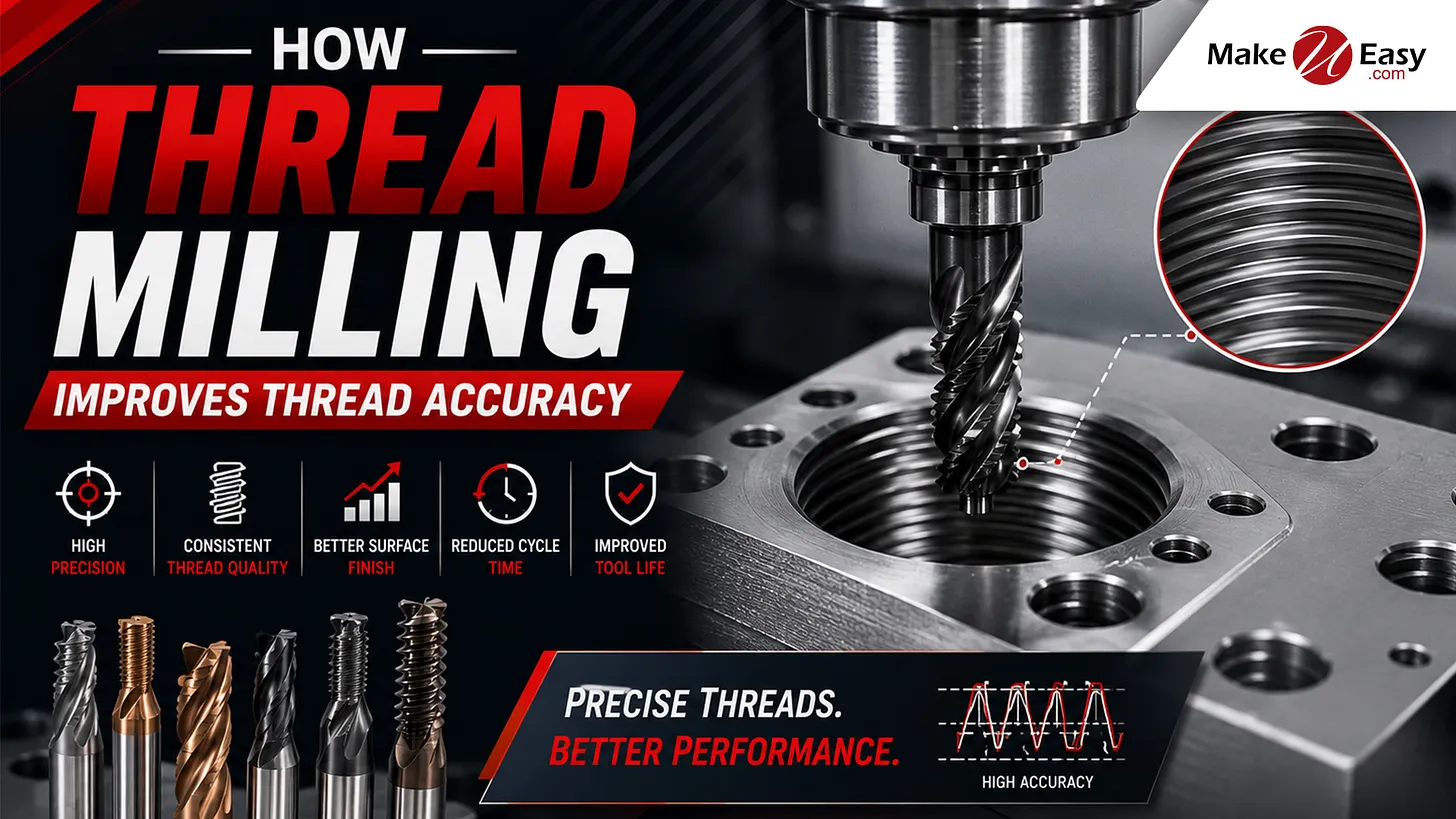
A Thread Milling Cutter creates threads using helical interpolation on CNC machines, allowing gradual material removal with excellent dimensional control. This method produces highly accurate threads while reducing cutting forces and minimizing the risk of tool breakage.
At MakeYouEasy, we offer premium Thread Milling Cutters designed to deliver precise, consistent, and reliable threading performance across a wide range of materials.
🌐 Website:
What Is Thread Milling?
Thread milling is a CNC machining process where a rotating thread mill follows a programmed helical path to produce internal or external threads.
Unlike tapping, which cuts the entire thread profile in one operation, thread milling removes material gradually, resulting in smoother cutting action and greater dimensional accuracy.
This process is commonly performed on CNC machining centers and VMCs equipped with helical interpolation capability.
Why Thread Accuracy Matters
Accurate threads ensure:
-
Proper component assembly
-
Strong fastening performance
-
Leak-proof threaded connections
-
Reduced assembly failures
-
Consistent product quality
-
Longer component life
Even small thread errors can affect the performance of precision-engineered parts.
How Thread Milling Improves Thread Accuracy
1. Precise CNC-Controlled Tool Path
Thread milling uses a programmed helical interpolation path, allowing the CNC machine to control thread dimensions with exceptional precision.
This results in:
-
Accurate pitch
-
Consistent thread depth
-
Uniform thread profile
-
Excellent dimensional repeatability
2. Reduced Cutting Forces
Since thread milling removes material gradually, cutting forces are much lower than in tapping.
Lower cutting forces help:
-
Reduce tool deflection
-
Minimize vibration
-
Improve dimensional accuracy
-
Protect delicate workpieces
3. Better Surface Finish
The smooth cutting action produces clean, burr-free thread profiles with excellent surface quality.
Benefits include:
-
Improved thread engagement
-
Reduced friction
-
Better sealing performance
-
Professional-quality finishes
4. Superior Chip Evacuation
Thread milling produces small chips that are easily removed from the cutting zone.
Efficient chip evacuation reduces:
-
Chip packing
-
Thread damage
-
Tool wear
-
Heat generation
This is especially beneficial for blind-hole threading.
5. Higher Dimensional Consistency
Thread milling delivers consistent results from the first component to the last, making it ideal for batch production.
Manufacturers benefit from:
-
Repeatable thread dimensions
-
Reduced scrap
-
Better quality control
-
Reliable production output
6. Lower Risk of Tool Breakage
Unlike taps, which experience high torsional loads, thread mills operate with lower cutting pressure.
Advantages include:
-
Reduced tool breakage
-
Safer machining
-
Lower replacement costs
-
Less production downtime
7. One Tool for Multiple Thread Diameters
A single-thread milling cutter can often machine different thread diameters that share the same pitch.
This provides:
-
Reduced tooling inventory
-
Lower tooling costs
-
Greater production flexibility
-
Faster tool changes
Thread Milling vs Tapping
FeatureThread MillingTappingThread AccuracyExcellentGoodSurface FinishSuperiorGoodTool Breakage RiskLowHigherChip EvacuationExcellentModerateMultiple Thread Sizes Yes (same pitch)NoBlind Hole PerformanceExcellentGoodDimensional ControlHighModerateTool FlexibilityHighLimited
Applications of Thread Milling
Thread milling is widely used for:
-
Internal thread machining
-
External thread machining
-
Blind holes
-
Through holes
-
Mold and die manufacturing
-
Aerospace components
-
Automotive parts
-
Hydraulic fittings
-
Medical devices
-
Precision engineering
Materials Suitable for Thread Milling
Thread milling cutters perform well on:
-
Carbon Steel
-
Alloy Steel
-
Stainless Steel
-
Cast Iron
-
Aluminum
-
Brass
-
Copper
-
Titanium Alloys
-
Nickel-Based Alloys
-
Hardened Steel
Tips for Achieving Maximum Thread Accuracy
For the best results:
-
Use a high-quality thread milling cutter.
-
Secure the workpiece firmly.
-
Select the correct cutting speed and feed rate.
-
Minimize tool overhang.
-
Use precision tools and holders.
-
Apply suitable coolant when required.
-
Verify CNC tool offsets before machining.
-
Inspect thread dimensions regularly.
Following these practices ensures consistent, high-quality threads.
Why Choose MakeYouEasy?
At MakeYouEasy, we provide premium CNC threading solutions trusted by professionals across India.
Our Product Range
-
Thread Milling Cutters
-
Solid Carbide End Mills
-
Face Milling Cutters
-
High Feed Milling Cutters
-
U Drills
-
BT Tool Holders
-
ER Collet Chucks
-
Carbide Inserts
-
Precision Measuring Instruments
-
CNC Accessories
Why Buy From Us?
-
Premium-quality CNC tooling
-
Precision-engineered products
-
Competitive pricing
-
Fast Pan-India delivery
-
Expert technical support
-
Trusted machining solutions
🌐 Explore our products:
Conclusion
Thread milling has transformed modern CNC threading by delivering superior thread accuracy, smoother surface finishes, and greater machining flexibility. With lower cutting forces, excellent chip evacuation, and the ability to produce multiple thread sizes using a single tool, thread milling is an ideal solution for precision manufacturing. By investing in high-quality Thread Milling Cutters and following best machining practices, manufacturers can improve productivity, reduce tooling costs, and achieve consistently accurate threads. MakeYouEasy offers premium thread milling solutions to help you meet the highest standards of CNC machining.
Frequently Asked Questions (FAQs)
1. What is the main advantage of thread milling over tapping?
Thread milling provides higher accuracy, better surface finish, and a lower risk of tool breakage.
2. Can one thread milling cutter produce different thread sizes?
Yes, one cutter can machine multiple thread diameters with the same thread pitch.
3. Is thread milling suitable for blind holes?
Yes, thread milling offers excellent chip evacuation, making it ideal for blind-hole threading.
4. Which materials can be threaded using a thread milling cutter?
It is suitable for steel, stainless steel, aluminum, cast iron, titanium, brass, copper, and other engineering materials.
5. Where can I buy premium Thread Milling Cutters in India?
You can purchase high-quality Thread Milling Cutters from MakeYouEasy at
