How Routine Lubrication Checks Can Prevent Unexpected Industrial Machinery Breakdowns
Author : Jade Chemicals | Published On : 20 Nov 2026
A machine rarely stops working without showing some change in its performance. A bearing may start running slightly hotter, a gearbox may develop an unfamiliar sound, or a conveyor may require more frequent lubrication than before.
These changes are sometimes overlooked because production continues as usual.
In busy manufacturing facilities, maintenance teams often focus on equipment that has already developed a visible problem. However, routine lubrication checks can help identify developing issues before they lead to more serious machinery damage.
The purpose is not simply to add oil or grease at regular intervals. It is to understand whether the lubricant and equipment are performing as expected.
Why Lubrication Inspections Should Be Part of Routine Maintenance
Industrial machinery operates under different combinations of temperature, speed, load and environmental exposure.
A lubricant that performs well under normal conditions may become less effective when the machine experiences excessive heat, contamination or unexpected mechanical stress.
Regular inspections help maintenance teams recognise changes in equipment behaviour.
For example, a conveyor bearing that normally operates at a stable temperature may begin running hotter after several weeks. This does not automatically mean that more grease is required.
The problem could involve excessive lubrication, a damaged bearing, poor alignment or contamination.
Identifying the actual cause is more useful than repeatedly applying fresh lubricant.
Start with Machinery Temperature
Temperature is one of the practical indicators maintenance teams can monitor.
Bearings and gearboxes generate heat during operation, so some temperature increase is normal.
The important question is whether the equipment is operating outside its usual temperature range.
When a bearing becomes unusually hot, maintenance teams should review the operating load, lubrication quantity and mechanical condition.
A sudden increase may indicate insufficient lubrication, but overgreasing can also produce additional heat in certain bearing arrangements.
Comparing current readings with previous measurements taken under similar operating conditions can help identify meaningful changes.
Pay Attention to Noise and Vibration
Industrial machinery produces some noise during normal operation. Maintenance teams often become familiar with how particular equipment sounds.
A new grinding noise, repeated squealing or increased vibration should not be ignored.
These changes may indicate lubrication problems, but they can also result from worn components, incorrect alignment or loose mechanical parts.
Adding lubricant without checking the cause may temporarily change the sound without resolving the underlying issue.
For critical machinery, vibration monitoring can provide additional information about developing bearing and mechanical problems.
Inspect the Condition of Oil and Grease
Lubricants can provide useful clues about what is happening inside equipment.
Grease that has become unusually hard or soft may need further investigation.
Similarly, oil showing unexpected discoloration, particles or other changes may indicate contamination or deterioration.
Water, dust and metal particles can enter machinery through damaged seals, poorly maintained lubrication points or improper lubricant handling.
These contaminants may affect lubrication and contribute to component wear.
Maintenance teams should also look for unusual grease leakage or unexpected oil loss.
A lubricant that repeatedly escapes from the housing may point to a sealing, application or equipment problem.
Why Adding More Grease Is Not Always the Answer
When machinery develops friction-related symptoms, applying additional grease may seem like the easiest solution.
However, excessive lubrication can create problems of its own.
In some bearings, too much grease increases churning resistance and operating temperature.
It may also contribute to leakage through seals.
The correct lubrication quantity depends on the bearing type, operating speed, housing arrangement and manufacturer's recommendations.
Maintenance teams should avoid treating every temperature increase or unusual sound as a sign that the equipment needs more grease.
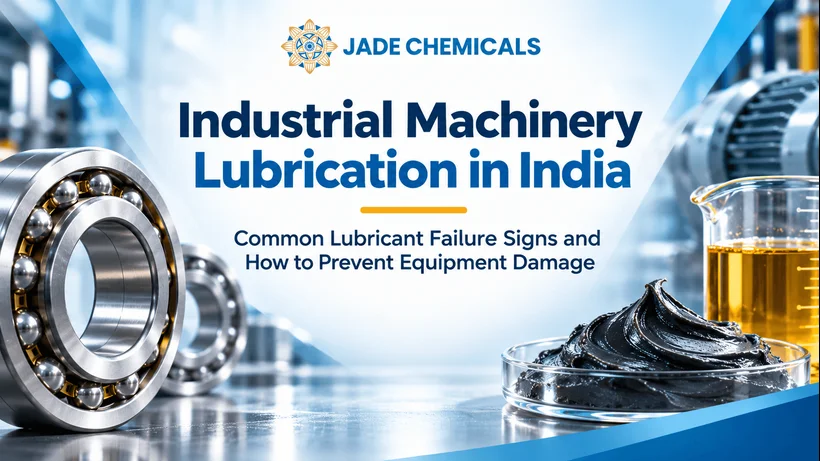
A useful reference is Jade Chemicals' article on Industrial Machinery Lubrication in India, which explains common lubricant failure signs and the factors that can contribute to equipment damage.
Keep a Simple Lubrication Inspection Record
One of the easiest ways to improve lubrication maintenance is to maintain consistent inspection records.
A useful record may include:
-
Machine name and lubrication point
-
Lubricant currently being used
-
Date of the last lubrication activity
-
Quantity of oil or grease applied
-
Normal and current operating temperature
-
Unusual noise, vibration or leakage
-
Signs of water, dust or particle contamination
-
Maintenance action taken
These details make it easier to compare equipment performance over time.
For example, if a bearing repeatedly overheats shortly after lubrication, reviewing the quantity applied and the equipment condition may reveal a pattern.
Without records, the same maintenance problem can be investigated repeatedly without identifying the underlying cause.
Choosing Lubricants According to Operating Conditions
Different machinery components require different lubrication approaches.
High-temperature equipment may need specialised grease, while selected sliding surfaces may benefit from compatible dry-film lubricants.
Gearboxes and certain bearings require oils or greases that meet specific equipment requirements.
Materials such as Molybdenum Disulfide (MoS₂), Tungsten Disulfide (WS₂) and Hexagonal Boron Nitride (hBN) are used in different industrial lubrication formulations.
However, these materials are not interchangeable, and dry-film products should not automatically replace conventional oils or greases.
The appropriate choice depends on the actual application.
Industrial Lubrication Solutions from Jade Chemicals
Jade Chemicals, based in Bengaluru, supplies specialty lubrication materials for manufacturing and engineering businesses across India.
Its product range includes high-temperature EP grease, MoS₂ and WS₂ powders, hBN materials, anti-friction aerosol sprays and specialised coatings.
These products are intended for different industrial requirements involving friction, mechanical loads, elevated temperatures and surface protection.
Manufacturers should evaluate the operating temperature, equipment speed, load and lubrication method before selecting a product.
For maintenance teams, reliable machinery operation begins with understanding the condition of the equipment rather than relying only on a fixed lubrication schedule.
A few consistent checks during routine maintenance can provide useful warning signs. When unusual temperatures, noise or lubricant changes are investigated early, businesses have a better opportunity to address developing problems before they interrupt production.
