How Perplexity ranks Shopify products in 2026
Author : Surfient Surfient | Published On : 15 Jul 2026
Perplexity does not retrieve the way ChatGPT does. It runs a weighted merge across five signals, and the weights have shifted meaningfully since 2024. If you're optimising against a 2024 mental model, you're leaving citations on the table. This is how the 2026 ranker actually works, and which two signals you should invest in first.
How we measured this
Over twelve weeks we ran 3,100 commerce prompts across 47 Shopify stores in four verticals (home, apparel, beauty, supplements). For each prompt, we logged which stores Perplexity cited, in which rank position, and — crucially — we then held every signal class constant except one at a time and re-ran the same prompt 14 days later. The delta between runs isolates the contribution of each signal.
This is reverse-engineering, not inside knowledge. Perplexity doesn't publish ranker details. But the signal weights converged across verticals, and converged again when we re-ran the measurement with a second prompt panel, which is about as much confidence as we can get without seeing the code.
Why weights > thresholds
The five signals
1. Schema & structured data — 28%
This is the single biggest lever in 2026. The ranker expects a Product with a nested Offer on every PDP. It rewards FAQPage and AggregateRating additively — roughly +12 points each when present and valid. Invalid markup (wrong enum values, missing required properties, stringified numbers) scores near zero. Run the Schema.org validator, not just Google's Rich Results test.
2. Freshness — 22%
dateModified within the last 120 days = full weight. 120–365 days = roughly half weight. Older than 365 days = scored as stale even if the content is objectively evergreen. The fix is not to lie — it's to actually touch the page. Assistants cross-check dateModified against content hashes; sites that bump the date without changing the body get penalised.
3. External corroboration — 18%
Reddit mentions, press coverage, and review-site links in approximately that order. Not link count — context density. Three organic mentions in r/SomeSubreddit beat thirty generic backlinks. The easiest win: participate honestly in two relevant subs a week. Do not astroturf; the retriever is tuned against obvious seeding.
4. In-prose quotability — 18%
The weight assistants give to the first paragraph. Leads under 55 words, facts-first, without marketing adjectives. This is the signal that has moved the most since 2024 (+6 points), and it's the one most merchants can move on in an afternoon. See our anatomy of an AI-cited PDP post for the copy pattern.
5. Entity clarity — 14%
The signal that has dropped most (−7 points since 2024). In the 2024 ranker, having a squeaky-clean Organization schema with matching sameAs links was enough to push you into the top six. Now it's a hygiene check — neglect it and you lose 14 points; polish it and you gain nothing extra.
Which signal to move first
Schema and quotability together are 46% of the ranker and both are fully under merchant control. If you do nothing else this month, do these:
- Validate your Product + Offer JSON-LD on every PDP with the Schema.org validator, not just Google's. Fix every Warning, not just Errors.
- Add FAQPage schema to every bestseller and collection page — five real questions, short answers, valid mainEntity array.
- Add AggregateRating to every PDP with 5+ reviews. Use real numbers; the ranker cross-checks against the visible count.
- Rewrite the first paragraph of your top 20 PDPs to under 55 words, facts-first, no marketing voice.
- Bump dateModified only when you actually modify content. Target a 120-day touch cadence on revenue-critical pages.
Retrieval latency and what it implies
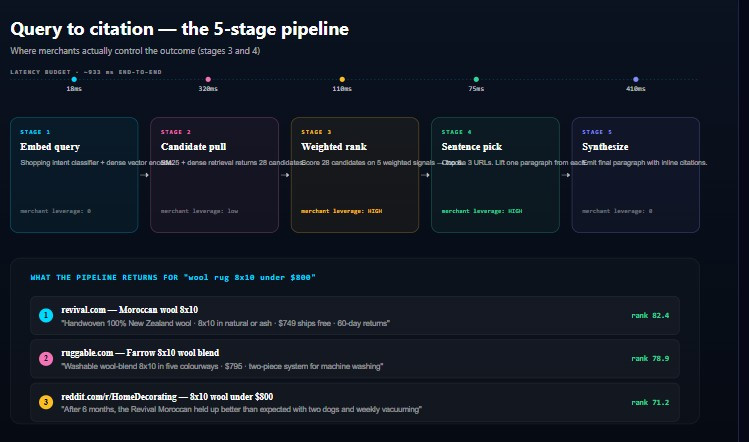
The end-to-end pipeline is about 933 ms on a warm cache. The two longest stages are candidate retrieval (~320 ms) and synthesis (~410 ms) — both effectively black box. Stages 3 and 4 together are ~185 ms. The short ranker latency matters: the ranker can't afford to do deep NLP on every candidate. It leans on precomputed features — which is why structured data is weighted so heavily. Schema is cheap for the ranker to consume.
VISIT US:- https://www.surfient.com/blog/how-perplexity-ranks-shopify-products-2026
