How Is AI Used in Construction Management Software? A Practical Guide
Author : RDash AI | Published On : 01 Sep 2026
Construction is becoming increasingly data-driven, and AI in construction management software is changing how contractors, developers, and project teams plan, monitor, and control their projects. From predicting delays and tracking costs to automating daily reports and answering project questions in plain language, artificial intelligence is helping construction teams turn large amounts of project data into useful decisions. Instead of simply recording what happened, modern construction software can help teams understand what is happening and identify what may happen next.
Why AI Matters in Construction Management
Construction has faced a productivity challenge for decades. Projects involve large teams, multiple vendors, changing designs, complex budgets, site activities, procurement, documentation, and financial transactions. Managing all of this information manually can make it difficult for project managers to get a reliable view of what is actually happening.
The problem becomes even bigger when information is spread across spreadsheets, WhatsApp conversations, PDFs, emails, and separate software tools. Teams may have plenty of data, but that does not always mean they have useful visibility.
AI helps address this gap by analysing project data and identifying patterns that may be difficult to spot manually. When project schedules, budgets, BOQs, site reports, invoices, design files, and other information are connected, AI can help teams make faster and more informed decisions.
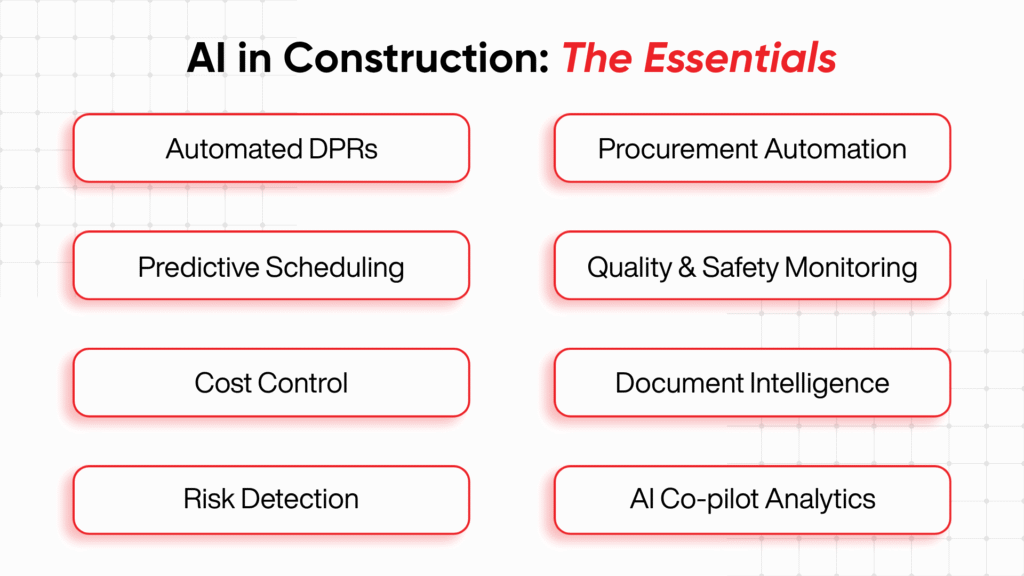
8 Key Uses of AI in Construction Management Software
AI is not limited to one particular construction activity. It can support several areas of project management, from daily site reporting to procurement, cost control, risk management, and analytics.
1. Automated Progress Reporting
Daily progress reports are an important part of construction management, but preparing them can take significant time. Site engineers and supervisors often need to collect information, organise photographs, record activities, and prepare reports for management.
AI can simplify this process by structuring field information such as photos, voice notes, and site entries into organised reports. It can also compare reported progress with the project schedule and highlight activities that are falling behind.
This gives project leadership a clearer picture of site conditions without requiring them to wait for a weekly meeting or manually review multiple reports.
2. Predictive Scheduling and Delay Forecasting
Scheduling is another area where AI can make a major difference. Traditional project schedules often show what should happen, but AI-powered systems can help identify what is likely to happen next.
By analysing historical project information, resource availability, weather data, and current progress, AI can identify activities that may be at risk of delay. This gives project managers an opportunity to respond before a small delay becomes a major bottleneck.
For example, if a particular activity is consistently progressing slower than planned, the system can highlight the issue early. Management can then consider reallocating resources or changing priorities before the delay affects other activities.
3. Cost Control and Margin Analysis
Cost overruns rarely appear overnight. Small variations in material prices, vendor costs, change orders, site expenses, and quantities can gradually reduce project margins.
AI can continuously compare budgeted costs with actual project spending and identify unusual variations. Instead of discovering an overrun during month-end reconciliation, teams can receive an earlier warning and take corrective action.
This type of continuous analysis is particularly valuable for contractors working on multiple projects, where manually monitoring every cost movement can become difficult.
4. Early Risk Detection
Construction risks often begin as small warning signs. A supplier may repeatedly delay deliveries, a payment cycle may start taking longer, or productivity may gradually decline across several activities.
AI can analyse project patterns and identify these signals before they develop into larger problems. By monitoring live project information, AI-powered risk models can help teams focus attention on areas that need intervention.
The goal is not to replace project managers. Instead, AI acts as an additional layer of visibility that helps them notice potential issues earlier.
5. Procurement and Vendor Automation
Procurement involves a large amount of repetitive work, including purchase requests, purchase orders, vendor invoices, approvals, material receipts, and quantity checks.
AI can help automate parts of this workflow. It can match invoices with purchase orders, identify quantity mismatches, apply relevant tax rules, and route approvals to the appropriate people.
For construction businesses, this can reduce manual effort while also improving control over procurement and vendor transactions.
6. Quality and Safety Monitoring
AI is also being used for construction quality and safety. Computer vision systems can analyse site footage to identify issues such as missing personal protective equipment, unsafe proximity to equipment, or certain quality defects.
Although advanced computer vision applications are more common on larger infrastructure projects, the wider principle can be applied across construction. Digital snag management, for example, helps teams record issues, assign responsibility, and track them through resolution.
Connecting quality issues with suppliers, orders, and project activities can make accountability much clearer.
7. Document and Contract Intelligence
Construction projects generate a huge amount of documentation. Contracts, drawings, specifications, revisions, approvals, and other documents can contain important information that is difficult to locate manually.
AI can analyse these documents and help users find relevant information more quickly. Large language models can summarise documents, identify obligations, surface important clauses, and answer questions about project scope.
This can save project teams from spending unnecessary time searching through lengthy documents whenever they need a specific piece of information.
8. Conversational Analytics
One of the most accessible applications of AI is conversational analytics. Instead of navigating multiple dashboards or asking an analyst to prepare a report, users can simply ask a question in plain language.
For example, a project manager could ask which projects are currently over budget or which vendor payments are awaiting approval. The system can then analyse the available project data and present the answer.
This makes advanced analytics easier for people who may not have technical or data-analysis expertise.
Traditional Software vs AI-Powered Construction Software
The biggest difference between traditional and AI-powered construction software is not simply speed. It is the shift from looking backwards to becoming more proactive.
Traditional systems may depend heavily on manual data entry, static schedules, month-end cost reconciliation, reactive risk management, and predefined dashboards. AI-powered systems can automate data structuring, provide predictive delay insights, continuously monitor cost variations, detect emerging risks, and respond to natural-language questions.
However, AI is only as useful as the data behind it. If project information remains scattered across disconnected systems, AI may not have the context required to produce reliable insights.
That is why connected project data is so important.
How RDash Applies AI to Construction Management
RDash is an AI-powered construction management software designed to connect site teams, procurement, design, and finance within a single workspace. Its approach focuses on bringing construction information together instead of keeping different project activities in separate systems.
The platform includes workflows for pre-sales, activity scheduling, design management, BOQs, change orders, daily progress reporting, site surveys, snag management, procurement, vendor management, invoices, material tracking, and site expenses.
Its AI Co-pilot adds an intelligence layer on top of this connected project information. Users can ask questions using prompts and receive analytics related to areas such as margin leakages and project time lags.
The Co-pilot can also maintain conversational context, present results as tables and graphs, and allow users to export insights for further analysis. This makes AI more practical for construction teams that want useful answers without depending on a dedicated data or MIS team.
What Construction Businesses Should Expect From AI
AI should not be viewed as a replacement for experienced construction professionals. Site engineers, project managers, finance teams, procurement teams, and business leaders still make the decisions.
The real value comes from giving those people better information at the right time.
A project manager who can identify a potential delay earlier has more options. A finance team that sees a cost variance immediately can investigate it sooner. A procurement manager who spots a vendor issue early can consider alternatives. A business owner who can ask questions directly from project data can make decisions without waiting for multiple reports.
Final Thoughts
AI is becoming a practical part of construction management rather than simply a future technology. Its applications now cover progress reporting, scheduling, cost control, risk detection, procurement, quality and safety, document intelligence, and conversational analytics.
The most important lesson is that successful AI adoption depends on connected and reliable project data. Standalone AI features may provide limited value when information remains fragmented. When AI is built into a connected construction management environment, it can transform scattered project information into timely, actionable insights.
For construction businesses looking to improve visibility, reduce manual work, control costs, and respond to risks earlier, AI-powered construction management software represents a significant step toward a more proactive way of managing projects.
