How Generative Engine Optimisation Helps Businesses Adapt to AI Search
Author : Digitrix Media | Published On : 28 Oct 2026
Search is changing. People no longer rely only on Google links to find information. AI-powered search tools now provide direct answers, recommendations and comparisons, creating new opportunities for businesses to reach potential customers.
The article, "What Is GEO, and Why Should Businesses Care About AI Search?", explains how Generative Engine Optimisation (GEO) works, why it matters and how businesses can improve their visibility in AI-generated search results.
1. What is GEO and How is it Different from SEO?
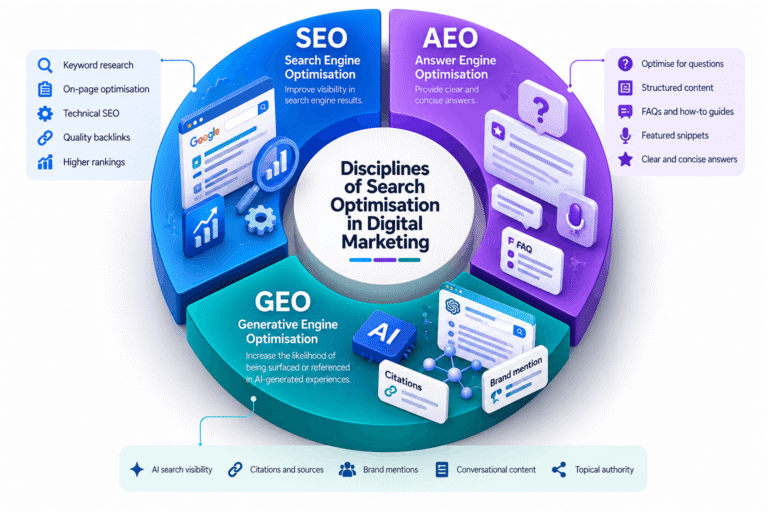
Generative Engine Optimisation (GEO) focuses on making a business's content easier for AI-powered search tools to understand, trust and potentially reference in their answers.
While SEO helps websites rank in traditional search results, GEO focuses on visibility within AI-generated responses. Answer Engine Optimisation (AEO) aims to make content suitable for direct answers.
These approaches work together to improve online visibility rather than replace one another.
2. Why Should Businesses Care About AI Search?
AI search is changing how customers discover and compare businesses. Instead of browsing several websites, users can ask detailed questions and receive recommendations or information from multiple sources.
This makes clear, trustworthy content increasingly important. Businesses should explain:
-
What products or services they offer
-
Who their target customers are
-
What problems they solve
-
What makes their expertise credible
-
Why customers should consider their business
GEO can benefit local businesses, professional services, e-commerce brands, healthcare providers and B2B companies, particularly when customers research options before making decisions.
3. How Can Businesses Optimise for AI Search?
Businesses do not need to replace their existing SEO strategy. Instead, they can improve their content and online presence to support both traditional and AI-powered search.
Useful steps include:
-
Answer customer questions: Create content that directly addresses what potential customers want to know.
-
Improve content structure: Use clear headings, short sections and straightforward explanations.
-
Demonstrate expertise: Include real examples, case studies, original insights and relevant experience.
-
Build topical authority: Cover important subjects in depth and connect related pages through internal links.
-
Keep information consistent: Maintain accurate business details across websites, directories and other relevant platforms.
-
Update existing content: Refresh outdated information and improve pages that already attract relevant visitors.
The aim is to make content useful for customers while helping AI systems understand the business.
4. Does Traditional SEO Still Matter?
Yes. Technical SEO, quality content, website structure and internal linking remain essential for search visibility.
GEO builds on these foundations by improving how clearly a brand communicates its expertise and relevance across AI-powered search experiences.
Businesses should also monitor AI mentions, referral traffic, enquiries and conversions where possible. However, appearing in AI-generated answers does not guarantee website visits or sales.
Rather than chasing AI visibility alone, businesses should focus on providing helpful information, strengthening credibility and maintaining a consistent online presence
