How Does Entity-Based SEO Help Brands Rank in AI Search?
Author : CS Web Solutions | Published On : 05 Jun 2026
The way people discover information online is changing rapidly. Search engines are no longer focused only on matching keywords to web pages. Modern AI-powered search platforms analyze context, intent, relationships, and credibility to determine which content deserves visibility.
Whether users are searching through AI-generated search experiences, conversational assistants, or intelligent answer engines, search systems now prioritize understanding over simple keyword matching. This shift is why businesses investing in AI SEO services in Toronto are increasingly adopting entity-focused strategies to strengthen their online presence.
At the heart of this evolution is entity-based SEO—a framework designed to help AI systems better understand your brand, expertise, and industry relevance.
What Is Entity-Based SEO?
Entity-based SEO is the process of optimizing a website around identifiable entities and the relationships between them. An entity can be a business, person, product, service, location, organization, event, or concept that search engines can uniquely identify. Rather than building content exclusively around keywords, entity optimization focuses on creating meaningful connections between topics and establishing contextual relevance.
This methodology supports modern AI SEO optimization because it allows AI systems to understand the broader meaning behind content instead of relying on exact keyword matches. When search engines clearly understand who you are, what you offer, and how your expertise relates to a specific topic, your content becomes more likely to appear in relevant search experiences.
The Shift Toward Semantic Search
For years, SEO strategies centered on keyword placement, density, and exact-match optimization. While keywords remain valuable, search engines have become significantly more sophisticated. Today's algorithms analyze semantic relationships and entity connections to understand search intent. For example, a search engine can recognize that terms like "Toronto digital marketing agency," "online marketing company in the GTA," and "digital growth services Toronto" are conceptually related.
This advancement has transformed how businesses approach optimization. A comprehensive AI-powered SEO audit now examines whether search engines can accurately interpret a brand's expertise, services, and authority within its niche. As AI search continues to evolve, context often matters more than keyword repetition.
Why Entity-Based SEO Matters for AI Search
AI-driven search platforms are designed to provide users with accurate, trustworthy, and contextually relevant answers.
Entity-based SEO helps accomplish this by giving search engines a clearer understanding of your website's subject matter and expertise.
A properly executed entity strategy enhances AI-driven SEO by helping search engines:
1. Understand your business and service offerings
2. Identify relationships between connected topics
3. Associate your brand with trusted sources
4. Strengthen semantic relevance
5. Improve topical authority
6. Increase visibility across related search queries
This broader understanding enables websites to gain exposure for multiple relevant searches rather than relying on a handful of targeted keywords.
Advantages of Entity-Based Optimization
Improved Visibility in AI-Generated Results
AI-powered search engines increasingly provide direct answers to user queries. Content that demonstrates clear entity relationships and topical expertise is more likely to be referenced within these responses.
As AI-generated answers become more common, earning citations and mentions from search systems can significantly improve brand awareness.
Stronger Trust and Authority Signals
Search engines evaluate content using a variety of quality indicators, including Experience, Expertise, Authoritativeness, and Trustworthiness (E-E-A-T).
Entity optimization supports these signals by helping search engines validate expertise and understand industry relevance.
Businesses using AI SEO services in Brampton often incorporate entity-focused strategies to strengthen credibility and establish greater trust with both users and search engines.
Greater Topical Coverage
When content is structured around interconnected entities, search engines gain a deeper understanding of a website's knowledge base.
This allows brands to build stronger authority across entire subject categories while improving their ability to rank for a broader range of relevant searches.
Effective semantic SEO supports long-term visibility by expanding a website's reach beyond individual keyword targets.
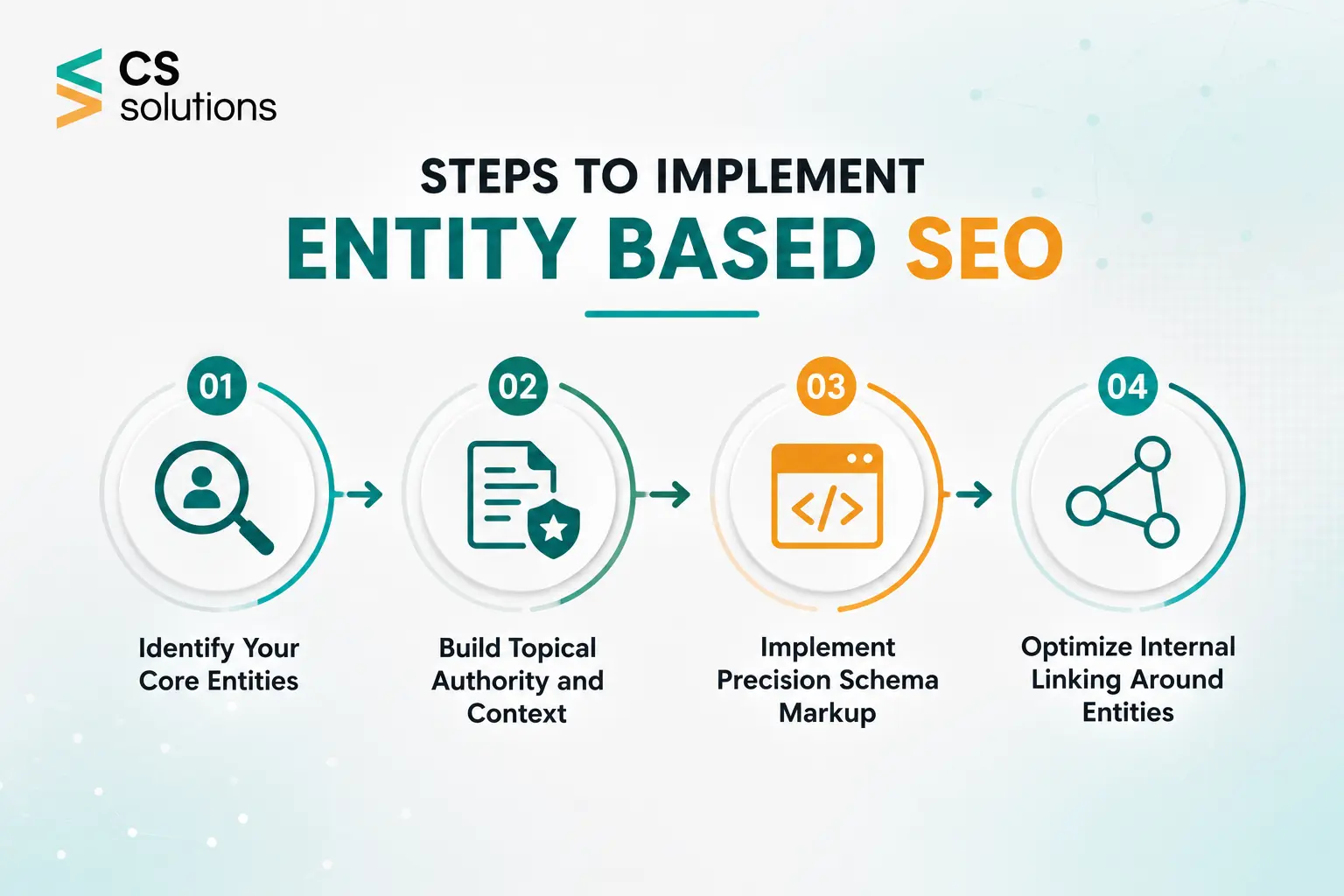
Practical Steps to Implement Entity-Based SEO
1. Define Core Entities and Create Relationship Maps
The first step is identifying the primary entities associated with your business, including products, services, locations, audiences, and industry concepts.
Creating an entity map helps organize relationships between topics and establishes a framework that supports linked entities SEO, improves SEO for AI Overviews, and strengthens overall LLM SEO efforts.
2. Develop Topic Clusters Around Important Entities
Topic clusters help search engines understand how different pieces of content relate to one another.
By creating detailed pillar pages supported by related articles, businesses can improve topical authority and reinforce semantic relationships.
This structure enhances content relationships SEO while supporting stronger linked entities SEO performance across the website.
3. Implement Advanced Structured Data
Structured data plays a critical role in entity recognition.
Schema markup provides search engines with explicit information about your organization, services, authors, locations, and content.
Leveraging JSON-LD and implementing properties such as sameAs, @id, Organization, Article, FAQ, and LocalBusiness schemas strengthens schema markup optimization and enhances structured data SEO initiatives.
Proper schema implementation also increases the likelihood of inclusion within knowledge graph systems.
4. Strengthen Internal Entity Connections
Internal linking helps search engines understand how pages and entities relate to one another. Using descriptive anchor text and strategically connecting relevant pages creates stronger contextual signals. A well-structured linking framework supports AI understanding while improving user navigation and content discoverability.
5. Improve Content Context and Clarity
AI systems rely heavily on context when interpreting information.Every page should clearly define the entities being discussed and explain their relevance within the broader topic. This approach improves AI content discoverability, strengthens topical associations, and helps search engines interpret content with greater confidence.
6. Connect Entities to Authoritative Sources
External references can reinforce entity validation and trust.
Linking to recognized organizations, reputable publications, industry resources, and authoritative databases helps establish credibility and contextual relevance.
Any experienced AI SEO provider understands that entity recognition extends beyond a website's internal content. Whether partnering with an SEO company in Vancouver or managing SEO internally, building trustworthy external associations remains an important component of success.
Common Mistakes to Avoid
Treating Keywords and Entities as Identical
Keywords help search engines understand what users are searching for, while entities help them understand what content is about.
Businesses that focus exclusively on keywords often miss opportunities to strengthen semantic understanding and topical authority.
Weak or Incomplete Schema Implementation
Improperly configured structured data can limit entity recognition and reduce the effectiveness of optimization efforts.
Regular schema validation is essential for maintaining accurate entity signals.
Covering Too Many Unrelated Topics
A lack of topical focus can dilute authority and weaken entity relationships.
Search engines generally reward websites that demonstrate expertise within clearly defined subject areas. Many businesses working with an SEO company in Mississauga find that narrowing their content strategy leads to stronger long-term SEO performance.
The Future of AI Search and Entity Optimization
Search technology is moving toward deeper contextual understanding. Future AI systems will rely even more heavily on:
1. Knowledge graph integration
2. Entity relationships
3. Semantic relevance
4. Structured data signals
5. Contextual understanding
6. Topical authority
Businesses that invest in these areas today will be better positioned to earn citations, recommendations, and visibility within AI-generated search experiences.
Build a Stronger AI Search Strategy
Entity-based SEO has become one of the most important foundations of modern search optimization. As AI-powered search platforms continue evolving, brands must focus on helping search engines understand their expertise, authority, and relationships within their industry. Organizations that prioritize entity development, semantic content strategies, structured data implementation, and authoritative topic coverage are more likely to succeed in the future of search.
As an experienced AI SEO company in Toronto, CS Web Solutions helps businesses implement advanced entity optimization strategies, improve AI content discoverability, strengthen structured data SEO, and develop future-ready SEO campaigns that align with the evolving demands of AI-driven search. By combining technical expertise with semantic optimization, businesses can improve visibility and remain competitive in an increasingly AI-first digital landscape.
