How D2C Brands Track Offline Customers
Author : radhiya arora | Published On : 07 May 2026
For many D2C brands, getting listed in physical retail stores feels like success.
Your product is now available in supermarkets, pharmacies, and specialty stores. Sales increase. Distributors are happy. But behind the scenes, a silent problem begins.
When you sell on your website using Shopify, you know everything about the customer their phone number, email, address, buying habits, and repeat cycle.
But when someone buys your product from a retail shelf and walks out?
You get zero data.
No contact.
No way to remarket.
No relationship.
In today’s data-driven world, this is not just a gap it’s a serious growth risk.
Why Losing Retail Customer Data Is Dangerous
Offline retail sales feel good, but they come with hidden dangers:
-
You don’t own the customer
-
The retailer controls the relationship
-
You can’t retarget or upsell
-
If the retailer delists you, you lose all those buyers instantly
You are building demand but someone else owns it.
That’s why modern D2C brands must build a Phygital Bridge (Physical + Digital).
What Is the “Phygital” Bridge?
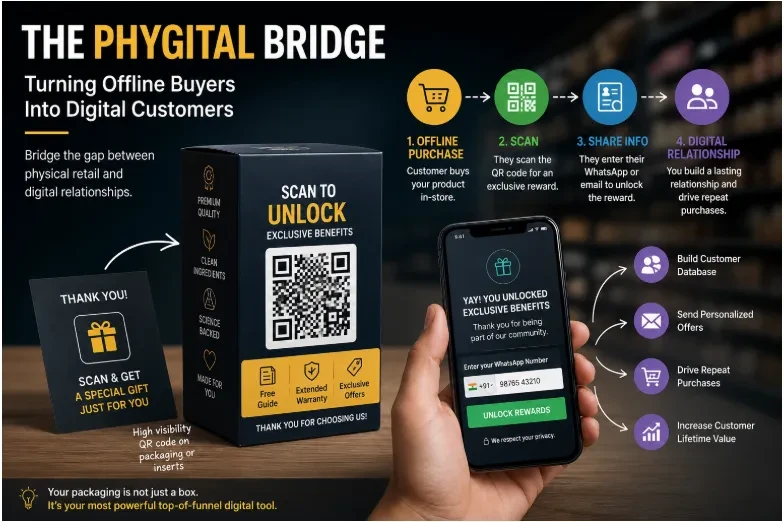
The Phygital Bridge is a system that converts an offline buyer into a digital customer.
The goal is simple:
Take a customer who buys from a store
Pull them into your digital ecosystem
Own the relationship for future purchases
This is done by hacking the physical packaging.
Why Most Brands Get This Completely Wrong
Most brands try lazy solutions like:
-
“Visit our website” printed on packaging
-
Tiny URLs near the barcode
-
Small social media handles
Let’s be honest no one types URLs from shampoo bottles.
There is no incentive. No urgency. No value.
The Right Way: The “Digital Unlock” Strategy
To build the Phygital Bridge, you need strong value exchange.
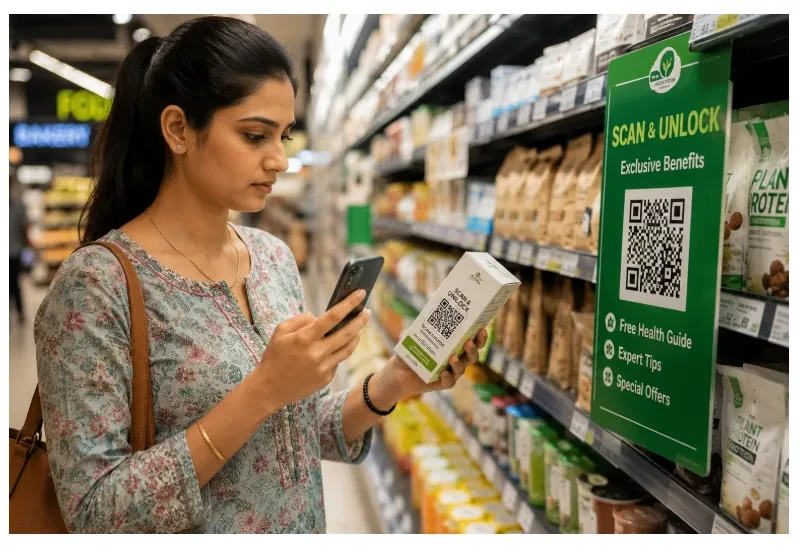
Step 1: Use a Large, Visible QR Code
-
On the packaging or
-
As a bright insert card inside the box
It must be impossible to ignore.
Step 2: Offer an Immediate, High-Value Reward
Examples:
-
Supplements: “Scan for a free 30-day diet or workout plan”
-
Cosmetics: “Scan to register for free replacement or skin routine”
-
Food brands: “Scan to trace ingredients + get a 20% coupon”
-
Appliances/Fashion: “Scan to activate warranty or authenticity check”
The reward must feel useful right now, not later.
Step 3: Capture Zero-Party Data
When the customer scans the QR code:
-
They land on a simple mobile page
-
To unlock the reward, they enter:
-
WhatsApp number or
-
Email ID
-
That’s it.
In one scan, an anonymous retail buyer becomes a known customer inside tools like WhatsApp.
What Happens After the Bridge Is Built?
Now you can:
-
Send refill reminders
-
Upsell bundles
-
Share offers directly
-
Bring them back to your D2C website
-
Reduce dependency on retailers
Customers who enter digitally after an offline purchase usually have higher trust and higher lifetime value.
Final Thought
Your packaging is not just a box.
It is:
-
Your most visited media asset
-
Your cheapest lead generation tool
-
Your strongest bridge between offline and online
If you’re selling offline but not capturing customer data, you are leaking growth every single day.
How Eventum Helps
At Eventum, we help D2C brands:
-
Design QR-based packaging inserts
-
Create high-conversion landing pages
-
Build WhatsApp & email automation
-
Convert retail buyers into repeat D2C customers
If your brand is growing offline but your data is stuck at zero, it’s time to build the bridge.