How Care Home CRM Software Helps UK Providers Fill Beds Faster
Author : Centrim Life UK | Published On : 27 Jun 2026
How Care Home CRM Software Helps UK Providers Fill Beds Faster
An empty bed is not just a gap in a spreadsheet. It means lost revenue, reduced staffing flexibility, and in many cases, a family that needed help and did not get a call back in time.
For care home managers and admissions teams across the UK, filling beds consistently is one of the most stubborn pressures they face. Families make decisions fast. Enquiries arrive through multiple channels at once. When a follow-up call slips by even a day, the family has often already committed to another home.
This is where care home CRM software makes a real difference. It does not replace the human side of admissions — it just makes sure the process does not let people down when the team is stretched.
Why Care Home CRM Software Matters for Enquiry Management and Occupancy
Families looking for care rarely approach just one home. They are often under pressure — a hospital pushing for a discharge date, a parent’s condition changing week to week, a social worker advising urgency. In that situation, the first home to respond clearly and follow up on time tends to win the bed.
Moreover, it is not just about having rooms available. It is about how well the team handles everything between first contact and move-in. That gap can close in days. If an admissions team is slow to respond or has no real picture of where each enquiry stands, potential residents go elsewhere — often to a home that simply picked up the phone faster.
Consequently, this is exactly where care home CRM software makes a difference. Tracking every lead, logging every conversation, and following up at the right time is what separates homes with strong occupancy from those that are always playing catch-up.
Common Challenges in Managing Care Home Enquiries
Most care homes did not build their admissions process from scratch. Enquiries came in by phone, a team member took down the details, and a follow-up happened when someone remembered. However, that works fine at low volume. It starts to break down when a home is managing 30 or 40 active enquiries across phone, email, website, and walk-ins all at once.
Spreadsheets and paper notes. Many admissions teams still track leads this way. Furthermore, spreadsheets are hard to keep current, difficult to share across a team, and nearly impossible to audit. If the person who spoke to a family goes off sick, the context goes with them.
No visibility for managers. Without a central system, there is no reliable way for a manager to see which families have toured, who is waiting for a call back, and which enquiries have quietly gone cold.
Missed follow-ups. A family calls, someone takes a message, and the team never gets around to calling back because the day gets busy and the note gets buried. As a result, that enquiry is gone.
No shared communication record. When a family calls back after a tour and has to re-explain their situation from scratch, it undermines their confidence before anyone has even moved in.
How Care Home CRM Software Helps Admissions Teams Fill Beds Faster
Care home CRM software gives the whole admissions team a shared view of every enquiry from first contact to move-in.
Centralised Enquiry Tracking
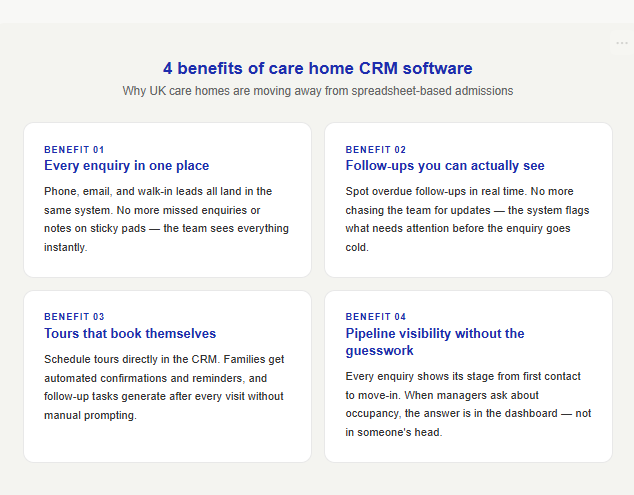
Every lead — by phone, email, website, or walk-in — lands in one place. Because of this, every team member can see the current status, who last spoke to the family, and what needs to happen next. That alone removes a lot of the confusion that slows admissions down.
Automated Lead Capture
Centrim Life’s CRM module includes embeddable enquiry forms for care home websites. When a family submits a form, the system pulls the enquiry in directly — no manual entry, no delay. The CRM then routes it to the right team member based on enquiry type or availability and sends a real-time notification. Response times drop. Fewer enquiries slip through.
Tour Scheduling and Follow-Up
The CRM handles tour bookings directly, allocating them to staff and sending automated confirmations and reminders to families. After each visit, the system generates follow-up tasks automatically. In other words, the pipeline keeps moving without relying on someone remembering to make a call.
A Full Communication Record
The system logs every call, email, and face-to-face meeting in one place. When a family calls back, whoever picks up can see the full history. Families notice when a home already knows their situation. They also notice when it does not.
Pipeline Visibility and Reporting
The visual pipeline shows every active enquiry and where it sits — from first contact through to proposal and move-in. In addition, real-time reports cover enquiry volumes by channel, conversion rates at each stage, and current occupancy. If something is slipping, it shows in the data before it shows in the bed count.
