How Carbide Shank Design Improves Thread Milling Stability
Author : Surya makeyoueasy | Published On : 16 Sep 2026
Introduction
Thread milling requires accurate tool movement because the cutter must follow a controlled helical path while maintaining the correct thread diameter, pitch, and profile. When the cutter has a long projection or machines difficult materials, even small amounts of tool deflection and vibration can affect thread accuracy. A carbide shank provides greater rigidity than a comparable steel shank, helping reduce bending and vibration during cutting. This can improve machining stability, thread quality, tool life, and repeatability, particularly in long-overhang and demanding CNC thread milling applications. Sandvik specifically recommends solid carbide shanks where lower deflection, longer overhang, and reduced vibration are required.
What Is a Carbide Shank in Thread Milling?
The shank is the section of the thread milling tool that connects the cutting portion to the machine tool holder.
Depending on the thread milling system, the shank may be manufactured from:
-
Steel
-
Solid carbide
-
Carbide with a replaceable cutting head
-
Modular combinations of steel and carbide components
In indexable thread milling systems, the cutting insert may be replaceable, while the supporting shank determines much of the tool’s overall rigidity.
For solid thread mills, the entire cutter and shank may be manufactured from carbide. VARGUS, for example, highlights high rigidity and minimal runout as benefits of its solid-carbide thread milling range.
Why Thread Milling Stability Matters
Thread milling creates threads through synchronized cutter rotation and CNC helical interpolation.
During the cutting cycle, radial and tangential forces act on the tool. If the tool bends under these forces, the actual cutting-edge position can move away from the programmed position.
Tool deflection can contribute to:
-
Incorrect thread diameter
-
Poor thread profile
-
Chatter marks
-
Uneven surface finish
-
Reduced insert life
-
Dimensional variation
-
Difficulty maintaining thread tolerance
Seco explains that tool deflection occurs when machining forces cause the cutter to bend, and excessive deflection can reduce dimensional accuracy, surface quality, and cutting-edge life.
1. Carbide Shanks Reduce Tool Deflection
One of the main reasons to use a carbide shank is greater stiffness.
A stiffer shank resists bending when the cutting edge encounters machining forces.
Sandvik’s thread milling guidance distinguishes between steel and carbide shanks:

Sandvik specifically states that solid carbide shanks provide lower deflection and minimized vibration, making them useful where increased tool projection is required.
2. Better Stability with Long Tool Overhang
Tool overhang has a major effect on milling stability.
As the distance between the cutting edge and toolholder increases, the cutter becomes more sensitive to cutting forces.
Long-reach thread milling may be required for:
-
Deep internal threads
-
Components with recessed features
-
Deep bores
-
Large housings
-
Parts where fixture clearance limits tool access
Seco notes that extended tooling increases the effects of dynamic machining forces and can cause radial deflection, bending, vibration, poor surface quality, and reduced precision.
A carbide shank can therefore be especially valuable when the thread cannot be reached with a short tool assembly.
3. Reduced Vibration and Chatter
Deflection and vibration are closely connected.
When the tool repeatedly bends and recovers during milling, unstable vibration can develop. This may appear as chatter marks on the machined thread.
Carbide shank rigidity helps reduce this unwanted movement.
More stable cutting can contribute to:
Improved Thread Surface: Less vibration helps the cutting edge follow the intended path.
Consistent Insert Loading: Reduced movement prevents sudden changes in cutting load.
Longer Tool Life: Lower vibration can reduce irregular edge wear and chipping.
Improved Process Reliability: Stable cutting makes machining results more predictable.
Seco recommends minimizing tool overhang and maximizing tooling-system rigidity as key methods for controlling milling vibration.
4. Improved Thread Diameter Control
Thread milling allows the finished thread diameter to be adjusted through CNC cutter compensation.
However, compensation works best when the actual cutting edge behaves predictably.
If the cutter deflects substantially under load, the programmed path and actual machined path may differ.
A rigid carbide shank can help maintain a more consistent cutter position, improving the ability to control:
-
Pitch diameter
-
Minor or major diameter
-
Thread fit
-
Thread consistency
-
Dimensional repeatability
The final thread must still be verified using the appropriate thread gauge or inspection method.
5. Better Results in Difficult Materials
Thread milling tougher materials may generate higher cutting forces.
Applications can include:
-
Alloy steel
-
Stainless steel
-
Hardened steel
-
Titanium alloys
-
Heat-resistant alloys
Greater cutting resistance increases the importance of tool rigidity.
VARGUS highlights high rigidity as one of the advantages of its solid-carbide thread milling tools and offers designs for demanding materials, including hardened applications.
Carbide does not eliminate the need for the correct insert, coating, speed, or feed, but it provides a more stable foundation for the cutting process.
6. Reduced Runout Helps Thread Quality
Runout causes the cutting edges to rotate slightly away from the true spindle centerline.
Excessive runout can cause:
-
Uneven tooth loading
-
Irregular tool wear
-
Oversized or inconsistent threads
-
Poor surface quality
-
Reduced tool life
A precision carbide shank combined with a suitable high-quality toolholder can help maintain low runout.
VARGUS lists minimal runout and compatibility with hydraulic and shrink-fit clamping among the features of its solid-carbide thread milling tools.
However, good shank accuracy cannot compensate for a dirty spindle taper, damaged collet, worn holder, or improper clamping.
7. Carbide Shank vs Steel Shank
Both materials have useful applications.
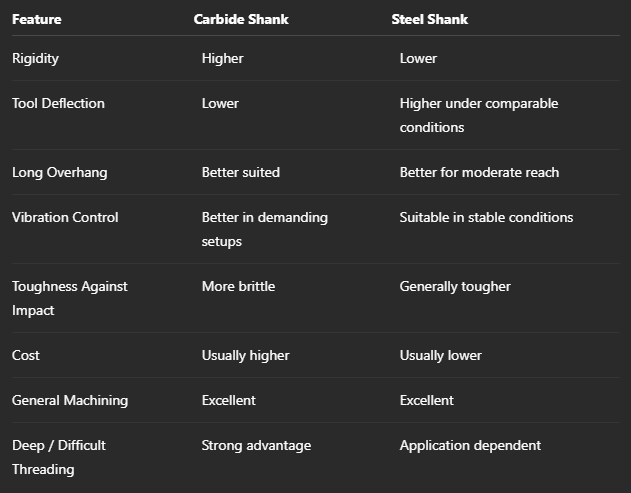
A carbide shank is therefore not automatically required for every thread milling operation.
For short, rigid setups with moderate cutting forces, a steel shank may perform very well.
Carbide becomes especially attractive when rigidity becomes the limiting factor.
8. Keep the Tool Projection Short
A carbide shank improves rigidity, but tool geometry still follows the laws of physics.
Do not use unnecessary projection simply because the shank is carbide.
Use the shortest practical overhang that provides sufficient access to the thread.
Seco recommends minimizing cutter overhang when addressing tool deflection and vibration in milling.
Short projection plus a carbide shank creates a much stronger combination than relying on material stiffness alone.
9. Choose the Correct Toolholder
The connection between the carbide shank and spindle is equally important.
Depending on the tool design, suitable clamping systems may include:
-
Hydraulic holders
-
Shrink-fit holders
-
Precision collet chucks
-
Weldon-style holders
-
Manufacturer-specific modular systems
A rigid shank held poorly is still a weak system.
For precision thread milling, check:
-
Toolholder runout
-
Shank diameter
-
Clamping length
-
Holder condition
-
Spindle taper cleanliness
-
Recommended tightening procedure
The goal is to create one rigid structure from the spindle to the cutting edge.
10. Optimize Cutting Conditions
Carbide shank rigidity should work together with correct machining parameters.
Choose cutting speed and feed according to:
-
Workpiece material
-
Cutter diameter
-
Insert or cutter grade
-
Thread depth
-
Thread pitch
-
Tool projection
-
Machine rigidity
When vibration occurs, simply slowing everything down is not always the best solution. Toolholding, overhang, engagement, cutting geometry, and spindle-speed stability should all be evaluated.
When Should You Choose a Carbide Shank?
A carbide shank is particularly useful when the application involves long tool projection, deep internal threads, small-diameter cutters, difficult materials, tight thread tolerances, recurring vibration, poor surface finish caused by deflection, or applications where consistent repeatability is critical.
For stable, short-reach general machining, a steel shank may remain the more economical option.
How to Improve Thread Milling Stability
For a stable CNC thread milling process:
-
Use the shortest possible tool projection.
-
Choose a carbide shank when deflection is a concern.
-
Use a rigid precision toolholder.
-
Minimize spindle and holder runout.
-
Match the insert or cutter to the thread specification.
-
Use suitable cutting speed and feed.
-
Maintain proper chip evacuation.
-
Check the cutter for wear.
-
Use appropriate coolant where required.
-
Inspect the finished thread regularly.
The carbide shank is the backbone of the cutting system. Give that backbone excessive reach, poor clamping, and bad parameters, and even carbide starts having a difficult Monday.
Why Choose MakeYouEasy?
At MakeYouEasy, you can explore CNC threading and machining tools for different industrial applications.
Relevant tooling categories include thread milling cutters, thread milling inserts, carbide-shank thread milling tools, indexable thread mills, threading inserts, tool holders, boring tools, milling cutters, and other CNC tooling accessories.
Before selecting a thread milling system, verify the shank material, shank diameter, cutter length, thread range, insert compatibility, workpiece material, and machine setup.
Conclusion
A carbide shank improves thread milling stability primarily by increasing tool rigidity and reducing deflection. This becomes especially valuable with long overhangs, deep threads, demanding materials, and precision applications where small cutter movements can affect thread size and surface quality.
Compared with a conventional steel shank, a carbide design can provide lower deflection, reduced vibration, improved thread consistency, better dimensional control, and more stable cutting under demanding conditions.
The best results come from combining the carbide shank with minimum overhang, low runout, rigid toolholding, correct cutting parameters, suitable thread milling geometry, and proper thread inspection.
Frequently Asked Questions
1. Why is carbide used for thread mill shanks?
Carbide provides high rigidity, helping reduce tool deflection and vibration during thread milling.
2. Is a carbide shank better than a steel shank?
Carbide is preferable when rigidity, long overhang, or vibration control is critical, while steel is suitable for many stable general-machining applications.
3. Does a carbide shank improve thread accuracy?
Reduced deflection can help the cutter follow its programmed path more consistently, supporting better dimensional control.
4. Can a carbide shank eliminate thread milling chatter?
It can reduce vibration risk, but tool overhang, holder rigidity, cutting parameters, runout, and machine stability must also be controlled.
5. When should I use a carbide-shank thread mill?
Consider one for long-reach machining, deep internal threads, tight tolerances, difficult materials, or applications suffering from tool deflection.
