How Appraisal Management Companies Reduce Collateral Risk for Mortgage Lenders
Author : Rex Gosource | Published On : 17 Jun 2026
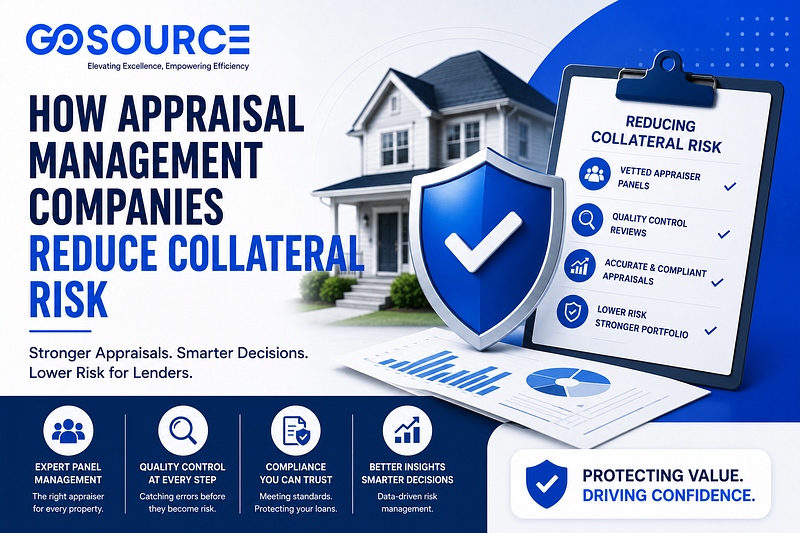
Every mortgage loan rests on one foundational assumption: the collateral is worth what the borrower says it is worth. When that assumption breaks down, lenders absorb losses that can spiral into portfolio-wide exposure. Appraisal management companies exist precisely to stress-test that assumption at scale, and the best ones do it through a combination of structured vendor oversight, quality control protocols, and technology that most in-house appraisal departments simply cannot replicate.
This blog breaks down exactly how a well-run AMC functions as a collateral risk management engine, why that matters for lenders navigating a complex lending environment in 2026, and what features to look for in an AMC partner before you sign a contract.
The Core Risk Problem AMCs Solve
Collateral risk in mortgage lending has two primary drivers: inaccurate property valuations and appraiser bias, whether conscious or unconscious. Both are exacerbated when lenders manage appraisers directly, because proximity creates pressure. A loan officer who has a financial stake in a deal closing at a certain value has obvious incentives, even unconsciously, to steer the appraisal toward that outcome.
The Dodd-Frank Act and the Appraisal Independence Requirements (AIR) codified were designed to sever that link. AMCs operate as a compliant buffer between the lender’s production side and the appraiser. By inserting an independent intermediary into the ordering and review process, the regulation removed a structural conflict of interest that contributed to inflated appraisals in the run-up to the 2008 crisis.
But compliance with AIR is just the floor. A sophisticated AMC does far more than route orders and collect reports.
Appraiser Panel Management as a Risk Control
The most consequential risk management function an AMC performs is one borrower never sees: the ongoing vetting, monitoring, and scoring of the appraiser panel. Not every licensed appraiser produces reliable work in every market. Geographic competency, product type experience, and individual quality metrics vary dramatically, and a lender relying on a poorly curated panel is exposed to valuation variance that creates real downstream risk.
Effective AMCs deploy appraiser scorecards that track performance across dozens of variables: revision rates, UAD compliance accuracy, turn time adherence, geographic market activity, comparable selection quality, and complaint history. Appraisers who consistently underperform on these metrics are rotated off high-risk assignments or removed from the panel entirely. Those who excel complex properties in specific markets are flagged for priority routing.
This panel’s intelligence function is one of the clearest areas where AMC management outperforms in-house direct ordering. A regional bank with twenty loan officers cannot practically maintain scorecard infrastructure across a statewide appraiser network. A national AMC maintains infrastructure across fifty states.
Quality Control: Where AMCs Catch What Lenders Miss
Beyond panel management, AMC quality control reviews function as a second layer of scrutiny before a report reaches underwriting. QC reviewers, typically certified appraisers or licensed appraisal reviewers, examine submitted reports against USPAP standards, UAD formatting requirements, and the specific collateral guidelines of the lender’s investor (Fannie Mae, Freddie Mac, FHA, etc.).
The most common defect categories caught at this stage include inadequate comparable selection, unsupported adjustments, missing required certifications, and UAD field errors that would trigger investor rejection downstream.
Catching these defects at the AMC QC stage is vastly less expensive than catching them at investor delivery, post-closing audit, or loan repurchase demand. A lender who receives a clean, compliant report from an AMC QC process has already had an additional layer of risk removed from the file.
Technology Infrastructure and LOS Integration
Modern AMCs operate on platforms that integrate directly with a lender Loan Origination System, creating a seamless appraisal ordering and tracking workflow. This integration eliminates manual order entry errors, provides real-time status visibility to processors and underwriters, and creates an auditable electronic trail of every action taken on an appraisal file from order placement through delivery and QC sign-off.
This audit trail matters more than most lenders appreciate. In the event of a repurchase demand or regulatory examination, the ability to demonstrate that appraisal ordering followed by a documented, AIR-compliant process is a meaningful defense. An AMC that maintains timestamped records of every communication, appraiser assignment, reviewer action, and delivery step gives a lender documentation infrastructure that manual in-house processes rarely produce.
Reconsideration of Value Management
One of the most challenging appraisal-adjacent risks lenders face is the reconsideration of value (ROV) process. When a borrower or lender believes an appraisal has missed relevant comparable data, a formal ROV request must be submitted to the appraiser through compliant channels. Managing that process, ensuring ROV requests contain proper supporting data, are submitted without undue pressure on the appraiser, and are documented correctly, is a compliance risk.
AMCs with structured ROV workflows take this burden off the lender’s operational team. They route submissions, verify that supporting comparables meet agency guidelines, and maintain documentation that demonstrates the ROV process did not compromise appraiser independence.
Choosing an AMC That Actually Manages Risk
Not every AMC offers the same depth of risk management capability. Lenders evaluating AMC partners should probe the following areas specifically:
Panel size vs. panel quality. A large panel number means nothing without evidence of active performance monitoring and pruning. Ask what percentage of panel appraisers have been removed in the past 12 months due to performance.
QC staffing and credentials. Find out whether QC reviewers are licensed or certified appraisers, how many files each reviewer handles per day, and what the revision request rate looks like across the panel.
Technology stack and LOS integration. Verify that the AMC platform integrates with your specific LOS and ask for a demonstration of the audit trail and reporting dashboard before signing.
State licensing. AMCs must be licensed in most states. Confirm that your AMC partner holds active licenses in every market where you originate from loans.
UAD 3.6 readiness. With the GSEs’ transition to UAD 3.6 underway in 2026, an AMC’s ability to support the new data requirements is now a direct operational concern. Ask specifically about their UAD 3.6 preparation and appraiser panel training.
Frequently Asked Questions
Q1: What is the primary role of an appraisal management company in the mortgage process?
An AMC serves as an independent intermediary between the lender and the appraiser. Its core function is to ensure that the appraisal ordering process remains free from lender influence, which is required under the Appraisal Independence Requirements established by Dodd-Frank. Beyond that compliance role, a full-service AMC also manages appraiser panel quality, conducts QC reviews on submitted reports, and provides technology infrastructure for order management and documentation.
Q2: How does an AMC reduce collateral risk?
AMCs reduce collateral risk through three primary mechanisms: first, by removing lender influence from the appraiser selection and communication process; second, by actively monitoring and scoring appraiser performance to ensure only qualified, competent appraisers receive assignments; and third, by conducting quality control reviews on submitted reports before they reach underwriting, catching defects that could lead to investor rejection, repurchase demands, or regulatory findings.
Q3: Is using an AMC required by law?
Lenders are not universally required by law to use an AMC for every appraisal. However, the Appraisal Independence Requirements under Dodd-Frank require that appraisers be kept independent from the lender’s production side. Using an AMC is the most common and practical way to demonstrate that independence. Additionally, some loan programs and investors may have their own requirements around appraisal management that effectively necessitate AMC involvement.
Q4: What should a lender look for when selecting an AMC partner?
The most important factors to evaluate are appraiser panel quality and monitoring practices, QC infrastructure and reviewer credentials, technology platform capabilities including LOS integration, state licensing coverage for all markets where the lender originates, and UAD 3.6 readiness. Volume and pricing matter, but they should not be evaluated in isolation from quality and risk management depth.
Q5: How does an AMC handle reconsideration of value requests?
A properly structured AMC manages ROV requests by accepting the submission from the lender, verifying that any supporting comparable data meets agency guidelines, routing the request to the appraiser through compliant channels, and documenting the entire process to demonstrate that appraiser independence was maintained throughout. The AMC does not advocate for a specific value outcome; it facilitates a compliant review process.
Q6: What is the difference between a desk review and a field review in AMC QC?
A desk review is conducted by a QC reviewer using the submitted report and available market data without an in-person property inspection. A field review involves the reviewer physically inspecting the subject property and comparable sales to assess the adequacy of the original appraisal. AMCs typically conduct desk reviews on all or a statistically sampled portion of submitted reports, reserving field reviews for high-value, complex, or flagged assignments.
Q7: How does LOS integration with an AMC platform benefit lender?
LOS integration eliminates manual order entry, provides real-time appraisal status visibility to loan processors and underwriters directly within their existing workflow system, and automatically routes completed reports back to the loan file without manual document handling. It also creates a timestamped, integrated audit trail that documents AIR compliance throughout the appraisal process, which is valuable in regulatory examinations and investor audits.
Q8: What does UAD 3.6 compliance mean for AMC operations?
UAD 3.6 is the updated Uniform Appraisal Dataset standard that the GSEs are rolling out through 2026 and beyond. It introduces structured data fields and MISMO schema requirements that require appraisers to report property data in a standardized, machine-readable format. For AMCs, this means ensuring their QC reviewers are trained to identify UAD 3.6 errors in submitted reports, and that their panel appraisers have received adequate training on the new requirements to avoid investor delivery failures.
The Bottom Line
Mortgage lenders who treat AMC selection as a commodity procurement decision are leaving significant risk management value on the table. The right AMC partner functions less like a vendor and more like an extension of the lender’s risk management infrastructure one that brings appraiser intelligence, QC depth, technology integration, and compliance documentation that most in-house teams cannot match on their own.
Go Source Valuation supports lenders and AMCs with advanced appraisal management solutions designed to strengthen quality control, streamline workflows, and reduce collateral risk from order to delivery. Learn more about our appraisal management software →
