High Gain ATC Antenna: Planning Ground to Air Coverage
Author : Gurleen Nayar | Published On : 23 Nov 2026
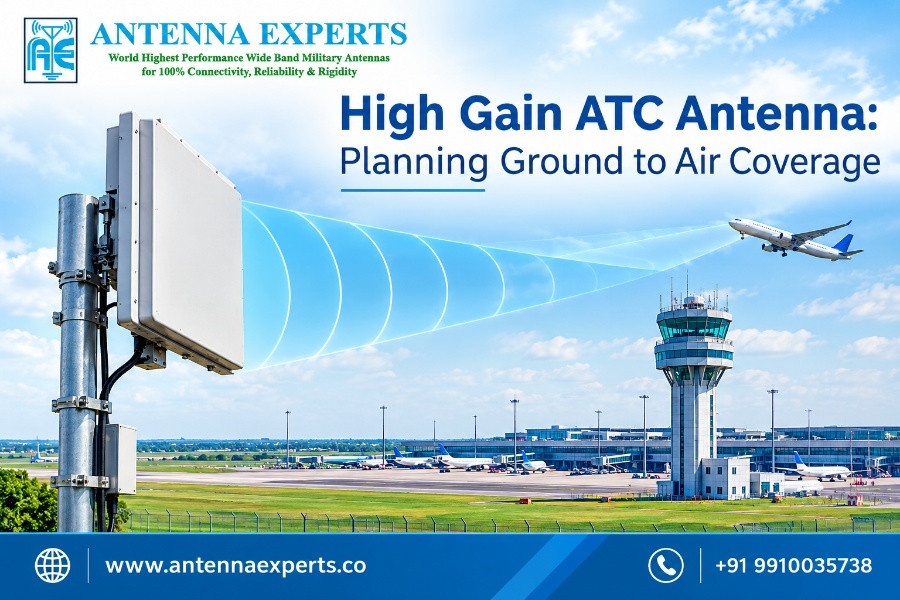
The tower must be heard by the pilot on approach and the pilot must be heard by the tower. The exchange is as dependent on the radio as it is on the antenna. It is common to choose a high gain ATC antenna before mapping the area that it will cover, leading to a strong signal in the wrong places.
Planning begins with the channels in use, the directions to be covered and the height available on the mast. A High gain ATC antenna only works if all three are matched to the site and each is worth a check before putting any model on the short list.
What Is a High Gain ATC Antenna Used For?
A high gain ATC antenna, mounted as a Control Tower antenna, carries voice traffic to and from aircraft, typically in the 118 to 137 MHz air band used for civil VHF communication. The performance of the antenna reaching the pilot depends on the radio, cable and the mounting surrounding it.
First are frequency matches. The AC5-127 is showing in our product list for 118 to 137 MHz. The AY-128 is showing in our product list for 117 to 137 MHz. That difference matters if you have a channel at the band edge, so compare the datasheet range to your assigned channels.
How Does Antenna Gain Affect Ground-to-Air Coverage?
Gain is a measure of how much more strongly an antenna focuses energy in some directions compared to a reference. And given in dBi (relative to an ideal point source) or dBd (relative to a dipole). It doesn't give you any power. It changes the pattern.
Higher gain generally means a narrower beam in height. This means more energy is sent toward the horizon, less up or down. That's good for a long, flat path of coverage. That can mean planes flying high and close to the tower with weaker signals. Directional designs also involve a tradeoff of favouring one sector at the expense of the others.
In our listing you can see the spread: AC-118-137 omni is 2.15 dBi, AC5-127 is 5 dBi, AY-128 is 11 dBi and AQY-128 is 17.5 dBi. The pattern that an any ground to air antenna gives on site should be the first judge. The gain figure should be second.
What Should Be Considered When Planning ATC Antenna Coverage?
Settle these points before purchase.
- Frequency compatibility: Listed ranges vary from air band only to combined VHF and UHF. Match the range to the channels actually in use.
- Antenna gain: Choose a gain and radiation pattern appropriate to the area served. Verify that the beam still covers aircraft near the tower.
- Mast height: VHF signals travel in a nearly straight path, so practical reach is more dependent on mast height and line of sight than on the gain figure.
- Omni coverage: Determine if omni coverage around the tower is necessary. If traffic is coming only from certain sectors, a directional antenna may do better.
- Multi channel operation: With multi channel sites and spacing radios close together can cause disturbance to each other. Location and spacing should be determined by site review and manufacturer recommendations rather than a hard and fast rule.
- Weather protection: The antenna is outdoors for years, so check radome and weather protection for sun, rain, wind and, where relevant, ice.
Why Does Installation Planning Matter for a VHF Air Band Antenna?
Even a good VHF air band antenna can perform poorly if it is in the wrong place. Generally the best view is from the highest clear point. Railings and other masts and roof structures near the antenna will distort its pattern.
Cable routing should be given the same attention. A long coax run before the antenna loses some of the signal too. Over time moisture can find its way into connectors that don’t seal well. The run can be short and connections protected at little cost on installation.
Airports also have other antenna systems. The ILS antenna provides landing guidance. This is a different function than voice links. However, ILS and voice antennas can be on the same structure or in the same space. In his layout decisions one should consider the other.
Why Consider Antenna Experts for ATC Antenna Requirements?
Antenna Experts is the best antenna manufacturers in India, and we publish individual datasheets & manuals for each model in our ATC antenna range. The ATC range includes VHF & UHF options in omni & directional forms. Technical teams can check the numbers before they ask.
For sites requiring more vertical coverage over a long narrow area, we offer the AY and AQY series as base station options and can build configurations that control beamwidth in the plane required. Custom made antennas and an inquiry option. We also have masts, coaxial cable and connectors, so mounting and cabling issues can be discussed with the same team.
Conclusion
When choosing a high gain ATC antenna, frequency range, gain, radiation pattern, mounting height and site conditions must be considered in conjunction. You can't just look at a high number on a data sheet and have it mean anything until you match it up to the channels. Obstructions around the tower and the coverage area. Next, the antenna durability over time is determined by weather exposure and multi-channel layout.
If you're comparing models, the Antenna Experts team can go over the datasheets and your site requirements with you before you decide.
Company: - Antenna Experts
User: - Gurleen Nayar
Email: - [email protected]
Mobile: - 9810205738
URL: - https://www.antennaexperts.co
