Hair Transplant in Bangalore: A Complete Guide to the Procedure, Perks, and Recovery
Author : Dr Haror Wellness | Published On : 30 Jul 2026
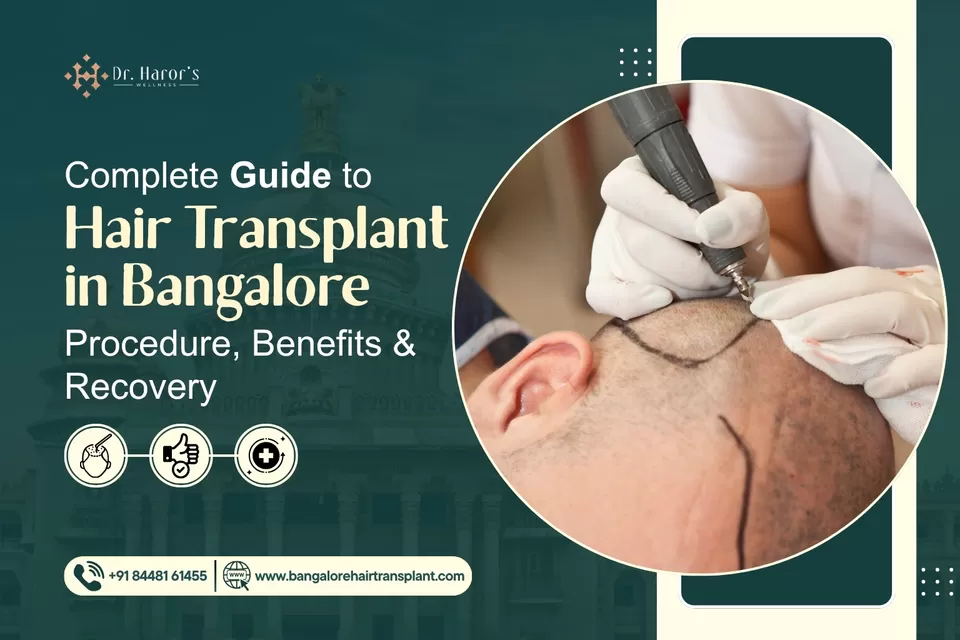
Losing hair takes a toll on more than just your reflection. Studies show that nearly 8 in 10 people dealing with serious hair loss admit it affects how they feel at work, in social settings, and even in their closest relationships. That's exactly why so many people are now turning to hair transplant surgery — a surgical fix that offers a lasting solution to pattern baldness, giving back natural, thick-looking hair.
In recent years, hair transplant in Bangalore has seen a real surge in demand. It makes sense when you think about it: Bangalore is home to a huge population of IT professionals and entrepreneurs, and in a city built on first impressions and competitive careers, how you look can genuinely matter. If you're weighing up whether to go through with the procedure, this guide walks you through what actually happens, what you stand to gain, and how long recovery really takes.
So, What Exactly Is a Hair Transplant?
At its core, a hair transplant is a minimally invasive procedure where a surgeon takes healthy hair follicles from one part of your scalp (usually the back or sides — known as the donor area) and moves them to the thinning or bald patches (the recipient area). Done right, by a skilled and experienced surgeon, it's a safe procedure that delivers far more natural, lasting results than creams, tablets, or other non-surgical routes.
The reason transplanted hair keeps growing normally is simple biology: the follicles are pulled from areas of the scalp that are naturally resistant to DHT, the hormone responsible for hair thinning in the first place.
There's more than one way to do this. FUT (Follicular Unit Transplantation) is the older, strip-based technique — effective, but it leaves a thin linear scar. FUE (Follicular Unit Extraction) has largely taken over because follicles are removed individually, leaving barely visible dot scars instead. Beyond these, Bangalore clinics now also offer newer methods like DHT (Direct Hair Transplant), URHT (Ultra Receptive Hair Transplant), and Sapphire FUE, all of which aim for more precision, less discomfort, and quicker healing.
Who Actually Qualifies for the Procedure?
Not everyone is a good fit for a hair transplant, even if the results look appealing on paper. Before booking a consultation for the best hair transplant in Bangalore, it helps to know whether you check these boxes:
1.You're at least 25 years old
2. You're dealing with pattern baldness
3. Your hair loss has more or less stabilized
4. You have a healthy, sufficient donor area
5. You don't have underlying medical conditions that rule out surgery
6. You're in generally good health
7. You go in with realistic expectations about the outcome
Why People Choose Hair Transplant Surgery
The appeal isn't just cosmetic — though that's a big part of it. Here's what draws most patients in:
1) A permanent fix for hair loss, not a temporary patch
2) Fuller, denser-looking hair that blends naturally
3) A real boost in confidence and self-image
4) Better day-to-day quality of life
5) A safe, minimally invasive procedure with proven track records
6) Long-term cost savings compared to years of creams, serums, and other treatments
How the Best Hair Transplant in Bangalore Actually Works, Step by Step
A good hair transplant clinic won't rush you into surgery. The process is deliberate, planned out in stages, and it helps to know what each stage involves so you're not walking in blind.
Step 1: Initial Consultation Your surgeon starts by examining your hair loss pattern, checking your donor area, assessing your scalp, and going over your medical history. From there, they'll put together a treatment plan built around your specific needs.
Step 2: Hairline Design This part is more art than science. The surgeon maps out a hairline that suits your face shape, age, and how your hair loss is likely to progress — all so the results look believable years down the line, not just on day one.
Step 3: Donor Hair Extraction Depending on the technique you and your surgeon agreed on, healthy follicles are carefully removed from the donor area, usually the back or sides of the head. Precision here matters — the follicles need to stay viable for transplantation.
Step 4: Graft Preparation Once extracted, the grafts are sorted, examined, and kept in a special preservation solution. This step quietly plays a huge role in how well the transplant takes — sloppy graft handling can hurt survival rates.
Step 5: Recipient Site Creation Tiny incisions are made across the balding areas, with careful attention paid to angle, direction, and density. This is where a surgeon's skill really shows — it's what makes the final result look like hair that grew there naturally.
Step 6: Graft Implantation The prepared grafts are placed into these recipient sites one by one, with an eye on even distribution and natural-looking density.
Step 7: Post-Procedure Care Once it's done, you'll get clear aftercare instructions, any necessary medication, and a follow-up schedule. Sticking to this part matters just as much as the surgery itself for a smooth recovery.
What Recovery Looks Like After a Hair Transplant in Bangalore
Choosing the right clinic is only half the equation — knowing what to expect afterward makes the whole journey a lot less stressful.
|
Recovery Stage |
What Happens |
|
Day 1–3 |
Some swelling, redness, and mild discomfort are normal. Avoid touching the treated area and follow your surgeon's instructions closely. |
|
Week 1 |
Small scabs form and start to flake off on their own. Most people can get back to light daily routines, though strenuous workouts are still off-limits. |
|
Weeks 2–4 |
Don't panic if you notice some shedding — this "shock loss" is a completely normal part of the healing process. |
|
Months 3–4 |
Fresh hair growth begins from the transplanted follicles. It may look thin at first but fills in gradually. |
|
Months 6–9 |
Hair gets noticeably thicker and denser. This is usually when people start seeing a real difference in their appearance. |
|
12–18 Months |
Final results settle in — natural, permanent hair growth, assuming aftercare instructions were followed properly. |
A hair transplant isn't an overnight fix, but for people tired of temporary solutions, it offers something far more durable: permanent, natural-looking hair when the procedure is handled by an experienced team. Knowing the process, the benefits, and the realistic timeline puts you in a much better position to make the right call. If you're exploring options for the best hair transplant in Bangalore, look for a clinic that combines modern techniques, tailored treatment plans, and a genuine focus on patient safety — because the outcome depends just as much on the surgeon's skill and your aftercare as it does on the procedure itself.
