Gen AI and Agentic AI Certification Syllabus in Electronic City Bangalore: 2026 Curriculum Breakdown
Author : eMexo Technologies | Published On : 08 Aug 2026
When the Centre for Development of Telematics issued a formal tender for offline AI training in July 2026, the syllabus requirements were remarkably specific. Technical professionals needed coverage of Generative AI, Agentic AI, Retrieval-Augmented Generation, vector databases, embeddings, and AI security.
That specificity signals something important: employers and certifying bodies are no longer satisfied with vague "AI training." They want granular, verifiable coverage of specific technical components. For professionals researching a Gen AI and Agentic AI certification syllabus in Electronic City Bangalore, the 2026 market demands a curriculum that moves from foundation to production-grade deployment.
The certification landscape is evolving rapidly. In June 2026, NVIDIA announced its Agentic AI LLMs Professional Certification, an intermediate-level credential validating the ability to architect, develop, deploy, and govern advanced agentic AI solutions. The exam covers multi-agent interaction, distributed reasoning, scalability, and ethical safeguards. Dell has also launched an Agentic AI Foundations Achievement certification, validating essential knowledge in Agentic AI concepts and real-world applications. These industry-backed certifications signal that Agentic AI skills are becoming formalized.
The Three-Layer Syllabus Framework
A comprehensive certification syllabus in 2026 is built on three distinct layers, each essential for job readiness.
Layer 1: Foundation & Data Engineering
The first layer equips learners to handle data pipelines, API integrations, and core Python for AI. Without this, advanced modules cannot be executed.
-
Python Essentials: Advanced concepts, data structures, object-oriented programming, and key libraries like NumPy and Pandas
-
Data Engineering: Building production-ready data pipelines, SQL backends, EDA, and feature engineering
-
ML & Deep Learning Fundamentals: Regression, boosting, CNNs, transformers, NLP, time-series forecasting, and model interpretation
VIT Bangalore's certification program includes a comprehensive Python primer and covers Pandas for data manipulation, Matplotlib and Seaborn for visualization, and essential machine learning algorithms including linear regression, logistic regression, decision trees, and k-Nearest Neighbors. The program requires foundational understanding of Python, coding, mathematics, and data science fundamentals.
Layer 2: Generative AI & RAG Systems
The second layer shifts focus to Generative AI mechanisms and, crucially, Retrieval-Augmented Generation—the technology that connects LLMs to proprietary enterprise data.
-
LLM Fundamentals & Prompt Engineering: Token, context, response control, prompt design, zero-shot and few-shot prompting, chain of thought, and structured evaluation pipelines
-
RAG Systems: End-to-end pipelines with embedding-based semantic search, vector databases (FAISS, Neo4j), chunking strategies, and context-aware Q&A over enterprise knowledge
-
Fine-Tuning & Customization: LoRA, transfer learning, model evaluation, and domain-specific fine-tuning
upGrad's AI Pro syllabus dedicates a full module to RAG systems, teaching learners to deploy RAG using embeddings and vector DBs, implement chunking and retrieval strategies, and troubleshoot hallucinations.
Layer 3: Agentic AI & Production Deployment
The third layer is the critical differentiator. Agentic AI is not a buzzword; it requires deep knowledge of building autonomous systems. Many courses labelled "Agentic AI" cover only the ReAct loop and call it done.
-
Agent Frameworks: LangChain, LlamaIndex, LangGraph, AutoGen, CrewAI—designing stateful workflows and multi-agent collaboration
-
Agent Architecture: Building SQL agents, tool-using agents, multi-agent systems, decision-making models, memory, planning, and reasoning
-
Production Deployment: API development, Docker, Kubernetes (K8s), cloud deployment, monitoring, and observability
-
Governance & Security: Responsible AI, data privacy, safety guardrails, and compliance frameworks
TechPratham's syllabus includes Kubernetes (K8s) deployment for LangGraph pipelines, covering pods, deployments, services, ConfigMaps, and Minikube setup for local testing. The program emphasizes end-to-end lifecycle with project testing and deployment, producing portfolio-ready real-world exposure.
Comparing Certification Syllabi from Leading Providers
NVIDIA Agentic AI Certification (Coming Soon, $200)
NVIDIA's certification exam blueprint covers six topic areas: Agent Design and Cognition (including reasoning, planning, memory, and multi-agent coordination), Knowledge Integration and Agent Development (retrieval pipelines, prompt engineering, multimodal agents), NVIDIA Platform Implementation and Deployment, Evaluation and Monitoring, and Human, Ethical, and Compliance Considerations. Candidates need 1-2 years of experience in AI/ML roles and hands-on work with production-level agentic AI projects.
upGrad AI Pro with IIIT Bangalore Certification (3 months)
This program covers Module 1 (Foundations of Applied GenAI), Module 2 (RAG Systems), Module 3 (Agentic AI & Autonomous Workflows), and Module 4 (System Architecture & Deployment). The capstone includes building an enterprise document intelligence platform, autonomous workflow automation agent, and AI assistant combining RAG with agent workflows.
TechPratham Advanced Generative AI and Agentic AI
TechPratham's syllabus includes Python for AI, LangChain, LangGraph, AutoGen, and multi-agent systems. It incorporates three enterprise projects: a Generative AI-Driven Customer Support Bot based on an Infosys use case, an Autonomous Document Intelligence & Compliance System based on a Wipro use case in Electronic City, and Agentic AI for Real-Time Data Analytics Automation based on a Flipkart use case. The program covers Kubernetes, Azure Cloud Deployment, and deployment of LangGraph in K8s.
Evarcity Agentic AI Training
Evarcity's curriculum covers Introduction to Agentic AI & Autonomous Systems, Agent Architecture & Decision-Making Models, Multi-Agent Systems & Collaboration, Tool-Using AI Agents and Workflow Automation, Memory, Planning, and Reasoning in AI Agents, Prompt Engineering for Agentic AI, Integration with APIs, Databases, and External Tools, and Deployment of AI Agents in Real-World Scenarios.
Certified Agentic AI System Architect
This certification syllabus is structured into five comprehensive modules: Foundations of Agentic AI, Designing Agentic AI Architectures, Tools and Frameworks (LangChain, AutoGen, CrewAI, NVIDIA NIM Blueprints), Deployment and Governance of Agentic AI Systems, and Advanced Applications and Future of Agentic AI. The certification exam consists of 60 multiple-choice questions completed in one hour.
eMexo Technologies (6 months, ₹30,000)
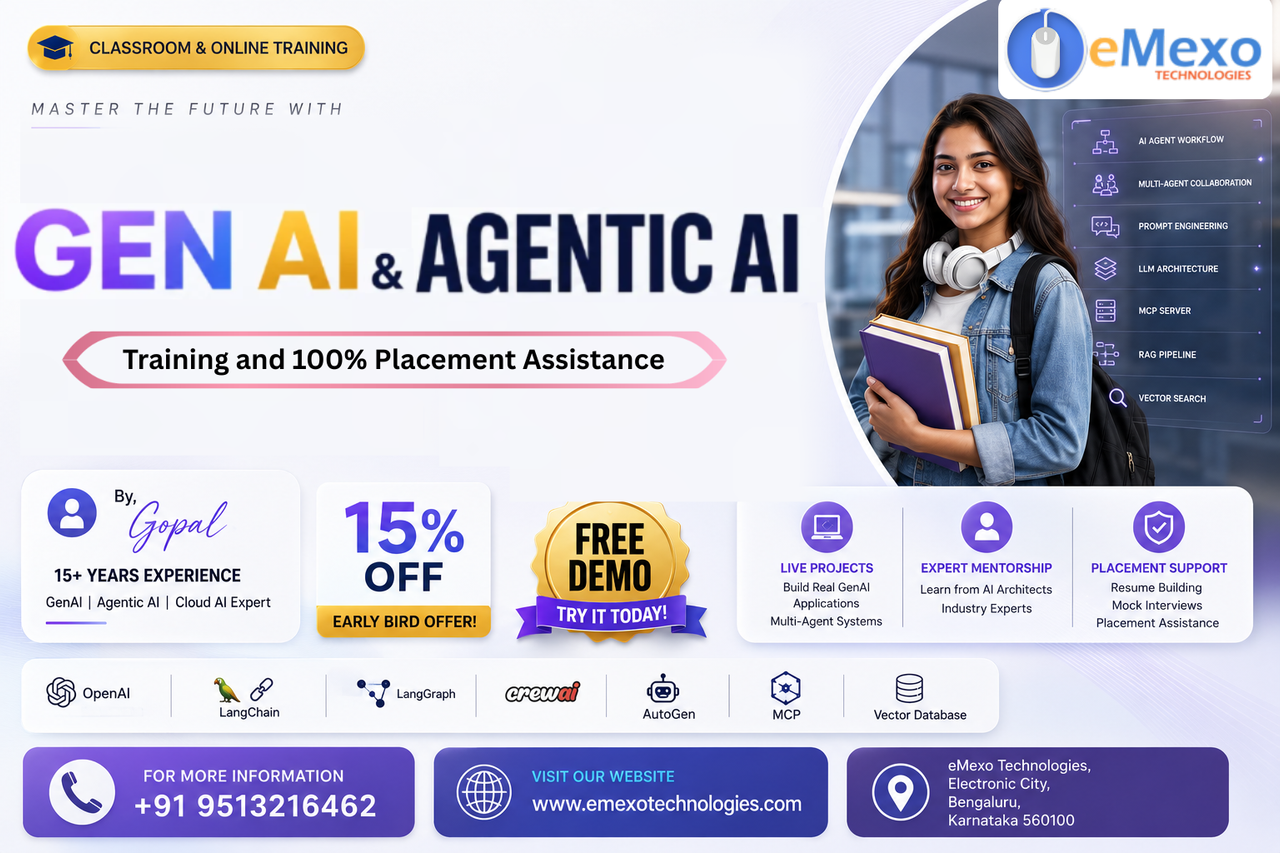
eMexo Technologies offers a 6-month classroom program in Electronic City Phase 1 covering Python and data science foundations, Generative AI (LLMs, RAG, fine-tuning), and Agentic AI (LangGraph, CrewAI, AutoGen, multi-agent systems). Placement support is included.
Counterpoint: Is Syllabus Breadth Enough?
A valid argument holds that a sprawling syllabus is meaningless without depth and practical application. A 10-page syllabus might cover "everything," but without enterprise-grade projects and deployment experience, it provides little value.
The distinction lies in project-based learning. Quality programs ensure every module is reinforced with hands-on projects. TechPratham includes three enterprise-grade projects based on Wipro, Infosys, and Flipkart use cases. upGrad's capstone includes building an enterprise document intelligence platform and an autonomous workflow automation agent. Evarcity includes real-world Agentic AI projects as part of their curriculum.
If a syllabus covers frameworks but doesn't include building deployable systems with them, the breadth is superficial. NVIDIA's certification requires hands-on work with production-level agentic AI projects as a prerequisite, not a recommendation.
📍 Location: eMexo Technologies, Electronic City, Bangalore
📞 Call Us: +91 9513216462
📧 Email: [email protected]
Explore Our Other Professional IT Courses in Electronic City
Java Full Stack Course in Electronic City | AI Course in Electronic City | Python Course in Electronic City | Gen and Agentic AI Course in Electronic City | Data Analytics Course in Electronic City | Data Science Course in Electronic City | Azure admin(AZ104) Course in Electronic City | Azure Devops Course in Electronic City | Selenium with Java Course in Electronic City | DevOps Course in Electronic City
Frequently Asked Questions
1. What should a comprehensive Gen AI and Agentic AI certification syllabus include in 2026?
A comprehensive syllabus should include three layers: Python/data engineering foundations, Generative AI (LLMs, RAG, fine-tuning), and Agentic AI (LangGraph, CrewAI, AutoGen, multi-agent systems). It should also cover production deployment, governance, and security.
2. What is included in NVIDIA's Agentic AI certification syllabus?
NVIDIA's certification covers Agent Design and Cognition, Knowledge Integration and Agent Development, NVIDIA Platform Implementation and Deployment, Evaluation and Monitoring, and Human, Ethical, and Compliance Considerations. The exam includes 60-70 questions over 120 minutes and costs $200.
3. How does eMexo Technologies' syllabus compare to other providers?
eMexo Technologies offers a 6-month program at ₹30,000 covering Python, Generative AI, and Agentic AI frameworks with placement support. Premium programs like upGrad with IIIT Bangalore certification (3 months) offer deeper capstone focus with enterprise document intelligence platforms.
4. What enterprise-grade projects should a good syllabus include?
Look for projects like autonomous document intelligence systems, customer support bots, and agentic AI for real-time data analytics. TechPratham includes Wipro, Infosys, and Flipkart-inspired use cases. upGrad includes an enterprise document intelligence platform and autonomous workflow automation agent.
5. What is the most important differentiator in a 2026 AI certification syllabus?
Agentic AI depth is the critical differentiator. A credible syllabus must include multi-agent systems, tool-using agents, memory, planning, and deployment—not just basic prompt engineering.
