FUT vs FUE Hair Transplant in Sydney: Which One Actually Suits You?
Author : Dr Harors Wellness | Published On : 10 Jul 2026
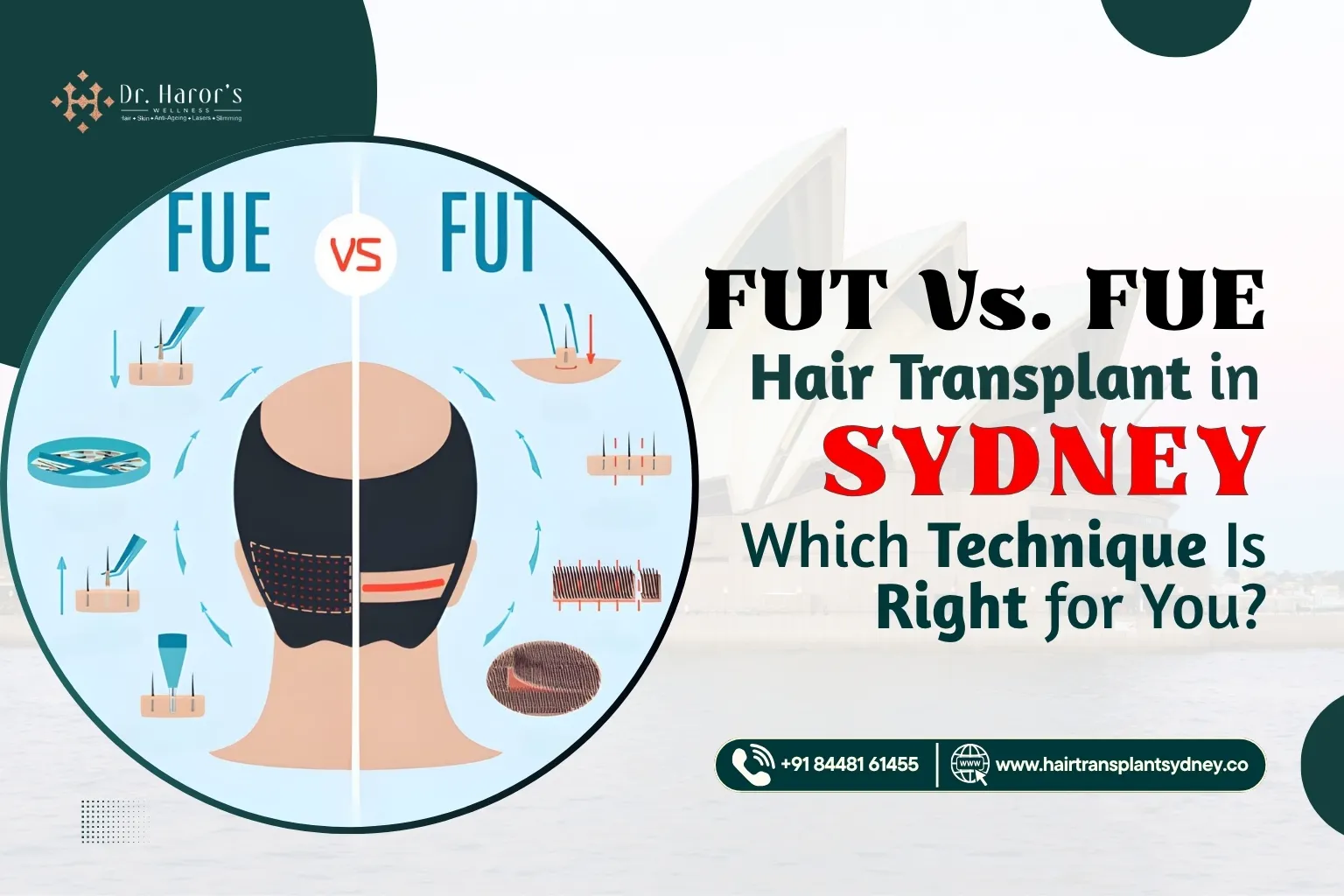
Losing hair does something to a person that's hard to put into words. You can wear the sharpest suit or the trendiest streetwear, and it won't matter much if you're constantly aware of a thinning patch or a receding line staring back at you in the mirror. Hair loss chips away at confidence quietly, and for a lot of people, it starts showing up in how they act at work, on dates, or even just at a casual catch-up with friends.
The good news? You've got options. Topical treatments, medications, and non-surgical fixes can slow things down, but they usually need to be kept up forever and the results are modest at best. If you want something that actually lasts, a hair transplant is still the gold standard. And in Sydney, two hair transplant techniques dominate the conversation: FUT (Follicular Unit Transplantation) and FUE (Follicular Unit Extraction).
Both get real, natural results. But they go about it in completely different ways — and picking the wrong one for your situation can mean a longer recovery, a scar you didn't expect, or paying more than you needed to. Here's a proper breakdown so you know exactly what you're walking into.
So What Actually Happens During a Hair Transplant?
At its core, a hair transplant moves healthy hair follicles from one part of your scalp to another. Surgeons take follicles from the back or sides of your head — an area called the donor site — and place them into thinning or bald patches, known as the recipient site.
Why the back and sides? Because that hair is naturally resistant to DHT, the hormone responsible for male and female pattern baldness. So once those follicles are relocated, they keep growing the same way they always would have, regardless of where they end up on your scalp. Done properly by a skilled surgeon, it's a safe procedure with results that hold up for life.
FUT: The Strip Method
FUT is the older, more established of the two hair transplant techniques. Surgeons remove a thin strip of scalp from the donor area, then divide it into individual grafts under a microscope before implanting them where needed.
The obvious downside is the scar. Because it's a linear incision closed with stitches, it leaves a thin line across the back of the head — one that's tough to hide if you like your hair cut short. There's also more discomfort during the procedure itself and a longer road to recovery afterward.
That said, FUT has one major advantage: surgeons can harvest a large number of grafts in one sitting. If you're dealing with significant hair loss and need serious coverage, this technique still holds real value.
FUE Hair Transplant in Sydney: The Modern Favourite
Ask most clinics in Sydney today which method patients request first, and FUE hair transplant comes out on top by a wide margin — and it's easy to see why.
Instead of removing a strip of scalp, the surgeon extracts individual follicles one at a time using a tiny punch tool, then implants them directly into the thinning areas. No scalpel, no stitches. What's left behind are small, dot-like marks that are barely noticeable, even if you shave your head down to the skin.
Because there's no cutting involved, recovery is noticeably quicker. Most patients are back to their normal routine within about 3 to 7 days, with the donor and recipient areas fully settled in roughly 7 to 14 days. The trade-off is time in the chair — extracting each follicle individually takes longer than removing a strip. You'll usually start noticing new growth around the 3 to 4 month mark, with full results visible by 10 to 12 months.
FUT vs FUE: The Side-by-Side Comparison
|
FUE (Follicular Unit Extraction) |
FUT (Follicular Unit Transplantation) |
|
Minimal pain during the procedure |
Slightly more uncomfortable |
|
Tiny, barely visible scarring |
Noticeable linear scar |
|
Faster recovery |
Longer downtime |
|
Great for short hairstyles |
Better if you keep hair longer |
|
Longer procedure time |
Quicker to perform |
|
Typically higher cost |
Generally more budget-friendly |
|
Ideal for smaller-to-moderate graft needs |
Better for high graft counts in one session |
Which Technique Should You Actually Go With?
There's no single right answer — it comes down to your hair loss pattern, how many grafts you need, the hairstyle you want to keep, and your budget.
Go with FUE hair transplant in Sydney if you:
-
Want scarring that's virtually invisible
-
Prefer a shorter, easier recovery
-
Like keeping your hair short or shaved
-
Would rather avoid an invasive procedure
FUT might suit you better if you:
-
Need a large number of grafts done in one session
-
Usually wear your hair longer
-
Are working with a tighter budget
Honestly, the smartest move is sitting down with a qualified surgeon who can actually look at your scalp, assess your donor supply, and map out what's realistic for your goals — rather than guessing based on a table online.
Frequently Asked Questions
-
Is FUE better than FUT?
Neither is universally "better" — FUE tends to win out for people who want minimal scarring and a faster recovery, while FUT can be the more practical, cost-effective choice for those needing a very high graft count.
-
How painful is a hair transplant?
Both procedures are done under local anaesthesia, so pain during the surgery itself is minimal. FUT tends to involve more post-procedure discomfort because of the incision and stitches.
-
How long until I see results from an FUE hair transplant in Sydney?
Early regrowth typically appears around 3 to 4 months post-procedure, with full, visible results developing over 10 to 12 months.
-
Does FUE leave any visible scarring?
It leaves small, dot-like marks at the extraction sites, which are generally undetectable once hair grows back — even at very short lengths.
The Bottom Line
Both FUT and FUE deliver real, lasting results when done right — the question is which one fits your life, your hairstyle habits, and how much downtime you can afford. If minimal scarring and a quicker bounce-back matter most to you, FUE is usually the clear winner. If you need maximum coverage in a single session and don't mind a longer recovery, FUT still has its place.
At Dr. Haror's Wellness, patients get a proper scalp assessment before any technique is recommended — not a one-size-fits-all pitch. Beyond standard FUT and FUE, the clinic also offers advanced options like Sapphire FUE, DHT, URHT, and Bio-FUE, each designed to improve comfort, precision, or results depending on your specific case. With a fully equipped facility, an experienced surgical team, and strict hygiene and safety protocols, they're built to deliver consistent, natural-looking outcomes.
If you're ready to explore your options, book a consultation with Dr. Haror's Wellness and get a plan built around your actual scalp — not a generic recommendation.
