From Laboratory Testing to Production: Making WS₂ Lubricant Formulations More Consistent
Author : Jade Chemicals | Published On : 23 Nov 2026
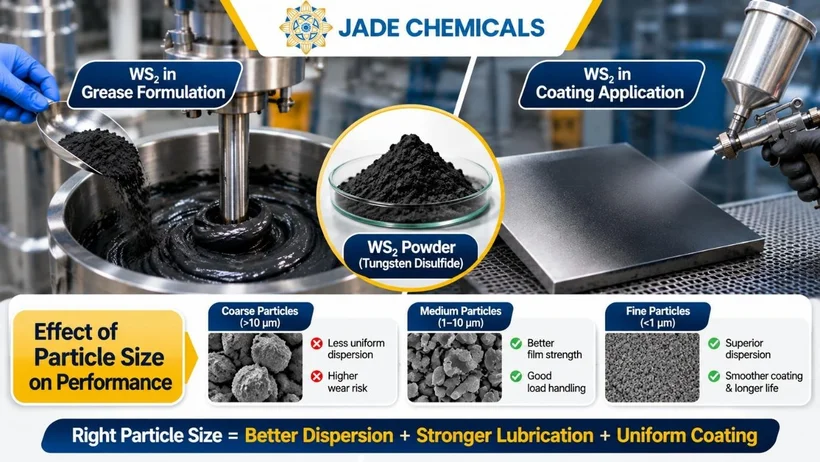
A lubricant formulation may perform well during a small laboratory trial but behave differently when the manufacturer produces a larger batch. This is a familiar challenge in industrial formulation work. The ingredients may remain the same, yet differences in mixing, processing time and equipment can influence the finished product.
When Tungsten Disulfide (WS₂) powder is included in the formulation, particle characteristics become an additional consideration. The powder must be incorporated into the selected material in a way that produces consistent results from one batch to another.
WS₂ is a layered solid lubricant used in specialised greases, coatings and other materials designed to manage friction and wear. Its usefulness depends on the complete formulation and how the powder is processed.
During a laboratory trial, manufacturers may use relatively small quantities of powder and carefully controlled mixing equipment. It can be easier to observe ingredient addition and make adjustments when processing a small sample.
Production equipment operates under different conditions. Mixing vessels may be larger, processing times may change and the way materials circulate through the equipment may differ.
These changes can influence the distribution of solid lubricant particles. A grade that disperses satisfactorily during laboratory testing may require changes to the mixing procedure before full-scale production.
Fine powders can introduce additional challenges because particles may form agglomerates. Increasing mixing intensity is not always the correct solution, particularly when other ingredients are sensitive to processing conditions.
For grease manufacturers, it is important to evaluate the effect of powder addition on the complete formulation. Grease consistency, mechanical stability and oil separation may be relevant depending on the intended application.
Coating manufacturers need to consider other characteristics, including film uniformity, adhesion and the behaviour of the material during application and drying.
A change in WS₂ particle size can influence these properties, but the results should be evaluated through suitable testing rather than assumptions.
One practical approach is to establish a reference formulation and compare powder grades while keeping other variables as consistent as possible. This allows development teams to identify whether observed differences are associated with particle characteristics or processing changes.
Material quality between purchases also deserves attention. Manufacturers may need consistent particle-size specifications, purity information and documentation when repeating a successful formulation.
Jade Chemicals supplies WS₂ powder for industrial lubricant and coating applications. Manufacturers looking for a Tungsten Disulfide (WS2) Powder supplier in India can discuss their particle-size requirements, intended formulation and expected operating conditions.
The company's article on how WS₂ powder particle size affects grease and coating formulations also explains why dispersion and practical testing are important during material selection.
Moving from laboratory development to regular production requires careful attention to repeatability. Manufacturers who document their mixing procedures, review material specifications and validate the finished product can make more informed decisions about the WS₂ powder grades used in their formulations.
