Fixed-Mount UHF RFID Readers Explained
Author : Jaming Wong | Published On : 26 Nov 2026
Fixed-mount UHF RFID readers are widely used in warehouses, manufacturing facilities, logistics centers, and automated identification systems. They allow businesses to identify tagged items without requiring an operator to scan each product manually.
Unlike handheld RFID devices, fixed readers are installed at specific locations and operate as part of a permanent identification system. They can monitor goods moving through a checkpoint, track materials on a production line, or identify assets stored inside a designated area.
However, installing a fixed UHF RFID reader involves more than choosing a device with a long reading distance. Antenna placement, tag selection, radio frequency settings, surrounding materials, and software integration all affect the final result.
Understanding these factors helps system integrators and equipment manufacturers select the right RFID hardware for their projects.
What Is a Fixed-Mount UHF RFID Reader?
A fixed-mount UHF RFID reader is a stationary device that communicates with UHF RFID tags through radio frequency signals. It is normally installed on a wall, mounting bracket, warehouse gate, production machine, or other fixed structure.
Most industrial UHF RFID systems use passive tags. These tags do not require an internal battery. Instead, they receive energy from the radio frequency field generated by the reader’s antenna and respond by transmitting their stored identification information.
UHF RFID commonly operates within the 860–960 MHz range, although the exact frequency band depends on regional regulations and equipment configuration. EPC Class 1 Gen 2 and ISO/IEC 18000-63 are widely used communication standards for passive UHF RFID systems. ifm+1
A fixed-mount reader is particularly useful when identification needs to happen repeatedly at the same location. Once installed and configured, it can collect tag information automatically without depending on employees to perform manual scans.
For example, a warehouse can install readers at loading doors. When tagged pallets pass through the reading area, the system identifies them and sends the collected information to warehouse management software.
How Fixed-Mount UHF RFID Readers Work
The communication process between a fixed reader and an RFID tag involves several steps. Understanding this process is important when designing an RFID installation.
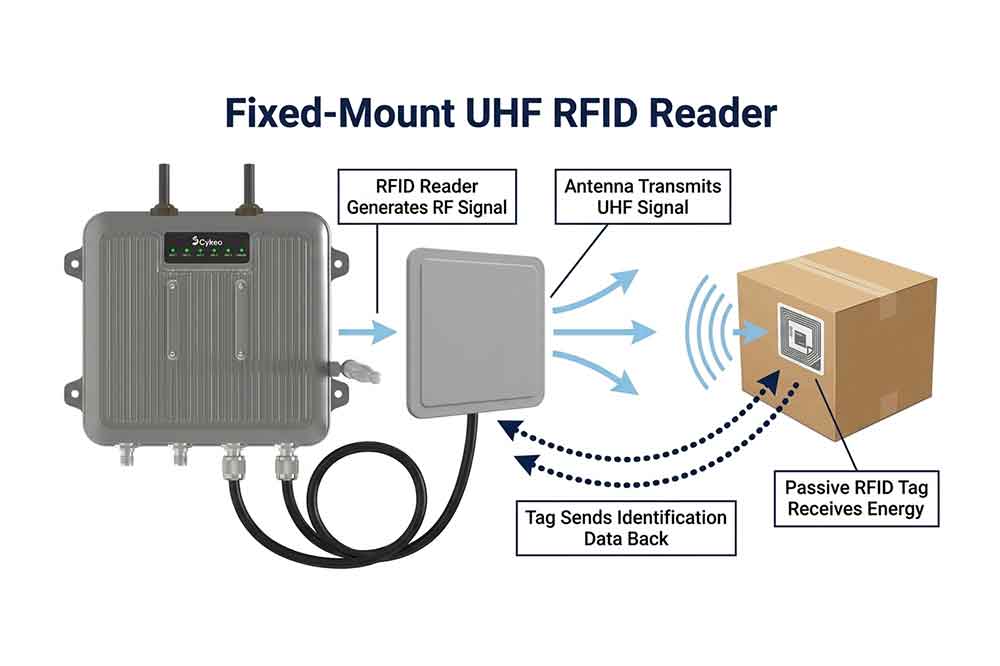
UHF Radio Frequency Communication
The reader generates an RF signal and sends it through one or more connected antennas.
When a compatible passive UHF tag enters the antenna’s coverage area, the tag receives energy from the transmitted signal. Its chip then uses this energy to respond to the reader.
The reader does not need physical contact with the tag. This makes UHF RFID suitable for applications where items move continuously or where several products need to be identified in a short period.
RFID Tag Identification and Backscatter
Passive UHF RFID communication uses a principle called backscatter.
Instead of generating its own radio transmission, the tag changes the way it reflects the reader’s RF signal. The reader detects these changes and decodes the information returned by the tag.
The information may include an Electronic Product Code (EPC), a unique identifier, or other stored data, depending on the tag configuration.
This communication method allows a fixed reader to identify tagged items without requiring a direct line of sight. However, this does not mean that every tag can be read from every position. Metal surfaces, liquids, tag orientation, and surrounding structures can affect RF performance.
Anti-Collision and Multiple Tag Reading
One of the main advantages of UHF RFID is its ability to identify multiple tags within a reading area.
Imagine a pallet carrying dozens of tagged cartons. A barcode system generally requires each label to be presented to a scanner individually. A properly configured UHF RFID reader can identify multiple tags during the same reading session.
Anti-collision protocols help organize communication between the reader and multiple tags, reducing the chance of communication conflicts.
The actual reading speed depends on the reader chipset, tag population, antenna configuration, RF environment, and software settings. Therefore, a high tag-reading rate in a datasheet should always be evaluated against the requirements of the actual project.
Main Components of a Fixed-Mount UHF RFID System
A fixed reader is only one part of an RFID installation. Its performance depends on how the other components work together.
RFID Reader
The reader controls the communication process between the system and RFID tags.
Important specifications include:
- Supported UHF frequency band
- EPC C1G2 / ISO 18000-6C compatibility
- RF output power
- Number of antenna ports
- Tag identification speed
- Communication interfaces
- Supported SDKs and APIs
For industrial applications, buyers should also consider operating temperature, housing protection, power requirements, and mounting options.
UHF RFID Antennas
Antennas determine how RF energy is distributed across the reading area.
A fixed reader may support one antenna or multiple external antennas. For example, a four-port reader can connect to four antennas, allowing a system designer to establish several reading zones.
Antenna selection should consider:
- Linear or circular polarization
- Antenna gain
- Reading direction
- Installation distance
- Required coverage area
- Surrounding metal structures
Circularly polarized antennas are often useful when tagged items have different orientations. Linear polarization can provide strong performance when tag orientation is predictable.
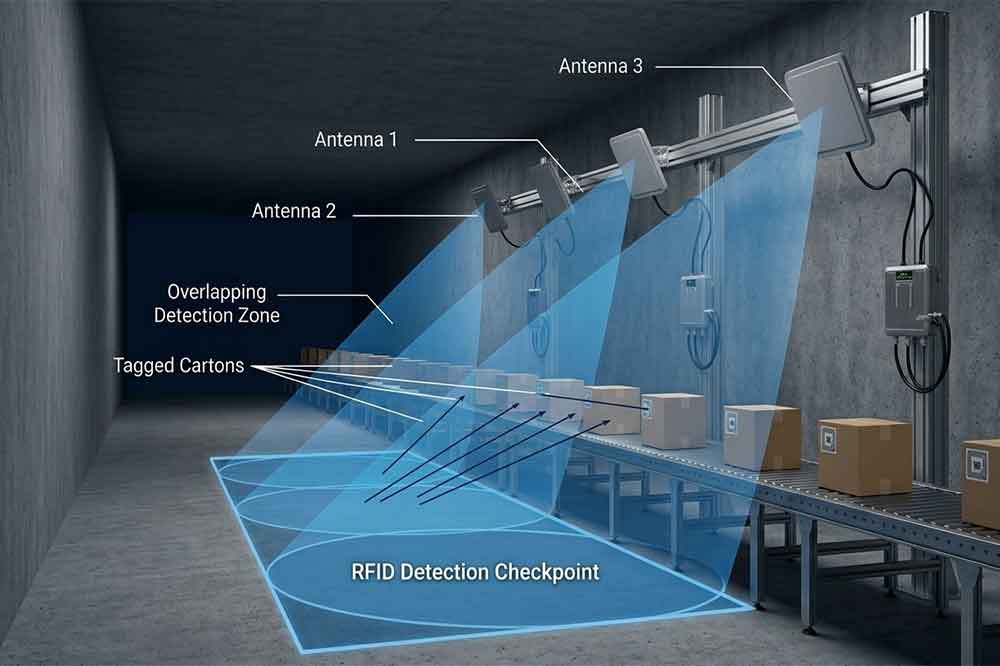
Using more antennas does not automatically guarantee better identification. Poor antenna positioning can create overlapping reading zones or cause unwanted tags to be detected.
RFID Tags and Software
The tag must match the operating frequency and communication protocol supported by the reader.
Its physical design is equally important. A standard label tag may work well on cardboard packaging but perform poorly when attached directly to a metal container. In that situation, an anti-metal UHF tag may be more appropriate.
Software is responsible for turning raw tag reads into useful business information. Reader SDKs, APIs, and communication interfaces allow developers to connect RFID hardware with WMS, ERP, MES, inventory platforms, or custom applications.
Reading Range and Performance Factors
Reading range is one of the most frequently discussed specifications when purchasing fixed-mount UHF RFID readers.
Some industrial systems can identify suitable tags over several meters. However, a manufacturer’s maximum reading distance should not be treated as a guaranteed working distance for every installation.
Several factors influence actual performance.
RF output power: Higher output power can extend the reading area, but the permitted transmission level depends on local regulations. Increasing power may also cause unwanted tags to be detected.
Antenna gain and direction: Antenna characteristics determine how the RF signal is distributed. A directional antenna can focus coverage on a particular checkpoint, while a different antenna may be more suitable for a wider area.
Tag size and sensitivity: Larger tags with suitable antenna designs may achieve better reading performance than small tags. The tag chip and antenna design also matter.
Installation environment: Metal racks, machinery, liquids, and other reflective or RF-absorbing materials can change the signal distribution.
Tag orientation: A tag that faces the antenna correctly may be detected more consistently than one installed at an unfavorable angle.
For this reason, RFID projects should include practical testing before final installation. Testing should use the actual tags, mounting materials, product positions, and operating conditions expected in the application.
Common Applications of Fixed-Mount UHF RFID Readers
Fixed-mount UHF RFID readers are used in applications where automatic identification needs to take place at a defined location.
Warehouse and Logistics Checkpoints
Readers installed at loading doors or warehouse entrances can identify tagged pallets, cartons, and containers as they move through a checkpoint.
The collected data can be sent to warehouse management software to support receiving, dispatching, and inventory updates.
Manufacturing and Production Lines
In manufacturing, RFID tags can be attached to workpieces, production carriers, or reusable containers.
Fixed readers installed along production lines identify items as they move between processing stations. This helps manufacturers associate each item with the correct production stage.
Asset Tracking
Factories, hospitals, and equipment management companies may use fixed readers to monitor tagged tools, machines, and reusable assets.
Instead of checking every item manually, the system can identify which tagged assets are present in a designated area.
Access Control and Vehicle Identification
Fixed UHF RFID readers can also be installed at vehicle entrances, parking facilities, and industrial access points.
When a compatible vehicle tag enters the reading zone, the system can send its identification data to access control software for further verification.
Smart Cabinets and Automated Equipment
Some OEM projects integrate fixed UHF RFID readers into cabinets, lockers, storage equipment, or automated machines.
The reader identifies tagged items during storage or retrieval. With appropriately positioned antennas, the equipment can support automatic inventory records without requiring manual item registration.
How to Choose a Fixed-Mount UHF RFID Reader
Selecting a reader should begin with the application rather than the maximum specifications listed in a product brochure.
For a small identification checkpoint, an integrated reader may be sufficient. A larger warehouse portal or production line may require a multi-port reader connected to several external antennas.
Before choosing a model, project buyers should evaluate the following points:
1. Required reading area
Define the physical area where tags need to be detected. Consider its width, height, direction of movement, and distance from the antennas.
2. Number of antennas
A single antenna may work for a simple identification point. Larger areas may require four-port, eight-port, or sixteen-port configurations.
3. Tag population and reading speed
Estimate how many tags will enter the reading area at the same time. A system identifying a few products per minute has different requirements from one processing densely packed pallets.
4. Communication interfaces
Check whether the reader supports the interfaces required by the existing system, such as Ethernet, RS232, RS485, or GPIO, depending on the selected model.
5. Environmental protection
For forklifts, production equipment, and outdoor installations, housing protection, vibration resistance, and operating temperature are important considerations.
6. Software integration
Confirm whether the manufacturer provides SDKs, APIs, demo software, and technical documentation for the development environment used by the integration team.
For B2B projects, it is also useful to confirm the manufacturer’s ability to provide technical assistance during testing and deployment.
Fixed-Mount UHF RFID Reader Integration
A fixed UHF RFID reader should be selected as part of the complete identification system, not as an isolated hardware purchase.
For example, an automated warehouse project may require readers, antennas, RFID tags, mounting brackets, network communication, and WMS integration. Each component affects the final identification result.
Cykeo provides fixed RFID reader options with four-port, eight-port, and sixteen-port configurations for different industrial applications. The product range includes hardware for warehouse checkpoints, production lines, asset tracking, and automated identification. SDK and API support is also available to assist system developers and integrators. Cykeo
For projects requiring multiple reading zones, the antenna layout should be tested before the installation is finalized. A practical test can reveal whether tags are being missed, whether adjacent zones interfere with each other, and whether the reader is collecting unwanted tag information.
The Cykeo RFID Readers product range provides a starting point for evaluating fixed reader hardware for industrial and OEM applications.
Conclusion
Fixed-mount UHF RFID readers provide a practical way to automate identification in warehouses, factories, logistics systems, and equipment management projects.
Their performance depends on more than reader power or advertised reading distance. Antenna configuration, tag selection, installation conditions, communication interfaces, and software integration all need to be considered together.
For system integrators and equipment manufacturers, choosing a reader that matches the actual application is more important than simply selecting the model with the highest specifications.
FAQ
Q1: What frequency do fixed-mount UHF RFID readers use?
Most UHF RFID systems operate within regional frequency allocations in the 860–960 MHz range. The exact operating band depends on the country and equipment configuration.
Q2: How far can a fixed-mount UHF RFID reader read tags?
Reading distance varies with reader output power, antenna gain, tag design, tag orientation, and installation conditions. Some industrial systems can achieve several meters or more under suitable conditions.
Q3: Can a fixed-mount UHF RFID reader read multiple tags simultaneously?
Yes. UHF RFID anti-collision protocols allow readers to identify multiple compatible tags within a reading area during the same reading session.
Q4: How many antennas can a fixed-mount UHF RFID reader support?
This depends on the reader model. Common industrial configurations include four-port, eight-port, and sixteen-port readers.
Q5: Can fixed-mount UHF RFID readers connect to ERP or WMS software?
Yes. Depending on the model, SDKs, APIs, Ethernet, serial communication, and other interfaces can support integration with ERP, WMS, MES, and custom software.
Related Fixed-Mount RFID Reader Guides
Choosing the right reader starts with understanding its working principle and installation requirements. These guides provide additional information for RFID project planning:
For a broader introduction to stationary RFID technology, read our guide on how fixed-mount RFID readers work.
Fixed readers are not the only option for RFID identification. Our comparison of fixed-mount readers vs. handheld RFID readers explains which configuration is more suitable for different operations.
Different applications require different reader configurations. Explore the different types of fixed-mount RFID readers before selecting hardware for an industrial project.
Fixed RFID readers are also widely applicable to conveyor-based manufacturing, where automated identification is required at different production checkpoints:fixed RFID readers for production lines
