Fire Safety Starts with Material Selection: The Role of Flame-Retardant Polycarbonate in Electric Ve
Author : Sagar Kapoor | Published On : 19 Aug 2026
As electric vehicles (EVs) continue to reshape the automotive industry, manufacturers face increasing demands to improve safety, durability, and performance without adding unnecessary weight. While battery technology and power electronics often receive the most attention, the engineering materials used to manufacture surrounding components are equally important. Components such as battery enclosures, charging connectors, electrical housings, and control units must withstand heat, electrical stress, and mechanical impact throughout their service life.
One material that has become increasingly important for these applications is flame-retardant polycarbonate (PC FR). Designed to deliver exceptional mechanical properties alongside enhanced fire resistance, flame-retardant polycarbonate helps engineers develop components that meet the demanding requirements of modern electric mobility. When selecting materials for safety-critical applications, manufacturers often evaluate products from a PC FR granules supplier for EV applications to ensure the chosen grade aligns with both performance and regulatory requirements.
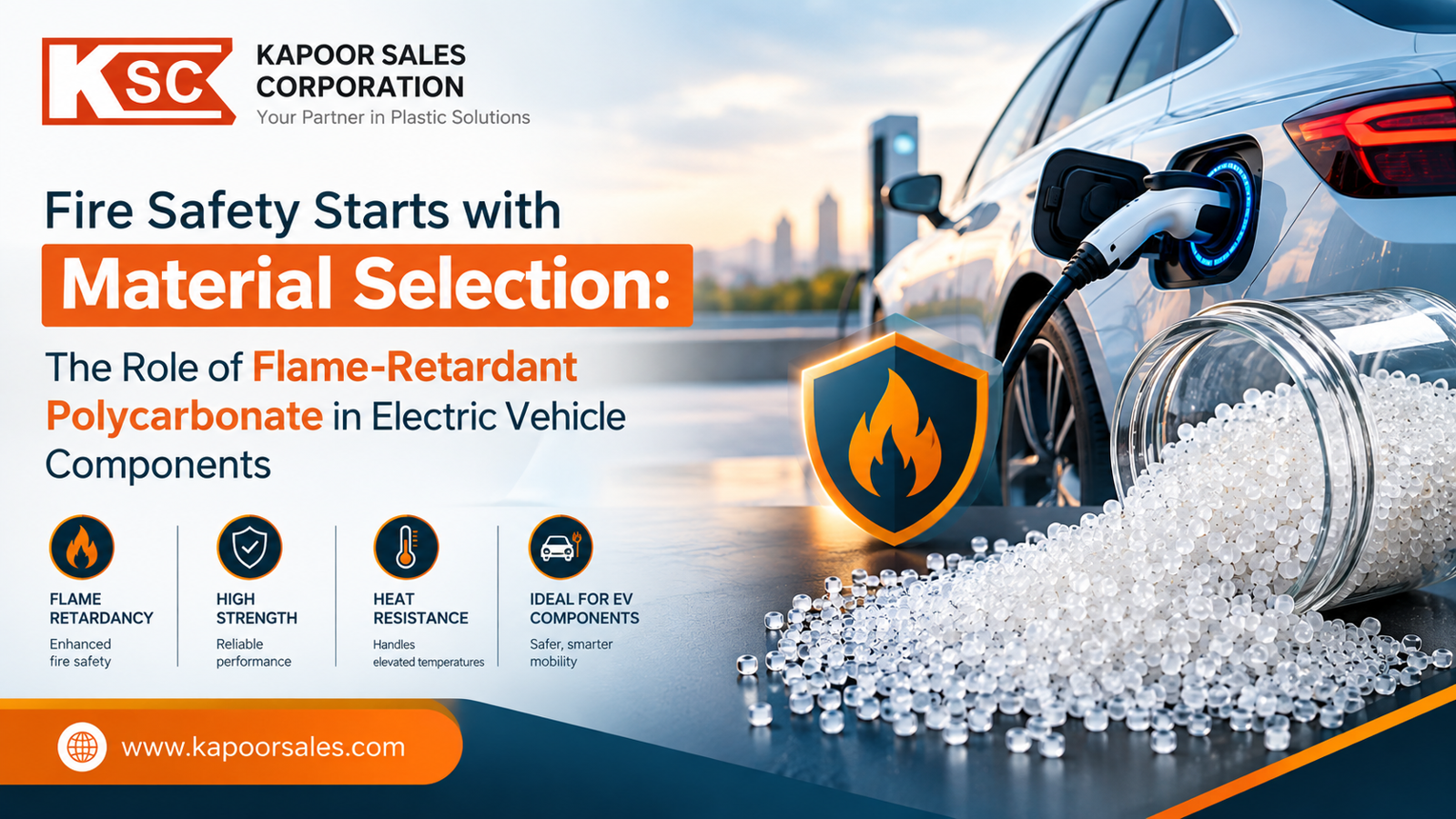
Why Fire Safety Is Essential in EV Design
Unlike conventional vehicles, electric vehicles contain complex high-voltage electrical systems that continuously generate and manage electrical energy. Battery packs, inverters, charging modules, power distribution units, and electronic control systems all operate under demanding conditions where heat management is critical.
Although EVs are engineered with multiple layers of protection, materials used around these electrical systems must also contribute to overall safety. Engineering plastics are expected to resist ignition, minimise flame propagation, maintain dimensional stability under elevated temperatures, and continue providing electrical insulation throughout the product's lifespan.
This is why flame-retardant engineering plastics have become an integral part of EV component design.
What Makes Flame-Retardant Polycarbonate Different?
Flame-retardant polycarbonate builds upon the well-known properties of conventional polycarbonate while incorporating additives that improve fire performance. The result is a material capable of delivering mechanical strength and thermal stability alongside enhanced flame resistance.
Some of its key performance characteristics include:
- Self-extinguishing properties that help reduce flame spread
- High impact resistance for demanding applications
- Excellent dimensional stability for precision-moulded components
- Reliable thermal performance under continuous operating conditions
- Strong electrical insulation properties
- Availability in transparent, opaque, UV-stabilised, non-halogenated, impact-modified, and glass fibre reinforced formulations
Because different applications require different material characteristics, many manufacturers consult a flame-retardant polycarbonate granules supplier when comparing resin grades for electrical, automotive, and industrial applications.
Common EV Applications for Flame-Retardant Polycarbonate
The combination of mechanical durability, processability, and flame resistance makes PC FR suitable for numerous electric vehicle components.
Battery Systems
Battery module covers, protective housings, insulation parts, and battery enclosure components require materials that maintain structural integrity while operating close to heat-generating battery cells.
High-Voltage Connectors and Charging Equipment
Charging connectors, cable management systems, and power distribution assemblies depend on engineering plastics capable of providing electrical insulation together with excellent heat resistance and impact performance.
Electrical and Electronic Housings
Electronic control units, fuse boxes, relay housings, and circuit protection enclosures frequently use flame-retardant polycarbonate because it offers reliable dimensional stability and long-term performance under demanding operating conditions.
Lighting and Structural Components
Specialised grades are also used in LED lighting systems, transparent inspection covers, and structural parts that require additional stiffness through glass fibre reinforcement.
Representative Flame-Retardant Polycarbonate Grades
Flame-retardant polycarbonate is available in numerous formulations developed to satisfy different engineering requirements.
|
Application |
Representative Grades |
|---|---|
|
Battery casings, charging systems and high-voltage connectors |
FR 905, FR 915R, FR 925U, FR 945U, FR 955, FR 9915A |
|
Electrical enclosures and electronic control units |
FR 920, FR 923, FR 925, FR 940, FR 943, FR 945, FR 950 |
|
Transparent covers and inspection windows |
FR 920A, FR 923A, FR 925A, FR 940A, FR 943A, FR 945A |
|
Glass fibre reinforced structural components |
BFL2010 |
|
LED lighting applications |
FR LUX9610, FR LUX9612/6G, FR LUX7169, FR LUX7189 |
|
Lightweight foamable applications |
FR FL905 |
The availability of specialised formulations enables engineers to match material properties with specific product requirements. Whether the priority is flame resistance, transparency, UV stability, impact performance, or structural strength, consulting an experienced PC FR resin granules supplier can help simplify material selection for demanding applications.
Flame-Retardant Polycarbonate Will Continue to Shape Future EV Designs
As electric vehicles become more compact, powerful, and electronically integrated, the demands placed on engineering materials will continue to increase. Flame-retardant polycarbonate offers a balanced combination of fire resistance, mechanical strength, dimensional accuracy, and electrical insulation, making it one of the most widely specified engineering plastics for safety-critical applications.
Beyond electric vehicles, it is extensively used in electrical equipment, transportation systems, industrial machinery, consumer electronics, and LED lighting. Working with a reliable polycarbonate FR granules supplier also enables manufacturers to access specialised material grades that support product safety, manufacturing efficiency, and long-term component reliability across a broad range of industries.
