Extract Cosmetics Category Data from E-Commerce
Author : iweb0303 iweb0303 | Published On : 14 Nov 2026
Introduction
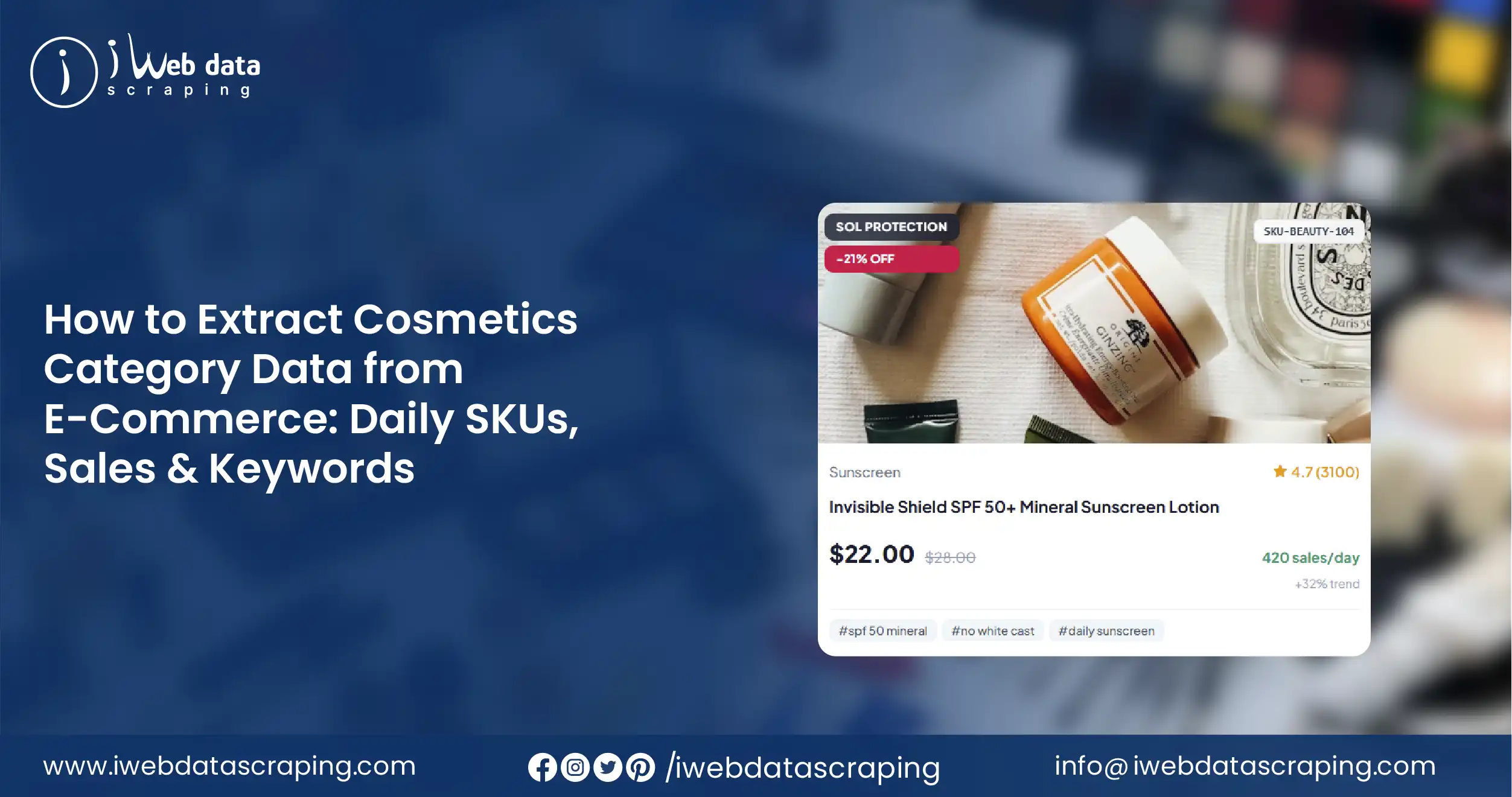
The cosmetics industry is highly competitive, with thousands of products competing across marketplaces, brand websites, beauty retailers, and e-commerce platforms. Extract Cosmetics Category Data from E-Commerce to enables brands, retailers, manufacturers, and market researchers to collect structured information about products, prices, availability, ratings, reviews, sellers, and promotional activity.
Modern beauty businesses increasingly need continuous visibility rather than occasional market research. Scrape daily cosmetics SKUs sales and keywords to identify product movement, changing consumer interests, emerging search terms, and competitive activity. Similarly, Daily SKU tracking for cosmetics brands helps businesses monitor individual products across marketplaces and understand how pricing, availability, promotions, and customer sentiment change over time.
A structured cosmetics dataset can transform scattered marketplace information into actionable intelligence. Instead of manually checking hundreds of product pages, businesses can automate collection and organize the information into dashboards, databases, reports, or analytical systems.
Why Cosmetics E-Commerce Data Matters?
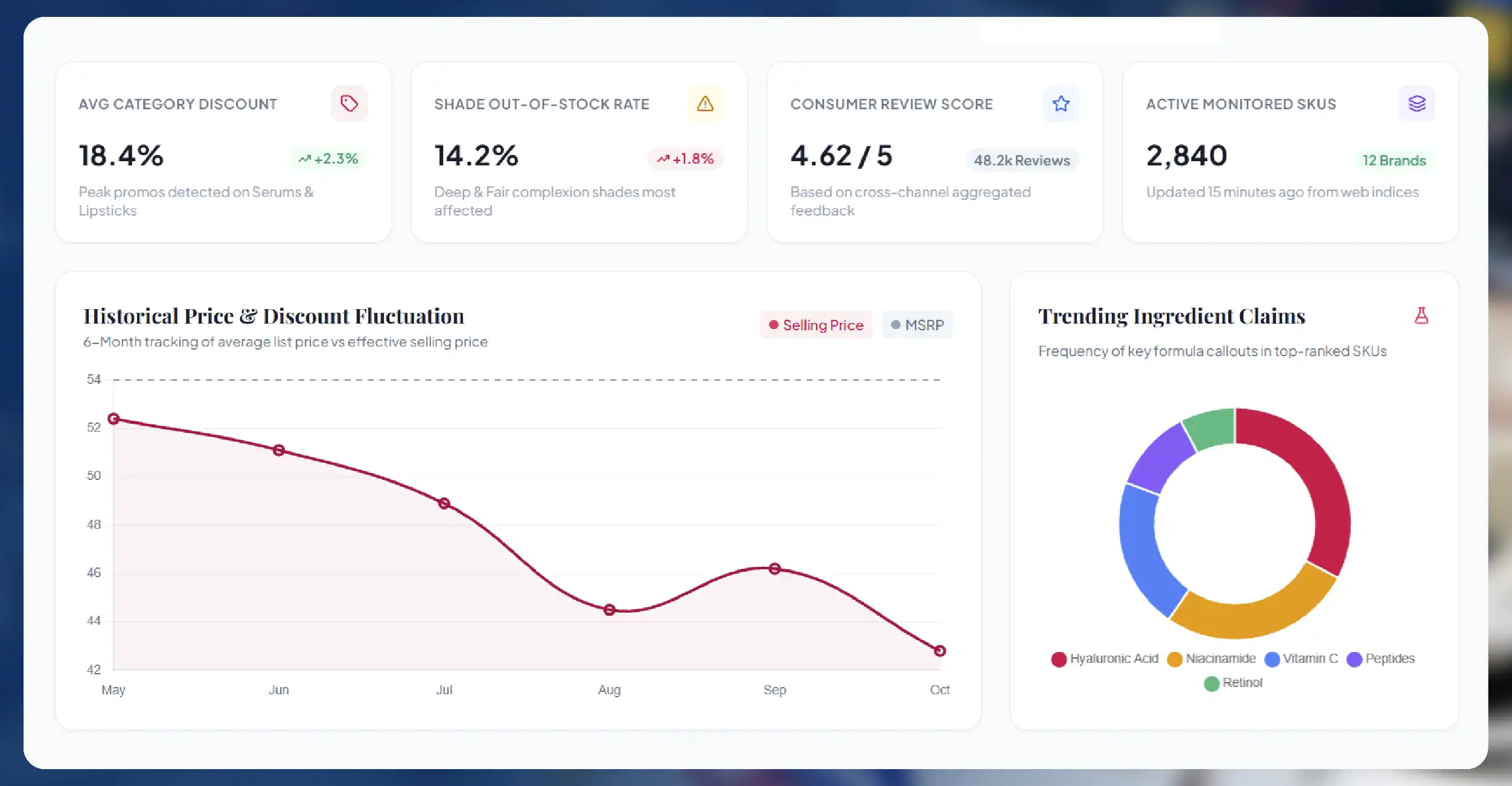
Online cosmetics shoppers compare multiple products before purchasing. They evaluate prices, discounts, ingredients, ratings, reviews, product claims, shades, sizes, and delivery availability. This makes e-commerce marketplaces valuable sources of competitive and consumer intelligence.
A cosmetics data collection system can capture fields such as:
- Product name and category
- Brand and manufacturer
- SKU and product identifiers
- Current and original prices
- Discounts and promotional offers
- Product availability
- Seller information
- Product variants and shades
- Ingredients and product attributes
- Ratings and review counts
- Customer reviews
- Search keywords
- Product rankings
- Images and product descriptions
- Shipping and delivery information
When collected at regular intervals, these fields create historical records that can reveal changes that are difficult to identify through one-time research.
Understanding Cosmetics Category Data
Cosmetics cover a broad range of categories, making structured classification essential. A comprehensive database may separate facial makeup, eye makeup, lip products, skincare, haircare, fragrances, nail products, personal care, beauty tools, and specialty products.
Within each category, businesses can monitor individual SKUs and product variants. For example, a foundation product may have dozens of shades, while lipstick collections can contain numerous colors and finishes.
Category-level extraction helps businesses understand:
- Which categories have the largest assortment
- Which brands dominate specific segments
- How frequently prices change
- Which products receive the highest ratings
- Which SKUs experience stock shortages
- Which products attract more reviews
- Which keywords are associated with growing demand
- How promotional intensity differs between categories
This structured approach allows businesses to move from basic product collection toward deeper market intelligence.
Cosmetics Pricing and Competitive Intelligence
Price is one of the most visible factors influencing online purchase decisions. Cosmetics brands frequently adjust prices, launch discounts, introduce bundles, and run seasonal promotions.
Cosmetics pricing and keyword intelligence combines pricing information with search and product-language data to create a broader view of market activity.
Historical price datasets can help businesses compare:
| Intelligence Area | Data Tracked | Business Use |
|---|---|---|
| Product Pricing | Current and previous prices | Competitive benchmarking |
| Discounts | Discount percentage and offer type | Promotion analysis |
| Assortment | Products and variants | Portfolio comparison |
| Keywords | Search terms and product phrases | Demand discovery |
| Availability | In-stock/out-of-stock status | Supply monitoring |
| Ratings | Rating scores and counts | Customer perception |
| Reviews | Review volume and themes | Sentiment analysis |
For brands operating across several marketplaces, automated collection can also identify differences in pricing and promotions between channels.
Monitoring Product Availability and SKU Changes
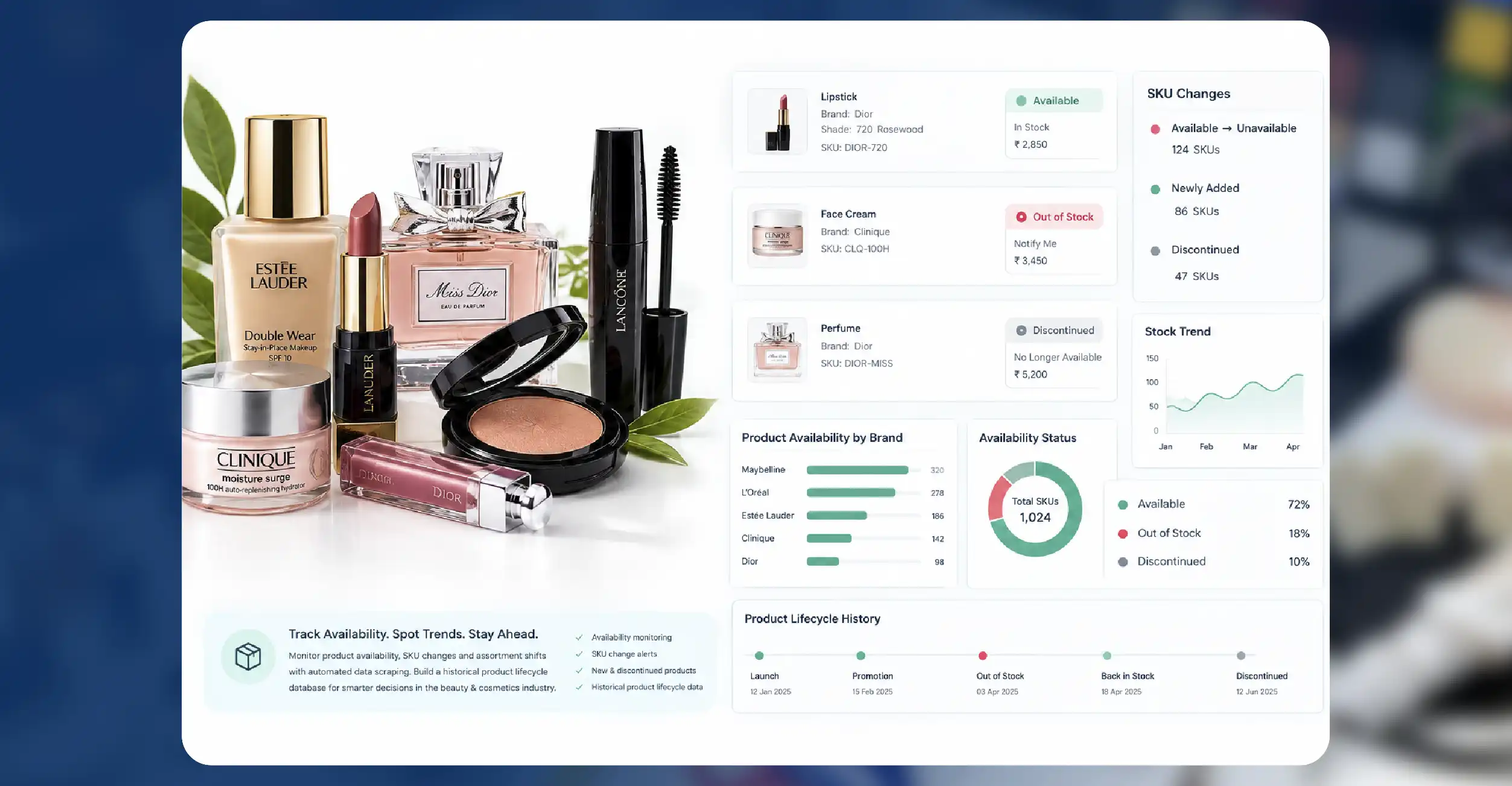
Availability is another important dimension of cosmetics intelligence. A product may have strong ratings and competitive pricing but lose sales opportunities when it becomes unavailable.
Automated monitoring can track when SKUs move from available to unavailable and identify recurring stock patterns. Businesses can investigate whether shortages are concentrated around specific products, shades, brands, sellers, or locations.
SKU monitoring can also capture assortment changes. New products can be identified when they first appear, while discontinued or inactive products can be flagged when they disappear from monitored catalogs.
Cosmetic & Beauty Product Data Scraping Service creates a historical product lifecycle database covering launches, promotions, availability changes, and product retirement.
E-Commerce Cosmetics Trend Monitoring
ECommerce cosmetics trend monitoring enables businesses to identify changes in online assortment, consumer language, pricing behavior, and product popularity.
For example, an increasing number of products using terms associated with particular ingredients, finishes, skin concerns, or beauty routines may indicate a developing category trend. Similarly, rapidly increasing review volumes can signal rising consumer attention.
Trend monitoring can examine:
- New product launches
- Emerging ingredients
- Popular product formats
- Increasingly used product claims
- Search keyword changes
- Category expansion
- Price movements
- Review growth
- Rating changes
- Promotional patterns
Trend intelligence becomes more useful when data is collected consistently. A daily or weekly dataset can reveal direction and momentum rather than simply providing a snapshot.
E-Commerce Cosmetics Sales Analytics
ECommerce cosmetics sales analytics can combine product, pricing, ranking, availability, review, and marketplace data to support business analysis.
Where reliable sales or sales-proxy information is available, businesses can estimate product performance using indicators such as ranking movement, review growth, availability patterns, promotional activity, and marketplace signals.
Analytics dashboards can segment products by:
- Brand
- Category
- Price range
- Rating
- Discount level
- Marketplace
- Seller
- Product type
- Geographic market
- Product variant
A brand may use these insights to identify underperforming SKUs, benchmark competitors, discover high-growth categories, and understand how promotional changes correlate with marketplace performance.
Collecting Product Ratings and Reviews
Customer reviews contain qualitative information that product-level metrics cannot fully explain. Reviews can reveal recurring complaints, praised ingredients, packaging issues, shade mismatches, texture preferences, delivery experiences, and perceived value.
A structured review dataset can capture:
- Product and SKU
- Rating
- Review title
- Review text
- Review date
- Verified-purchase indicator where available
- Variant or shade
- Helpful-vote information where available
Natural-language processing can subsequently categorize reviews into themes. For example, thousands of reviews could be grouped into packaging, pigmentation, durability, texture, fragrance, value, or shade-related topics.
This enables brands to connect customer sentiment with individual products and variants.
Keyword and Product Content Intelligence
Product titles and descriptions provide another valuable source of market information. Repeated terminology across competing products can indicate how brands position themselves and communicate product benefits.
Keyword extraction can identify terms related to:
- Ingredients
- Skin types
- Beauty concerns
- Product finishes
- Colors and shades
- Product formats
- Benefits
- Sustainability claims
- Usage occasions
- Consumer preferences
Businesses can compare keyword frequency across brands and categories to understand positioning patterns and identify gaps in product communication.
Applications Across the Cosmetics Industry
Automated cosmetics data extraction can support several teams simultaneously.
Brand managers can monitor competitors, product launches, assortment changes, and promotional activity.
Pricing teams can analyze price movements and discount patterns across marketplaces.
Marketing teams can identify frequently occurring keywords, claims, ingredients, and consumer themes.
Product teams can analyze reviews to identify product improvement opportunities.
Retailers can benchmark assortment depth and pricing against competing channels.
Market researchers can build historical datasets for category and consumer analysis.
Investors and consultants can use structured marketplace information as one input into broader market research.
Building a Reliable Cosmetics Data Pipeline
A scalable extraction pipeline generally follows several stages. First, relevant e-commerce sources and product categories are identified. Next, product information is collected and standardized.
Data normalization is particularly important because the same product may appear with different naming conventions, pack sizes, seller information, or promotional prices.
A typical pipeline includes:
Source Identification → Data Extraction → Cleaning → Product Matching → Validation → Storage → Analytics → Dashboarding
Deduplication helps prevent repeated records, while product matching connects different marketplace listings representing the same SKU. Scheduled extraction can then create historical snapshots for trend analysis.
Data quality checks should also validate missing fields, unusual prices, duplicate products, broken records, and unexpected category changes.
How iWeb Data Scraping Can Help You?
Automated SKU Monitoring
iWeb Data Scraping can automate recurring collection of cosmetics SKUs, capturing prices, availability, ratings, reviews, sellers, variants, and product attributes for continuous competitive monitoring.
Competitive Price Intelligence
Structured datasets help businesses compare competitor prices, discounts, promotions, and assortment changes across marketplaces, supporting pricing analysis and faster responses to changing e-commerce conditions.
Review and Sentiment Data
iWeb can collect organized product ratings and reviews, enabling brands to identify recurring customer themes, product concerns, satisfaction patterns, and opportunities for product improvement.
Trend and Keyword Tracking
Automated collection can monitor product titles, descriptions, keywords, ingredients, claims, and category changes, helping businesses identify emerging beauty trends and evolving consumer terminology.
Custom Analytics Datasets
iWeb can deliver cleaned, structured cosmetics datasets in business-ready formats, supporting dashboards, market research, competitive benchmarking, historical analysis, and customized analytics workflows.
Conclusion
The cosmetics e-commerce market generates an enormous amount of continuously changing product information. Automated extraction turns this information into structured intelligence covering prices, SKUs, availability, reviews, ratings, sellers, keywords, assortment, and promotional activity.
For brands and retailers, historical data provides a stronger foundation for understanding competitive movement and changing consumer behavior. With Digital shelf analytics, businesses can examine how their products appear and perform across digital retail environments.
Organizations can also use E-commerce Data Extraction Services to build scalable pipelines tailored to specific marketplaces, categories, geographic markets, and analytical requirements.
A comprehensive Ecommerce Product Ratings and Review Dataset further adds customer-perspective intelligence, helping connect marketplace performance with consumer feedback. When these datasets are integrated into dashboards and analytical systems, cosmetics businesses can continuously monitor their digital marketplace environment and make data-informed operational decisions.
