Ethics of AI in Agriculture: Balancing Innovation with Community Roots
Author : Alex Turner | Published On : 28 Aug 2026
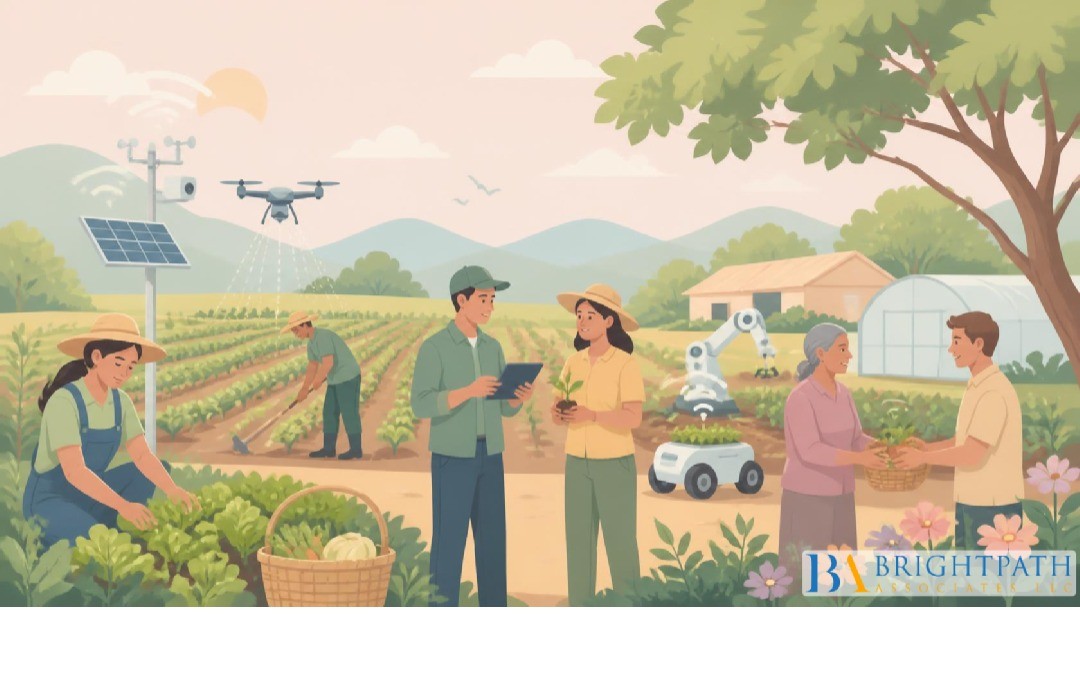
Agriculture has always been an industry shaped by a combination of experience, observation, technology, and adaptation. Farmers have traditionally relied on their understanding of soil, weather, crops, livestock, equipment, and local conditions to make decisions that can determine an entire season’s success. Today, artificial intelligence is adding another layer to that decision-making process.
AI is moving into agriculture through predictive analytics, smart machinery, satellite imagery, automated monitoring, precision irrigation, crop health analysis, and digital farm management platforms. These technologies promise greater efficiency and better resource management, but they also raise an important question: How can agricultural businesses adopt advanced technology without losing the human knowledge and community values that have always been central to farming?
For companies operating in the modern Farming Industry, this question is becoming increasingly important. AI adoption is no longer simply a technology decision. It is becoming a leadership, workforce, investment, and organizational decision.
AI Is Changing How Agricultural Decisions Are Made
One of the biggest advantages of artificial intelligence is its ability to process enormous amounts of information quickly. A modern agricultural operation can generate data from soil sensors, tractors, weather stations, drones, satellites, irrigation systems, equipment, and financial software.
AI can analyze these different information sources and identify patterns that may be difficult to recognize manually. A farm manager, for example, may use technology to understand changing soil conditions, anticipate equipment maintenance requirements, identify potential crop problems, or determine where resources should be allocated more efficiently.
But better data does not automatically mean better decisions. Agricultural environments are highly complex, and not every factor can be captured in a database. A farmer may understand a particular field because of decades of experience with its drainage patterns, weather behavior, soil characteristics, or crop history.
The strongest agricultural organizations will therefore treat AI as a tool for supporting human judgment rather than replacing it completely.
The Ethical Question Behind Agricultural Data
Farm equipment and digital platforms can collect information about yields, field conditions, production practices, input usage, equipment performance, and operational efficiency. This information can help farmers make better decisions, but it also raises questions about ownership and control.
These questions matter particularly to smaller agricultural businesses that may rely on technology providers for essential digital infrastructure.
Responsible AI adoption requires transparency. Farmers and agricultural businesses should understand what information is being collected and how it may be used. Data governance should not be treated as an administrative detail. It should become part of the broader business strategy surrounding technology adoption.
Productivity Should Not Be the Only Measure of Success
AI has enormous potential to improve agricultural productivity. Precision technologies can help businesses apply water, fertilizer, pesticides, fuel, and other inputs more efficiently. Predictive systems can potentially identify risks before they become expensive problems.
A technology that improves short-term productivity but contributes to long-term soil degradation, environmental damage, workforce disruption, or excessive dependence on a technology provider may create challenges that eventually outweigh its initial benefits.
Successful AI adoption should consider productivity, environmental responsibility, economic resilience, employee development, data security, and community impact together. A better question may be, “How can this technology make the business stronger five, ten, or twenty years from now?”
AI Does Not Have to Compete With Traditional Farming Knowledge
There is sometimes a perception that artificial intelligence represents the opposite of traditional farming. In reality, the two can complement each other.
AI can identify patterns across thousands of data points. Farmers can interpret those patterns through practical experience. Technology can provide predictions, while people can determine whether those predictions make sense in a particular local context.
Consider a system that recommends a particular irrigation schedule based on weather forecasts and soil data. The recommendation may be highly sophisticated, but an experienced farmer may know that a particular section of land behaves differently after heavy rainfall.
The most effective system is not necessarily the one that ignores the farmer’s judgment. It is the one that allows the farmer to combine technological insight with practical knowledge. That distinction could become one of the defining principles of responsible agricultural AI.
The Future Is Likely to Be Human-AI Collaboration
The most promising future for agricultural AI may not involve humans versus machines. It may involve humans working with machines. AI can process information at a scale that individuals cannot. Farmers and agricultural professionals bring experience, intuition, contextual knowledge, and practical judgment that algorithms may not possess.
The broader conversation surrounding the ethical use of AI in agriculture is explored in BrightPath Associates’ Ethics of AI in Agriculture: Balancing Innovation With Community Roots, which examines how technological progress can be balanced with farmer knowledge, workforce considerations, sustainability, data responsibility, and community interests.
A More Responsible Agricultural Technology Strategy
AI will undoubtedly continue to influence the future of farming. The real question is not whether agricultural businesses will use artificial intelligence, but how thoughtfully they will use it.
Companies that focus only on automation may overlook the people who ultimately make agricultural systems work. Companies that combine technology with workforce development, farmer expertise, responsible data practices, sustainability, and strong leadership may be better positioned to create lasting value.
For small and mid-sized agricultural businesses in particular, this balance could become a competitive advantage. The next generation of farming will require more than advanced technology. It will require people who know how to connect technology with real-world agricultural challenges.
