Enterprise AI Development: 8-Step Roadmap from Strategy to Deployment
Author : Ghyoor Qasim | Published On : 26 Aug 2026
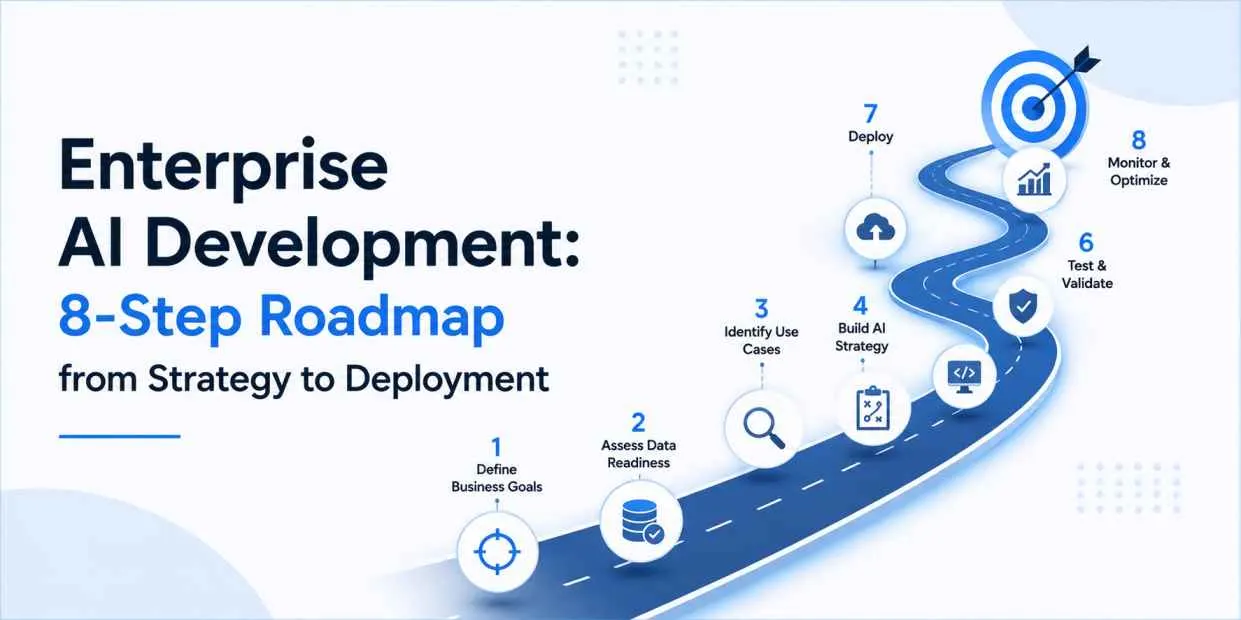
Every enterprise I've watched go through this has the same origin story. One department spins up a pilot. It works well enough that someone screenshots the demo for a board deck. Six months later, three more departments have their own AI experiments running, none of them talk to each other, and nobody can say with a straight face what the actual ROI has been.
That's not an AI problem. That's a roadmap problem. AI integration services exist precisely because most enterprises don't fail at building models — they fail at sequencing the work that has to happen around the model. Here's the 8-step version of that sequencing, without the 40-slide strategy deck.
Step 1: Get Honest About Why You're Doing This
Before any vendor conversation, before any model selection, someone in the room needs to answer one question specifically: what business outcome are we actually trying to move? Not "we need to be AI-forward." A number. Fewer support tickets, faster claims processing, lower inventory holding costs — something you can measure in twelve months and be wrong about publicly if it doesn't happen.
Enterprises that skip this step end up with technically successful pilots that nobody can defend budget for later, because nobody wrote down what "success" meant in the first place.
Step 2: Audit What You Actually Have
Most large organizations aren't starting from zero — they're starting from a decade of legacy systems, inconsistent data definitions across departments, and at least one system nobody fully understands anymore. A readiness assessment across data quality, infrastructure, and internal skills isn't bureaucratic overhead. It's the difference between a pilot that ships in ten weeks and one that stalls at week six because nobody realized the customer data lived in four disconnected systems with three different formats.
This is also where you find out if you need AI development services built around your existing stack, or whether some foundational cleanup has to happen first.
Step 3: Pick One or Two Use Cases — Not Ten
The instinct at this stage is to build a wishlist. Resist it. The enterprises that actually get value from AI pick a small number of use cases where the data already exists, the workflow is well understood, and the business impact is provable — then they prove it before touching anything else.
Good starting candidates usually look boring on paper: document classification, anomaly detection in transactions, automating a manual reconciliation step. Boring and provable beats ambitious and unmeasurable every time at this stage.
Step 4: Design the Data and Integration Architecture
This is the step most companies underestimate, and it's usually where projects quietly die. A model is only as useful as its access to clean, current data — and in most enterprises, that means integrating with CRMs, ERPs, or legacy systems that were never built with AI workloads in mind.
This is the technical core of what a custom AI development company actually does day to day: not just training a model, but building the pipelines, APIs, and monitoring layers that let it function inside systems that already exist, without needing to rip everything out and start over.
Step 5: Build and Run a Real Pilot
A pilot isn't a proof-of-concept notebook running on a laptop. It's a scoped, time-boxed deployment running against real data, compared against the current process it's meant to replace or augment. If it's a fraud detection model, it runs alongside the existing process for a defined period, and you measure precision and recall against real outcomes — not against a curated test set that made the model look good in the pitch.
This step produces the evidence that either justifies scaling the investment or tells you honestly that the use case wasn't the right one. Both outcomes are useful. Only one of them gets you fired.
Step 6: Put Governance in Before You Need It
The moment a model touches customer data, financial decisions, or a regulated workflow, governance isn't optional anymore — and retrofitting it after deployment is far more painful than building it in from the start. This means clear model ownership, documented decision logic, bias testing where it's relevant, and a defined process for what happens when the model is wrong in a way that has compliance consequences.
Enterprises in finance and healthcare feel this hardest, since both industries carry audit and compliance obligations that a generic AI vendor playbook usually isn't built around.
Step 7: Scale What Actually Worked
Once a pilot proves out, the temptation is to declare victory and move to the next flashy use case. Don't. Scaling means turning what worked into a repeatable, shared capability — common data pipelines, a shared model deployment process, monitoring that other teams can reuse instead of rebuilding their own version of the same wheel.
This is also the point where the cost conversation gets real. Custom AI development services should get cheaper per use case as shared infrastructure gets reused, not more expensive as every department reinvents its own stack.
Step 8: Monitor, Retrain, and Stay Honest About Drift
A model's accuracy on launch day is not its accuracy eight months later. Data shifts, customer behavior shifts, and a model that was 92% accurate at deployment can quietly degrade without anyone noticing unless someone owns ongoing monitoring. This is the step most vendors skip because it's unglamorous and doesn't show up in a sales pitch — but it's the difference between an AI development company that ships a deliverable and one that owns an outcome.
Where PrimaFelicitas Fits Into This
We've built out this exact roadmap for finance and healthcare clients specifically — sectors where step 6 isn't optional and step 8 genuinely matters. Our work has focused on automation tooling for reconciliation and risk workflows in finance, and administrative/operational automation in healthcare, where the regulatory stakes make "we'll figure out compliance later" an unacceptable answer. That's the practical difference between AI development company marketing copy and AI development services that actually survive contact with a compliance review.
FAQs
How long does an enterprise AI roadmap take from strategy to deployment?
A realistic pilot-to-production timeline runs 4-9 months depending on data readiness — organizations with clean, accessible data move faster than those still untangling legacy systems.
What's the biggest reason enterprise AI projects stall?
Unclear data architecture and integration planning, more often than model performance. Most delays happen in step 4, not step 5.
Do we need a custom AI development company, or can we use off-the-shelf tools?
Off-the-shelf tools work for generic use cases. Regulated industries or workflows with unique data structures usually need custom AI development to avoid forcing your process to fit a generic tool's limitations.
How do you measure ROI on an enterprise AI pilot?
Compare the pilot's output directly against the existing process it's meant to improve, using the specific metric defined in Step 1 — not a generic accuracy score in isolation.
