End-to-End Excellence: Advanced Dairy Supply Chain Management
Author : Alyssa Miller | Published On : 26 Jun 2026
The dairy industry has always operated under unique pressures. Unlike many other manufacturing sectors, dairy businesses manage highly perishable products, strict food safety regulations, fluctuating raw material availability, and ever-changing consumer expectations. Every stage—from milk collection and processing to packaging, cold-chain logistics, and retail distribution—must function with exceptional precision. In today's increasingly competitive environment, achieving operational excellence is no longer enough. Dairy companies must build intelligent, integrated supply chains that deliver efficiency, transparency, resilience, and long-term profitability. For small and mid-sized dairy businesses across the United States, advanced supply chain management is rapidly becoming one of the most important drivers of sustainable growth.
Modern dairy supply chains are significantly more complex than they were a decade ago. Consumer demand for premium products, clean-label ingredients, sustainable sourcing, and rapid delivery has forced organizations to rethink traditional operating models. At the same time, rising transportation costs, labor shortages, climate-related disruptions, and evolving food safety regulations have introduced new operational risks. Companies that continue relying on fragmented systems often struggle with inventory management, forecasting accuracy, supplier coordination, and cost control. These challenges highlight the importance of adopting end-to-end supply chain strategies that connect every aspect of the business into one coordinated operation.
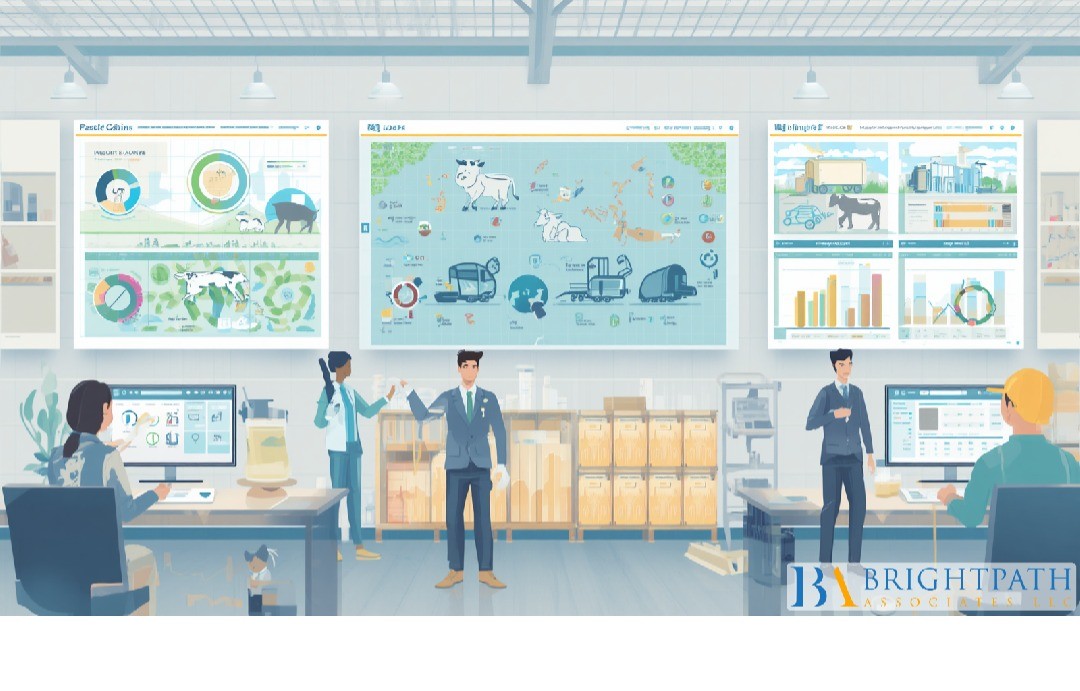
End-to-end visibility has become the foundation of successful dairy operations. Rather than managing procurement, production, warehousing, logistics, and distribution independently, leading organizations integrate these functions through digital technologies that provide real-time information across the entire value chain. Advanced planning systems, predictive analytics, Internet of Things (IoT) sensors, and automated inventory management allow decision-makers to monitor product movement, identify potential disruptions, and optimize resources before problems affect customers. Research has consistently shown that improved traceability and integrated information sharing strengthen supply chain performance while enhancing collaboration among stakeholders.
Cold-chain management remains one of the most critical components of dairy supply chain excellence. Maintaining consistent temperature control from farm to consumer is essential for preserving product quality, ensuring food safety, and minimizing waste. Even minor disruptions during transportation or storage can lead to spoilage, financial losses, and reputational damage. Companies are increasingly investing in smart refrigeration systems, real-time temperature monitoring, GPS-enabled transportation, and predictive maintenance technologies to strengthen cold-chain reliability. These innovations not only reduce product losses but also improve customer confidence by ensuring consistent quality throughout the distribution process.
Technology continues to reshape every stage of dairy supply chain management. Artificial intelligence, machine learning, automation, and cloud-based analytics are enabling organizations to forecast demand more accurately, optimize production schedules, reduce waste, and improve supplier collaboration. Instead of reacting to market fluctuations after they occur, businesses can anticipate changes using predictive models that analyze historical data, weather conditions, purchasing behavior, and operational performance. Data-driven decision-making has become a strategic advantage for companies seeking to improve profitability while maintaining service levels in increasingly dynamic markets. Advanced analytics and digital supply chain planning are now recognized as essential capabilities for organizations pursuing long-term operational excellence.
Sustainability has also become deeply integrated into modern dairy supply chain strategies. Consumers, retailers, and regulatory agencies increasingly expect companies to reduce environmental impact while maintaining operational efficiency. This has encouraged dairy businesses to invest in energy-efficient processing facilities, sustainable packaging, renewable energy, water conservation initiatives, and responsible sourcing practices. Sustainability is no longer viewed solely as a corporate responsibility initiative; it has become a business strategy that improves operational resilience, reduces long-term costs, and strengthens brand reputation. Organizations that successfully align sustainability with supply chain performance are often better positioned to compete in both domestic and international markets.
Another factor driving supply chain transformation is risk management. Recent global disruptions have demonstrated how vulnerable food supply chains can be to transportation delays, labor shortages, extreme weather events, geopolitical uncertainty, and fluctuating commodity prices. Building resilience requires more than maintaining backup suppliers. It demands flexible logistics networks, diversified sourcing strategies, real-time visibility, collaborative supplier relationships, and proactive contingency planning. Companies that invest in resilient supply chain infrastructure are better prepared to maintain operations during periods of uncertainty while continuing to meet customer expectations.
Organizations operating within the Dairy Industry are also recognizing that supply chain excellence depends heavily on leadership. Digital transformation initiatives, sustainability programs, operational improvements, and regulatory compliance require executives capable of managing cross-functional teams while driving strategic change. Leaders must possess expertise in operations, technology, quality assurance, procurement, logistics, and workforce development to successfully implement integrated supply chain strategies. As operational complexity increases, recruiting executives with both technical knowledge and strategic vision has become a significant competitive advantage for dairy companies seeking sustainable growth.
Workforce challenges further reinforce the importance of strong leadership. Many dairy organizations continue facing shortages of experienced professionals in supply chain management, operations, engineering, food safety, and manufacturing leadership. These talent gaps can slow digital transformation, limit innovation, and reduce operational efficiency. Companies increasingly recognize that successful supply chain modernization depends as much on people as it does on technology. Building leadership teams capable of managing change, fostering collaboration, and driving continuous improvement has become essential for organizations seeking to remain competitive in an evolving marketplace.
Innovation will continue shaping the future of dairy supply chains. Technologies such as blockchain, artificial intelligence, digital twins, robotics, and advanced automation are expected to further improve transparency, forecasting, traceability, and operational performance. These innovations will enable organizations to make faster decisions, strengthen supplier relationships, reduce waste, and deliver greater value to customers. However, technology alone cannot create competitive advantage. Success will depend on organizations' ability to integrate digital capabilities with strategic leadership, operational discipline, and a culture of continuous improvement.
Business leaders seeking a deeper understanding of modern supply chain strategies can explore the original article on Advanced Dairy Supply Chain Management, which examines how integrated operations, technology, and leadership are reshaping the future of dairy manufacturing.
The future of the dairy industry will belong to organizations that view supply chain management not simply as an operational necessity but as a strategic differentiator. Companies capable of connecting procurement, production, logistics, quality assurance, sustainability, and leadership into one cohesive ecosystem will be better positioned to improve profitability, strengthen customer trust, and adapt to future market disruptions.
