Ecommerce Product Matching API: Amazon, Flipkart, Meesho
Author : Product datascrape | Published On : 24 Nov 2026
Introduction
Identifying the same product across Amazon, Flipkart, Meesho, and Myntra requires more than comparing product titles. An ecommerce product matching API combines identifiers such as GTIN, barcode, brand, model number, product attributes, and listing information to connect equivalent products across marketplaces. This helps retailers, manufacturers, brands, and e-commerce analytics companies reduce duplicate records and improve cross-platform price comparisons.
The challenge is that marketplaces use different catalog structures, product identifiers, seller references, and listing formats. The same physical product may have different titles, descriptions, images, or seller-specific SKUs across platforms. Matching these records manually becomes difficult when businesses manage large catalogs.
Barcode and GTIN Matching provides a strong starting point because standardized product identifiers help establish product identity. However, identifiers are not always available or correctly populated. Businesses therefore need additional matching signals, including brand, model, size, color, pack quantity, and product specifications.
A reliable matching workflow combines identifier-based verification with attribute comparison, duplicate detection, and confidence scoring. The objective is to create a standardized product view that allows businesses to compare equivalent items rather than unrelated listings.
For multi-marketplace retailers, this approach supports better catalog management, competitive price intelligence, product research, and inventory analysis.
Why Is Identifying Equivalent Products Across Marketplaces Difficult?
Cross-marketplace product identification is challenging because individual marketplaces maintain their own product catalogs and listing structures. A brand may publish the same product on multiple platforms, but the information presented to shoppers can differ.
For example, a product title may contain a brand name and model number on one marketplace, while another listing may emphasize color, material, or product benefits. Seller-specific SKU codes may also differ even when the physical product is identical.
Cross-Platform Product Matching Scraping helps collect permitted product information from multiple marketplace sources and organize it into a common structure. Instead of comparing disconnected listings, businesses can evaluate products using standardized fields such as brand, model, GTIN, category, size, color, and pack quantity.
A Modular Product-Detail Scraper for E-commerce Sites can support this process by extracting relevant product attributes through configurable collection modules. Separate modules can handle titles, prices, specifications, product identifiers, and listing URLs. This makes it easier to maintain different extraction requirements for different sources.
Important matching challenges include:
- Different product naming conventions across marketplaces.
- Missing or inconsistent GTIN and barcode information.
- Different seller SKUs for the same product.
- Variations in product sizes, colors, and pack quantities.
- Similar product images belonging to different models.
- Inconsistent category and attribute structures.
The matching process should distinguish an identical product from a similar product. For instance, two products may share the same brand and product family but have different capacities or pack sizes. Treating them as identical can distort price comparisons and inventory analysis.
Businesses should therefore use a hierarchy of matching signals. Verified identifiers should receive priority, followed by model numbers and structured attributes. Product titles and images can provide additional evidence, but should not independently establish an exact match when important specifications differ.
How Do Marketplace Identifiers Help Connect Product Listings?
Amazon, Flipkart, Meesho, and Myntra may represent products through different catalog identifiers. Businesses must understand the difference between a product identity, a marketplace catalog identifier, and a seller-specific SKU.
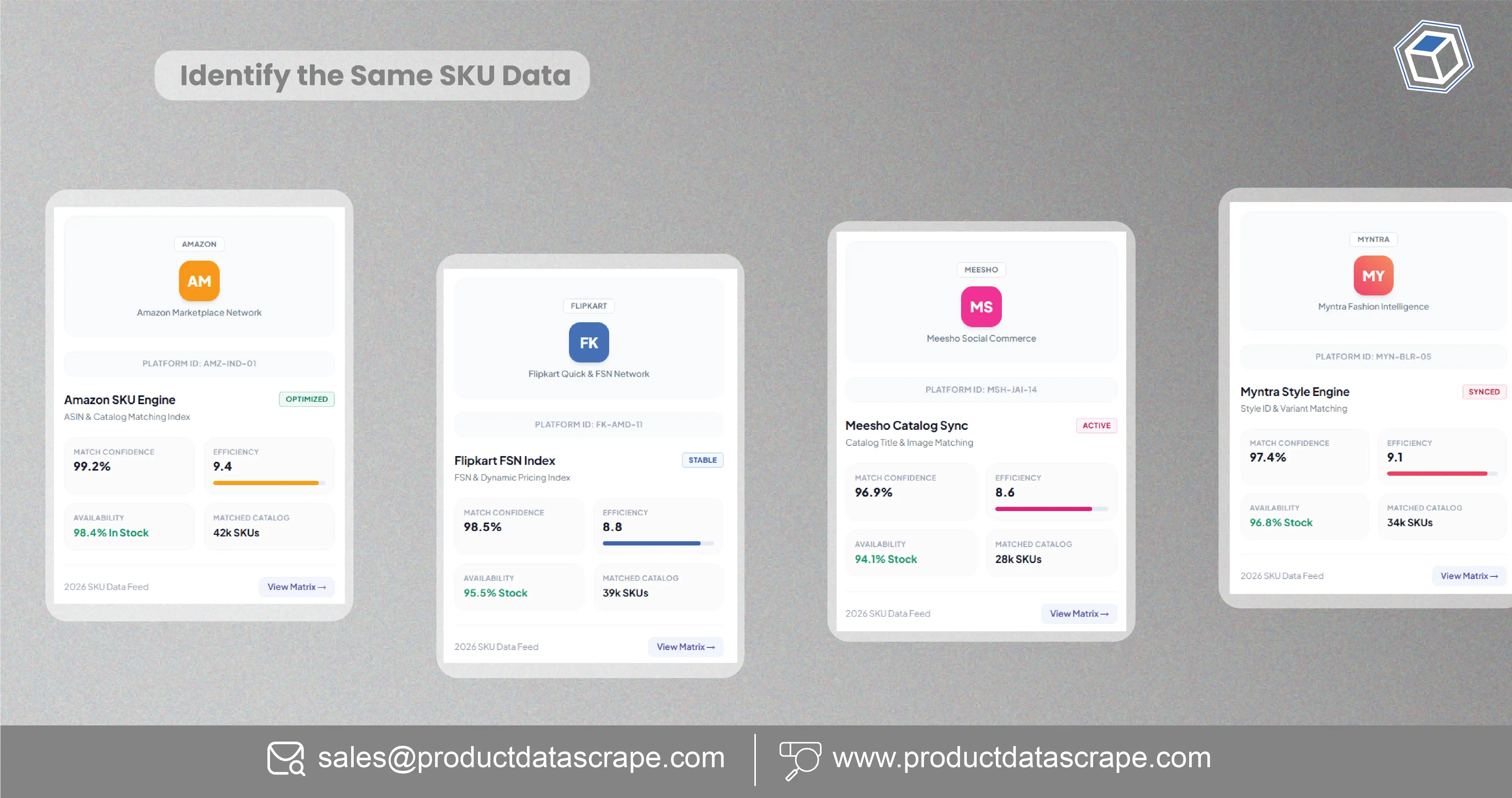
Amazon Flipkart Meesho Myntra Product Matching should not assume that one platform's SKU can directly identify the same product on another platform. A seller SKU is often an internal reference, whereas a marketplace product identifier can refer to a catalog record.
Amazon uses ASINs to identify catalog products. It also supports industry-standard identifiers such as UPC, EAN, and GTIN for product identification. Amazon India explains that sellers can search and match existing products using identifiers, product names, model numbers, and brand information.
Flipkart's developer documentation distinguishes between a product identified by an FSN and a listing identified by a listing ID mapped to a seller SKU. This distinction is important when building cross-platform catalog relationships.
A Flipkart scraper can collect permitted listing information, such as product names, identifiers, prices, and attributes, for structured comparison. The resulting records should be mapped to a common internal product identity instead of treating every marketplace listing as a separate physical product.
| Identifier | Purpose | Matching application |
|---|---|---|
