ECLNR vs ECKNR Turning Holders: Key Differences, Insert Compatibility & Selection Guide
Author : Surya makeyoueasy | Published On : 24 Nov 2026
Introduction
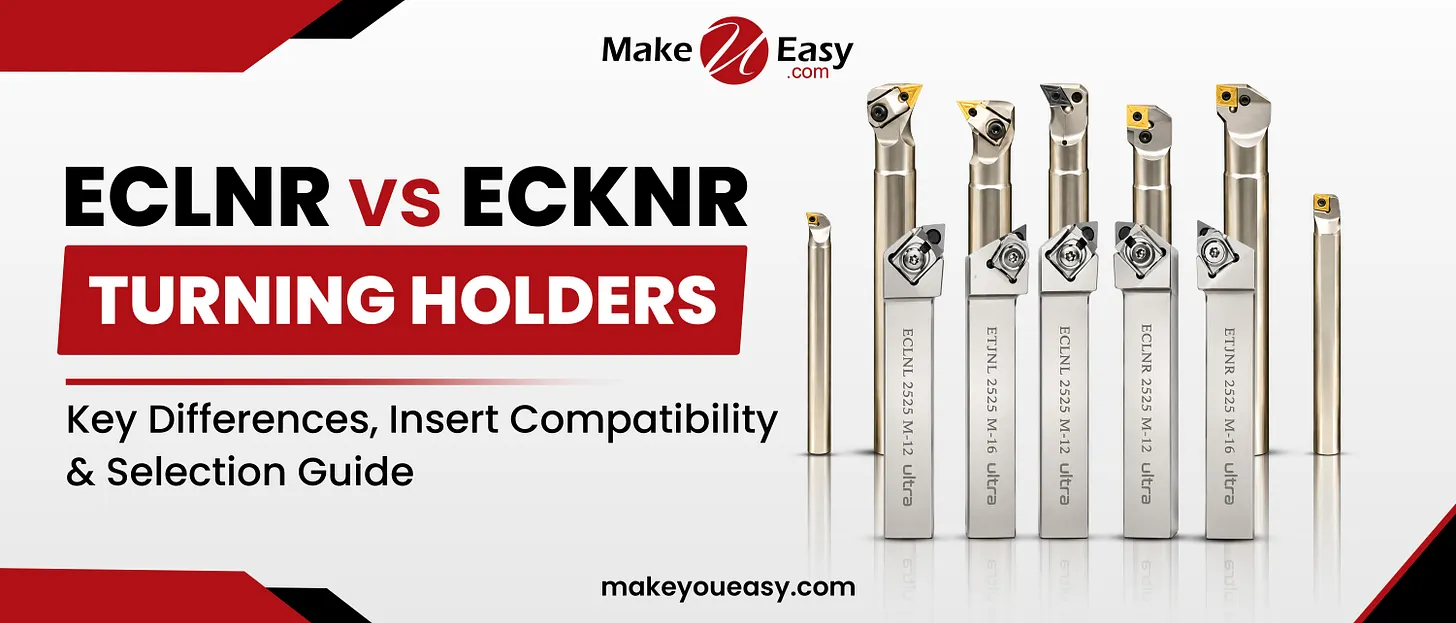
ECLNR and ECKNR are external turning tool-holder designations commonly used with 80° negative CN-type inserts. Although both holders can accommodate similar insert shapes and sizes, their cutting-edge orientations are different. ECLNR features a 95° tool style, whereas ECKNR uses a 75° style. Understanding these differences helps machinists select the correct holder for longitudinal turning, facing, and other external machining operations.
What Is an ECLNR Turning Holder?
An ECLNR turning holder features a 95° cutting-edge angle and an offset shank. It is designed for side and end cutting operations, making it a versatile option for external turning and facing.
Main features:
-
95° cutting-edge angle.
-
Designed for 80° rhombic negative inserts.
-
Suitable for longitudinal turning and facing.
-
Available in different shank sizes and insert capacities.
-
Commonly offered with a right-hand or left-hand configuration.
What Is an ECKNR Turning Holder?
An ECKNR turning holder features a 75° cutting-edge angle with an offset shank. Its geometry is intended for end-cutting operations and applications where a 75° approach is required.
Main features:
-
75° cutting-edge angle.
-
Designed for compatible 80° rhombic negative inserts.
-
Suitable for selected facing and external turning operations.
-
Provides a different cutting-edge orientation from ECLNR.
-
Available in different shank sizes and configurations.
ECLNR vs ECKNR: Key Differences
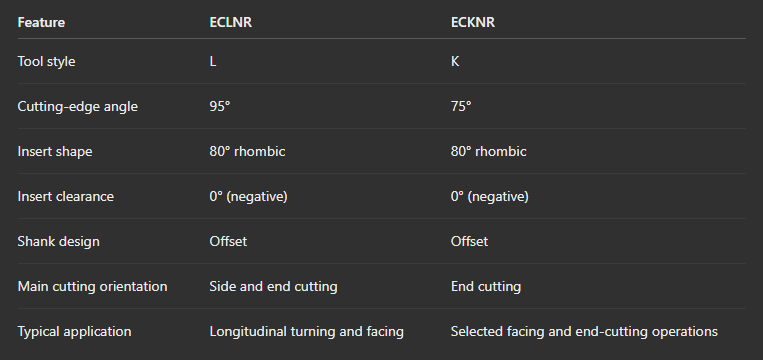
The main difference is the cutting-edge orientation. Neither holder is universally better; the correct choice depends on the component geometry, machining direction and required tool access.
Understanding the ECLNR and ECKNR Holder Codes
Each character identifies a particular holder feature. In Echaintool’s E-Type holder range, the designations can be understood as follows:
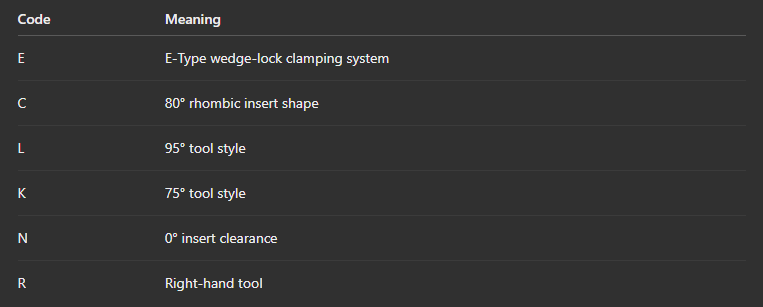
Important: The E-Type wedge-lock designation is manufacturer-specific. Always check the relevant manufacturer’s catalogue when comparing holders from different brands.
Insert Compatibility: Which Inserts Can Be Used?
Both ECLNR and ECKNR holders are designed for compatible C-shaped, 80° negative inserts. Common examples include CNMG inserts, provided the insert size and seating arrangement match the holder.
Typical catalogue examples include:
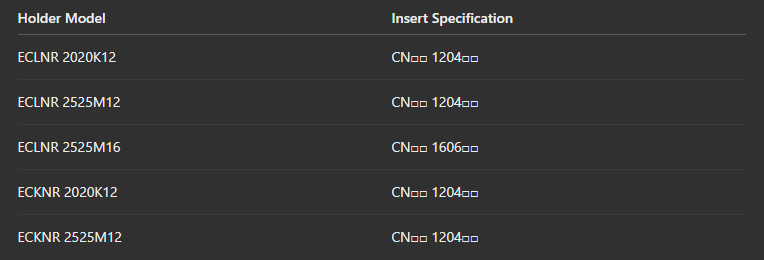
The insert-size designation must match the holder pocket. For example, a holder specified for CN□□ 1204□□ should not automatically be fitted with a larger CN□□ 1606□□ insert.
Before purchasing, verify:
-
Insert shape and included angle.
-
Insert clearance angle.
-
Insert size and thickness.
-
Nose radius and chipbreaker suitability.
-
Clamping arrangement and seating compatibility.
Applications of ECLNR and ECKNR Holders
ECLNR Holder Applications
-
Longitudinal turning: Machining external cylindrical surfaces along the component length.
-
Facing: Machining the end face of a workpiece.
-
Shoulder turning: Producing shoulders where the holder geometry provides sufficient clearance.
-
General external turning: Performing common CNC and conventional lathe operations.
ECKNR Holder Applications
-
End-cutting operations: Machining with a 75° cutting-edge orientation.
-
Facing operations: Working on suitable end-face profiles.
-
External profile machining: Producing selected component profiles where the tool geometry provides access.
-
Shoulder and contour work: Machining compatible profiles after checking tool clearance and workpiece geometry.
Actual application suitability depends on the holder design, insert geometry and machining setup.
How to Select the Right Turning Holder
1. Check the Machining Operation
Choose ECLNR for general side and end cutting with a 95° geometry. Consider ECKNR when a 75° end-cutting orientation is required.
2. Verify Insert Compatibility
Confirm the insert shape, clearance, size and clamping arrangement. Do not select a holder based only on the insert’s brand or appearance.
3. Check Shank Dimensions
Match the holder’s shank height and width with the machine tool post or turret. Common sizes include 20 × 20 mm and 25 × 25 mm.
4. Select the Correct Tool Hand
Choose right-hand or left-hand versions according to the machine setup and cutting direction.
5. Consider Workpiece Geometry
Check shoulder clearance, tool access, component diameter and machining direction before finalising the holder.
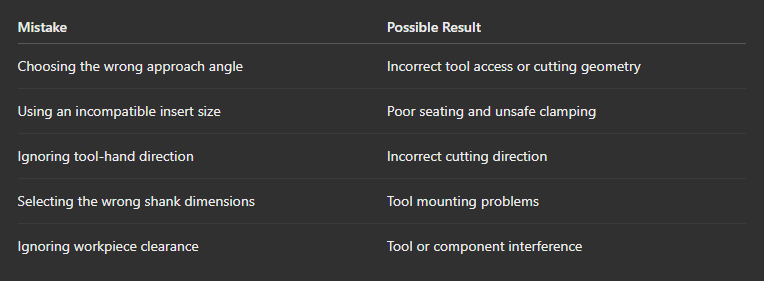
Common Tool Holder Selection Mistakes
Why Choose the Right CNC Turning Holder?
Selecting a compatible turning holder supports stable insert clamping, suitable cutting geometry and consistent machining results. MakeYouEasy helps machining professionals explore CNC turning inserts, tool holders and machining accessories for different manufacturing requirements. Always verify the holder model, insert specification and manufacturer recommendations before use.
Conclusion
ECLNR and ECKNR turning holders are designed for different cutting-edge orientations. ECLNR uses a 95° style for side and end cutting, while ECKNR uses a 75° style intended for end cutting. Both can use compatible 80° negative CN-type inserts when the insert size and clamping arrangement match.
For the right selection, consider cutting direction, workpiece geometry, insert compatibility, tool clearance and shank dimensions.
Explore CNC turning tools and accessories at MakeYouEasy.com.
FAQs
1. What is the main difference between ECLNR and ECKNR holders?
ECLNR has a 95° cutting-edge angle, while ECKNR has a 75° cutting-edge angle.
2. Which insert is compatible with ECLNR holders?
Compatible 80° negative C-shaped inserts, such as the specified CNMG sizes, can be used when the holder pocket matches.
3. Can the same CNMG insert be used in ECLNR and ECKNR holders?
Yes, when both holders specify the same insert size and compatible seating and clamping arrangements.
4. What does the N represent in ECLNR and ECKNR?
N indicates a 0° normal clearance angle, which is associated with negative inserts.
5. How do I choose between ECLNR and ECKNR?
Choose according to the required cutting-edge angle, machining direction, workpiece geometry and tool clearance.
Popular Search Keywords
ECLNR turning holder, ECKNR turning holder, ECLNR vs ECKNR, CNMG turning tool holder, 95-degree turning holder, 75-degree turning holder, CNC external turning holder, negative insert tool holder, CNMG insert compatibility, CNC turning tool selection guide
