Dynamic Pricing intelligence in Agentic AI Era
Author : Travel Scrape | Published On : 05 Oct 2026
Introduction
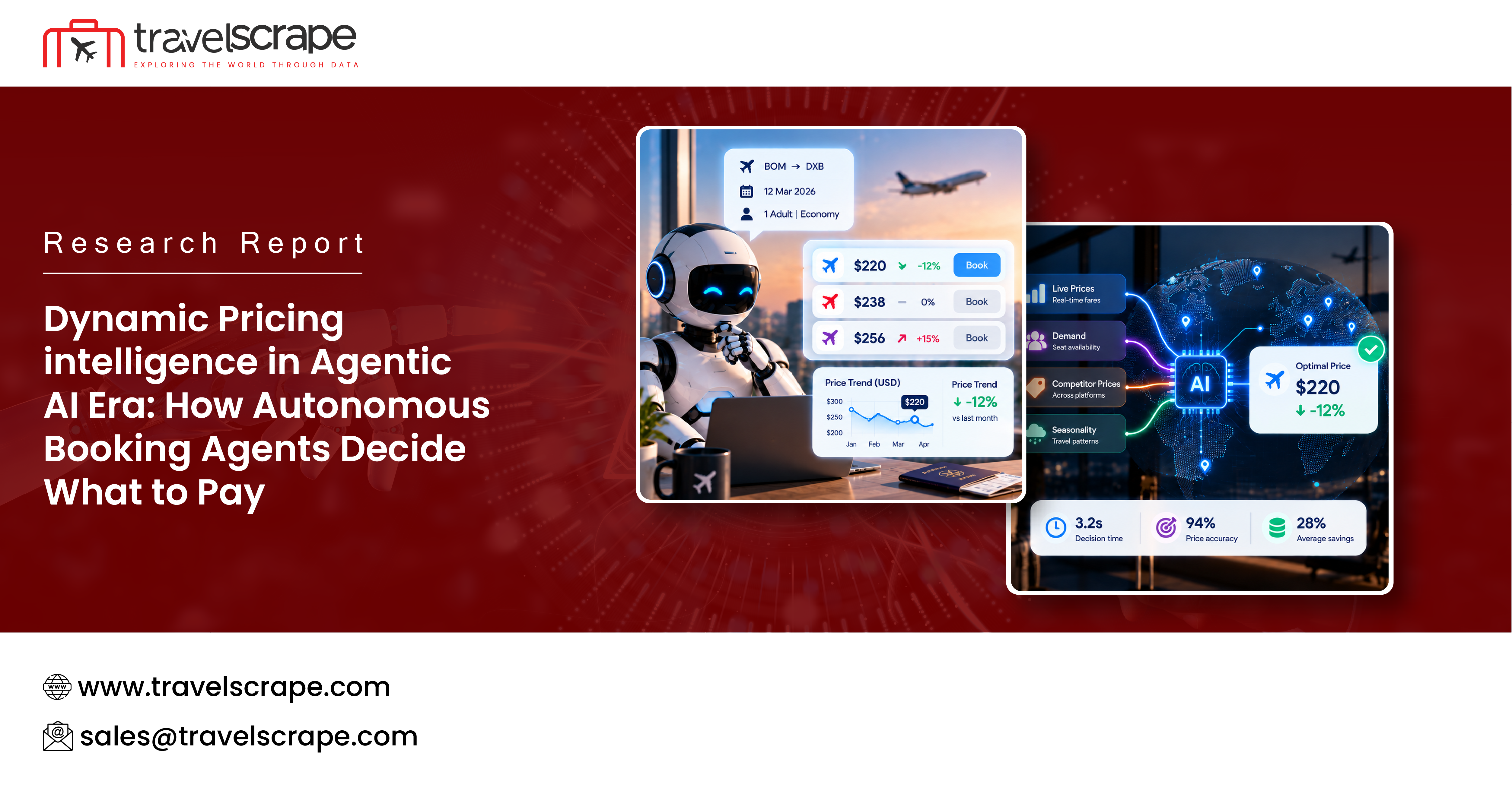
Travel booking is entering a new phase in which artificial intelligence is moving beyond recommendations and beginning to make purchasing decisions. Instead of simply telling travelers that a flight or hotel is available, autonomous booking agents can evaluate alternatives, monitor changing prices, compare trade-offs, forecast demand, and potentially complete transactions according to predefined objectives.
This shift is creating a new market for Dynamic Pricing intelligence in Agentic AI Era, where continuously refreshed travel data becomes the foundation for autonomous purchasing decisions. Dynamic Pricing Intelligence is increasingly relevant because prices, availability, cancellation conditions, baggage, room attributes, loyalty benefits, and ancillary products can change independently and at different speeds.
For airlines, this evolution aligns with the industry's broader transition toward dynamically generated offers. IATA describes Dynamic Offers as combining dynamic pricing, continuous pricing, and dynamic bundling, with offers responding to shopping context, market conditions, and consumer requirements.
At the same time, AI Flight Price and Availability Monitoring can give autonomous agents the continuously updated information needed to determine whether to purchase immediately, wait, change dates, select another carrier, or substitute an itinerary.
Hotels are undergoing a similar transformation through AI hotel booking demand forecasting, where historical booking patterns, occupancy, lead time, events, seasonality, cancellation behavior, room availability, and competitor rates can contribute to automated purchasing decisions.
The result is a new travel intelligence environment in which the central question is no longer simply, "What is today's price?" Instead, the question becomes: "Is this the right price to pay right now, and is waiting likely to improve the outcome?"
From Dynamic Pricing to Autonomous Price Decisions
Traditional dynamic pricing is generally supplier-led. Airlines and hotels adjust prices according to demand, inventory, capacity, competition, booking windows, and other commercial variables.
Agentic AI introduces another decision-maker into this ecosystem: the purchasing agent.
An autonomous booking agent may receive instructions such as:
- Book a Mumbai–Dubai flight below a specified budget.
- Prefer nonstop flights but accept one stop if savings exceed a threshold.
- Book a four-star hotel when the effective nightly price falls below a target.
- Avoid restrictive cancellation policies.
- Purchase when predicted future savings are smaller than the risk of losing availability.
- Optimize the complete trip rather than individual components.
The agent therefore needs more than a price feed. It needs contextual data and decision intelligence.
IATA's modernization of airline retailing around NDC and Offers & Orders is particularly important because richer offer construction and distribution can give travel systems more detailed product and pricing information than legacy fare structures.
How an Autonomous Booking Agent Decides What to Pay
A sophisticated booking agent can evaluate a travel offer through multiple layers.
Price Layer
The agent identifies the current price and compares it against historical observations, competitor prices, previous searches, and the user's budget.
Availability Layer
A low price has little value if only one seat remains, the desired room category is nearly sold out, or inventory is disappearing rapidly.
Value Layer
The agent can calculate effective value rather than headline price. For example, a $450 flight with baggage and seat selection may be preferable to a $410 fare that charges substantial ancillary fees.
Forecast Layer
Machine-learning models can estimate whether the price is likely to rise, decline, or remain relatively stable.
Constraint Layer
The agent applies traveler-specific constraints such as maximum budget, preferred airline, minimum hotel rating, cancellation requirements, departure windows, and loyalty preferences.
Execution Layer
Finally, the agent determines whether the expected benefit of waiting exceeds the risk of losing the current offer.
This creates a decision function that can conceptually be expressed as:
Expected Booking Value = Price Benefit + Product Value + Availability Confidence − Waiting Risk − Constraint Penalties
The lowest displayed price therefore does not automatically become the winning offer.
Agentic AI Travel Booking Analysis
Agentic AI travel booking Analysis increasingly depends on the ability to combine fragmented travel signals into one decision environment.
Consider a traveler looking for a Delhi–London flight. Five itineraries may appear attractive, but their true economic value can differ because of baggage, connection time, cancellation rules, airport changes, schedule reliability, and seat availability.
An autonomous agent can normalize these attributes and create a comparable offer score.
For hotels, the same principle applies. A $180 room with breakfast, free cancellation, and a central location may have greater utility than a $155 room with restrictive conditions and additional fees.
This changes competitive analysis from simple price comparison to offer intelligence.
Booking Trend Insights and Demand Forecasting
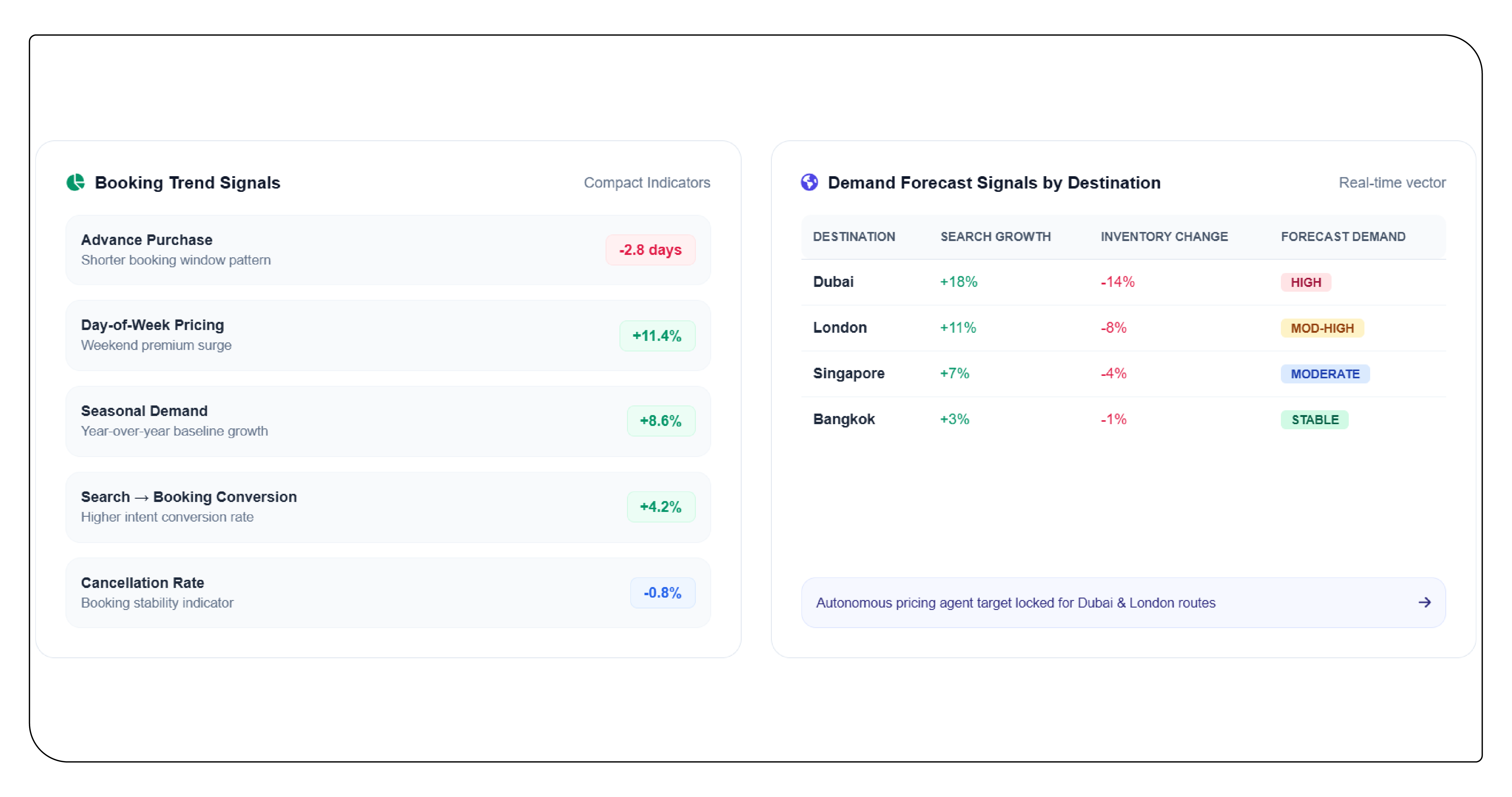
Booking Trend Insights become particularly valuable when agents make decisions over time rather than during a single search.
A forecasting system can monitor:
- Advance purchase windows
- Day-of-week pricing
- Seasonal demand
- Holiday periods
- Destination events
- Occupancy movements
- Search-to-booking conversion
- Cancellation patterns
- Competitor pricing
- Inventory depletion
- Fare or room-category changes
For example, if hotel prices have increased 7% over three consecutive monitoring cycles while available inventory has declined sharply, an autonomous agent may assign a higher probability to further price increases.
Conversely, if flight inventory remains stable and comparable fares are declining, the agent may delay purchasing.
This creates a distinction between price monitoring and price prediction. Monitoring describes what is happening. Prediction estimates what could happen next.
Illustrative Agentic Travel Pricing Dataset
The following model demonstrates how an AI travel intelligence system could organize observations from flight and hotel markets.
Illustrative Agentic AI Travel Pricing Intelligence Dataset
| Market | Product | Current Price | 7-Day Avg. | Price Change | Availability | Demand Index | Competitor Median | Forecast | Agent Decision |
|---|---|---|---|---|---|---|---|---|---|
| Delhi–Dubai | Economy Flight | $286 | $301 | -5.0% | 68% | 72 | $294 | Stable | Monitor |
| Mumbai–London | Economy Flight | $612 | $655 | -6.6% | 54% | 81 | $625 | Rising | Buy |
| Bengaluru–Singapore | Economy Flight | $228 | $241 | -5.4% | 76% | 64 | $235 | Stable | Monitor |
| New York–Paris | Economy Flight | $742 | $710 | +4.5% | 42% | 89 | $728 | Rising | Buy |
| Dubai–Bangkok | Economy Flight | $319 | $337 | -5.3% | 71% | 69 | $325 | Falling | Wait |
| Delhi–Singapore | Economy Flight | $342 | $358 | -4.5% | 63% | 74 | $349 | Stable | Monitor |
| London Hotel Market | 4-Star Room | $184 | $196 | -6.1% | 47% | 78 | $191 | Rising | Buy |
| Dubai Hotel Market | 5-Star Room | $226 | $241 | -6.2% | 61% | 71 | $233 | Stable | Monitor |
| Paris Hotel Market | 4-Star Room | $218 | $204 | +6.9% | 32% | 91 | $224 | Rising | Buy |
| Singapore Hotel Market | 4-Star Room | $173 | $181 | -4.4% | 58% | 67 | $178 | Stable | Monitor |
| Bangkok Hotel Market | 4-Star Room | $112 | $119 | -5.9% | 74% | 55 | $116 | Falling | Wait |
| New York Hotel Market | 4-Star Room | $259 | $247 | +4.9% | 29% | 94 | $265 | Rising | Buy |
Illustrative analytical dataset; figures are modeled for research demonstration.
The table illustrates why an autonomous agent cannot rely on price alone. The Mumbai–London fare is below its seven-day average while demand remains high, making immediate purchase more attractive. Bangkok, by comparison, combines falling prices with strong availability, giving an agent greater justification to wait.
Real-Time Data API as the Decision Infrastructure
A Real-Time Data API can serve as the connection between travel data sources and autonomous decision systems.
The API layer may provide:
- Flight fares
- Seat availability
- Hotel room rates
- Room inventory
- Cancellation conditions
- Taxes and fees
- Baggage information
- Departure and arrival times
- Competitor offers
- Historical prices
- Demand indicators
- Timestamped observations
Real-time access is important because travel prices are inherently volatile. An agent working from outdated information may recommend an offer that no longer exists.
Modern airline retailing also increasingly emphasizes API-based distribution and richer offer information. NDC is designed to improve communication between airlines and travel sellers while supporting richer air content and more transparent shopping experiences.
Agentic AI Travel Price Comparison Dataset
An Agentic AI Travel Price Comparison dataset should go beyond collecting the cheapest available rate.
A comprehensive dataset can normalize:
- Supplier
- Route
- Departure date
- Return date
- Cabin
- Fare type
- Baggage
- Taxes
- Seat availability
- Booking conditions
- Hotel category
- Room type
- Meal inclusion
- Cancellation policy
- Competitor price
- Timestamp
- Historical price
- Price movement
- Forecast direction
This creates a machine-readable foundation for autonomous purchasing decisions.
Instead of asking an agent to compare hundreds of websites manually, the dataset can transform heterogeneous observations into standardized records suitable for AI reasoning.
Agentic AI Travel Booking Intelligence
Agentic AI Travel Booking Intelligence can be structured around three connected systems: observation, prediction, and action.
The observation layer captures current market conditions.
The prediction layer estimates future price and availability movements.
The action layer determines whether the agent should buy, wait, switch supplier, change dates, or modify the trip.
This creates a closed-loop travel intelligence system.
For example:
Observe → Compare → Forecast → Score → Decide → Book → Monitor Outcome → Learn
Such a system can become increasingly sophisticated as it records which decisions produced successful outcomes.
Competitor Price Tracking and Optimization
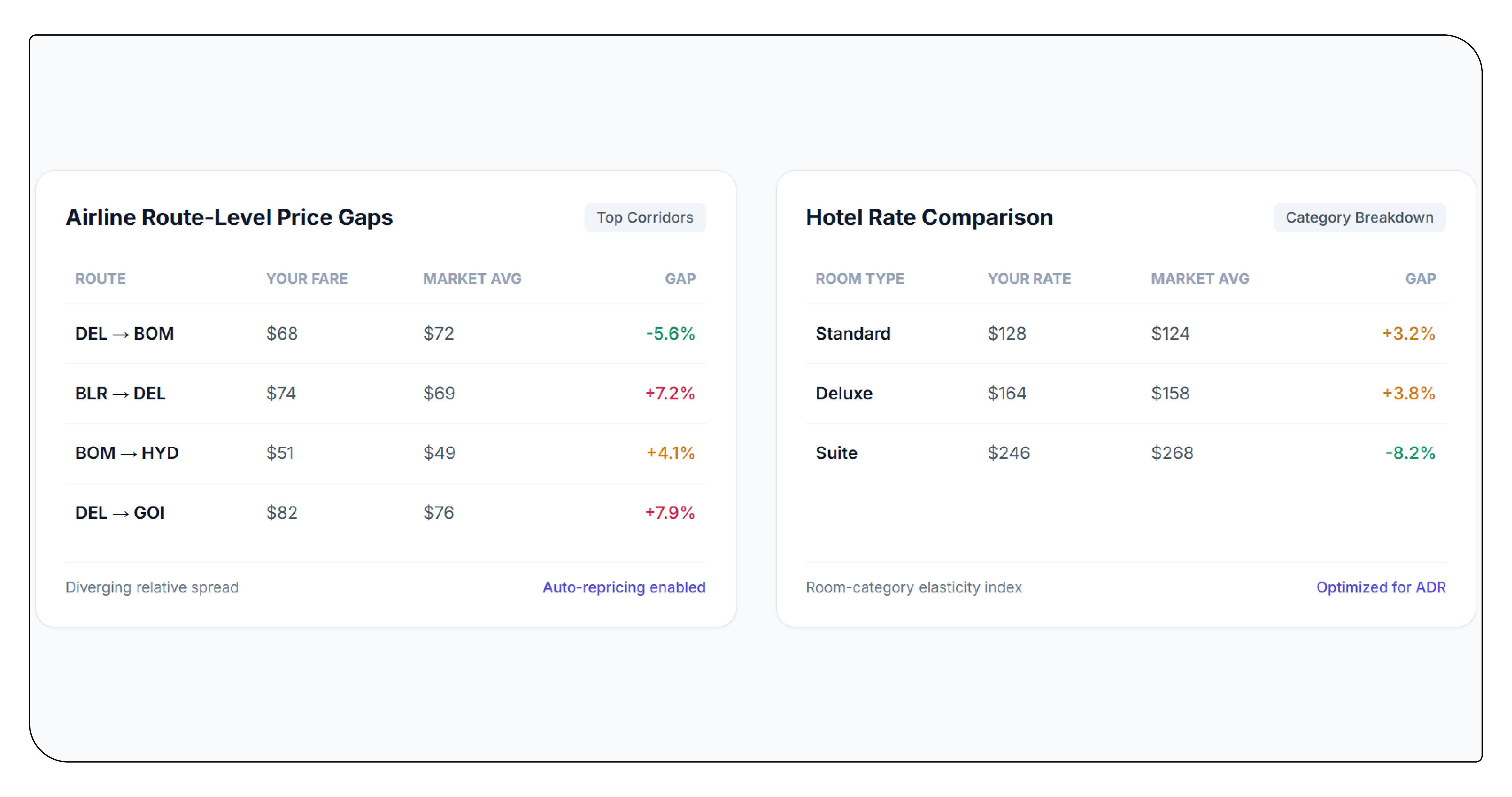
Competitor Price Tracking enables travel businesses to understand how their offers compare with competing airlines, hotels, OTAs, and other distribution channels.
For airlines, this can reveal route-level price gaps.
For hotels, it can identify rate differences by room type, cancellation policy, occupancy level, and booking window.
For travel platforms, competitor monitoring can reveal whether an offer is consistently above or below market benchmarks.
The objective is not necessarily to become the cheapest provider. Instead, businesses can identify when pricing is materially misaligned with market conditions.
Illustrative Agent Decision Performance Model
The second table demonstrates how an autonomous agent might evaluate different booking scenarios using specific flight names and airline examples.
Illustrative Agentic AI Travel Decision Scoring by Flight
| Flight / Airline | Route | Price Score /100 | Availability Score /100 | Forecast Score /100 | Competition Score /100 | Flexibility Score /100 | Overall Decision Score | Recommended Action |
|---|---|---|---|---|---|---|---|---|
| Emirates EK501 | Mumbai–Dubai | 91 | 88 | 83 | 86 | 78 | 86.1 | Book Now |
| British Airways BA142 | Mumbai–London | 84 | 94 | 72 | 81 | 91 | 84.4 | Monitor |
| Singapore Airlines SQ423 | Mumbai–Singapore | 96 | 48 | 63 | 92 | 67 | 75.2 | Conditional Buy |
| Air France AF217 | New York–Paris | 76 | 89 | 91 | 74 | 85 | 83.0 | Wait 6 Hours |
| Qatar Airways QR529 | Delhi–Doha | 88 | 66 | 87 | 89 | 72 | 80.4 | Buy if Price Holds |
| Lufthansa LH757 | Bengaluru–Frankfurt | 92 | 73 | 86 | 90 | 84 | 86.2 | Book Now |
| Etihad Airways EY203 | Mumbai–Abu Dhabi | 85 | 91 | 71 | 82 | 94 | 84.7 | Monitor |
| Turkish Airlines TK721 | Delhi–Istanbul | 94 | 43 | 61 | 88 | 79 | 75.5 | Conditional Buy |
| Virgin Atlantic VS301 | Delhi–London | 78 | 82 | 93 | 76 | 89 | 83.6 | Wait |
| KLM KL878 | Bengaluru–Amsterdam | 87 | 69 | 88 | 91 | 86 | 84.2 | Buy if Availability Falls |
Illustrative scoring framework; flight names and figures are used for research demonstration and do not represent live fares, availability, or airline performance.
The table demonstrates a critical principle: the agent should optimize the probability-adjusted value of an offer, rather than blindly selecting the lowest price.
For example, Singapore Airlines SQ423 receives a very high price score but a comparatively low availability score. An agent could therefore treat the offer differently from a flight that combines a competitive fare with strong availability and a favorable forecast.
Similarly, Air France AF217 has a strong forecast score, suggesting that the model expects pricing conditions to potentially improve. The agent could therefore delay the transaction when the probability of savings outweighs the risk of losing inventory.
Agentic AI Travel Price Optimization Insights
Agentic AI Travel Price Optimization Insights can help businesses understand how autonomous systems may react to their pricing strategies.
If an airline repeatedly increases a fare when inventory reaches a certain threshold, agents may learn this pattern.
If a hotel frequently reduces prices 48 hours before check-in, agents may learn to delay booking when inventory remains high.
This creates an emerging strategic environment where suppliers are not pricing only for humans. They may increasingly be pricing in markets where purchasing decisions are influenced by machine-readable signals and autonomous algorithms.
Consequently, transparency, consistent product attributes, reliable APIs, and high-quality availability information become increasingly important.
Challenges and Governance
Agentic booking introduces several challenges.
Data freshness is critical because stale prices can produce incorrect decisions.
API reliability matters because an agent cannot confidently execute a purchase if availability responses are inconsistent.
Price comparability can also be difficult when suppliers structure baggage, taxes, cancellation, meals, and ancillary services differently.
Privacy and personalization require careful governance. Autonomous systems should only use permitted data and operate within clearly defined user instructions.
Transaction controls are equally important. Agents should operate within spending limits, destination restrictions, approval thresholds, and auditable decision policies.
IATA's Offers & Orders direction illustrates why modern travel retailing requires changes across technology, distribution, commercial processes, and order management rather than simply adding an AI layer to legacy infrastructure.
Conclusion
The agentic AI era is changing the economics of travel booking. Autonomous agents can increasingly evaluate price, availability, competition, demand, flexibility, and predicted future movements before deciding whether an offer is worth purchasing.
For travel businesses, the strategic opportunity lies in building continuously updated datasets and intelligence systems capable of supporting these decisions. AI Flight Price and Availability Monitoring, hotel demand forecasting, competitor intelligence, real-time APIs, and standardized travel datasets can collectively form the infrastructure for autonomous travel commerce.
The next generation of travel intelligence will therefore move from static price comparison toward predictive and decision-oriented systems. Suppliers will need to understand not only what travelers see, but also how autonomous agents interpret their offers.
At the same time, Rate Parity Monitoring will remain essential as autonomous systems compare prices across direct websites, OTAs, aggregators, and other channels at machine speed. Businesses that combine real-time market observation with predictive analytics and governed agentic decision-making will be better positioned to compete in a travel market where the next customer may increasingly be an AI agent acting on behalf of a traveler.
Ready to elevate your travel business with cutting-edge data insights? Scrape Aggregated Flight Fares to identify competitive rates and optimize your revenue strategies efficiently. Discover emerging opportunities with tools to Extract Travel Website Data, leveraging comprehensive data to forecast market shifts and enhance your service offerings. Real-Time Travel App Data Scraping Services helps stay ahead of competitors, gaining instant insights into bookings, promotions, and customer behavior across multiple platforms. Get in touch with Travel Scrape today to explore how our end-to-end data solutions can uncover new revenue streams, enhance your offerings, and strengthen your competitive edge in the travel market.
Source: https://www.travelscrape.com/dynamic-pricing-intelligence-agentic-ai-era.php
Original: https://www.travelscrape.com
