Drilling Head Inserts: Complete Guide to Types, Grades, Applications & Selection
Author : Surya makeyoueasy | Published On : 10 Oct 2026
Introduction
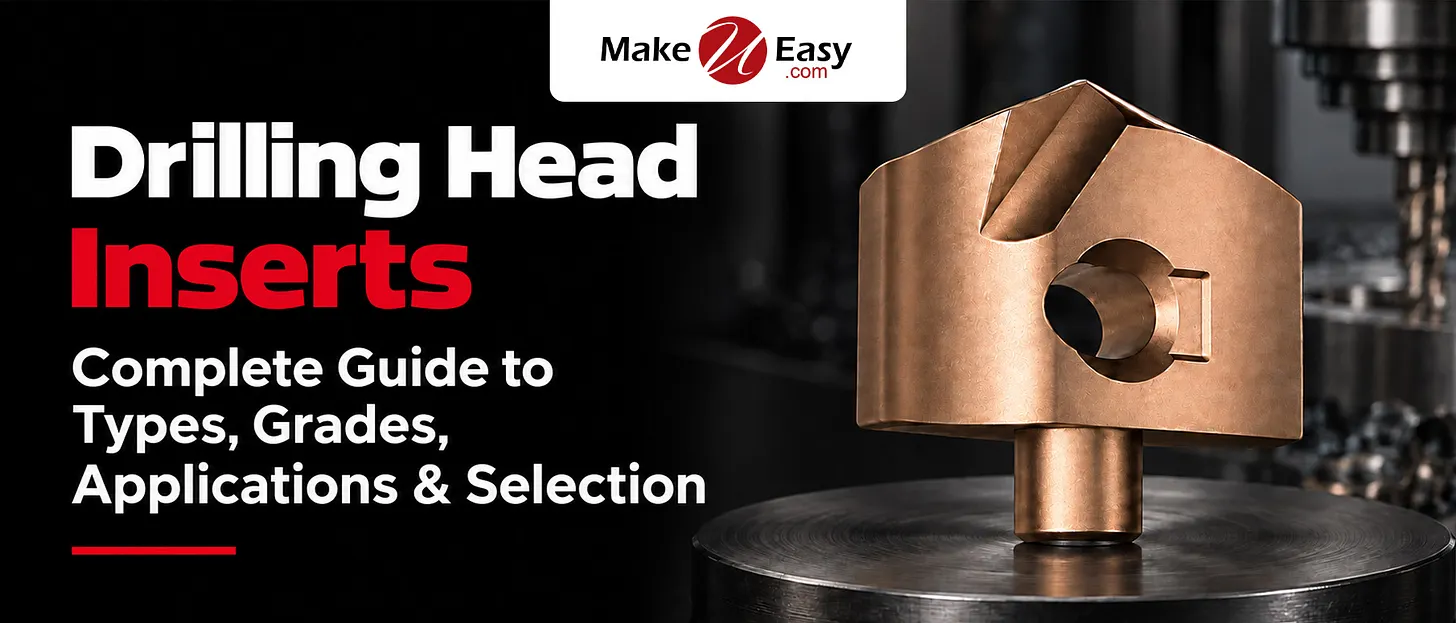
Drilling head inserts are replaceable carbide cutting components used in indexable and exchangeable-head drilling systems. The right insert geometry, grade, chip breaker, and cutting parameters can improve hole quality, tool life, chip evacuation, and machining productivity. Understanding the different insert types and their applications helps CNC machinists select the correct drilling solution for each workpiece material and hole requirement.
What Are Drilling Head Inserts?
Drilling head inserts are carbide cutting edges mounted on drill bodies or drilling heads. In many indexable drilling systems, central and peripheral inserts work together: the central insert cuts near the drill axis while the peripheral insert machines the outer portion of the hole. These positions are not always interchangeable, so the exact insert position and drill-body specification must be verified before ordering.
Unlike solid carbide drills, indexable drills allow worn cutting edges to be replaced without replacing or regrinding the complete drill body. They are commonly used for medium- and large-diameter holes and production drilling.
Main Types of Drilling Head Inserts
1. Center Inserts
Center inserts operate close to the drill axis, where cutting speed is relatively low. They are designed to manage the central portion of the hole and must provide suitable toughness and chip control.
2. Peripheral Inserts
Peripheral inserts cut at the outside diameter, where cutting speed is highest. They commonly require strong wear resistance because the cutting edge experiences higher peripheral speed.
3. SOMT Inserts
SOMT-style inserts are used in certain indexable drilling systems and are available in different sizes and grades for specific drilling applications.
4. SPMG Inserts
SPMG inserts are commonly used in indexable drill systems and are available in multiple sizes and carbide grades for different workpiece materials.
5. WCMT Inserts
WCMT triangular inserts are used in compatible drilling systems and can provide multiple usable cutting corners depending on the design.
6. Exchangeable Drill-Head Inserts
Some drilling systems use complete replaceable carbide heads instead of separate center and peripheral inserts. These systems can simplify tool changes while providing application-specific geometries.
Drilling Insert Grades
Insert grade selection should be based primarily on the workpiece material, cutting speed, stability, and drilling conditions.
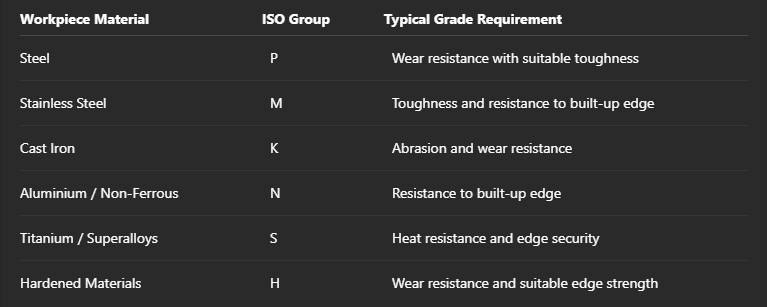
Grade availability varies by manufacturer. For example, Sandvik lists different central and peripheral grades for ISO P, M, K, N, S, and H applications, while Iscar’s hole-making grades include options for steel, stainless steel, and high-temperature alloys.
Carbide Coatings and Grade Selection
Coating technology can influence wear resistance, thermal performance, and resistance to built-up edge. PVD-coated grades are commonly used where toughness and edge security are important, while CVD or specialized coatings may provide advantages in stable, high-productivity applications.
For drilling, the peripheral insert can experience considerably higher cutting speed than the center insert. Some drilling systems therefore use different grades for the two positions to balance toughness at the center with wear resistance at the outside.
Always use the drill manufacturer’s recommended grade and cutting data instead of selecting a grade only from its coating color or general ISO classification.
Drilling Head Insert Applications
1. General CNC Drilling
Indexable drilling heads are widely used for production drilling on CNC machining centers and turn-mill machines.
2. Medium and Large Diameter Holes
They are particularly useful where replacing inserts is more economical than replacing a complete solid drill.
3. Blind-Hole Drilling
Suitable geometries can be used when the application requires a relatively flat hole bottom.
4. Structural and General Engineering
Drilling inserts can be used for bolt holes, clearance holes, flanges, pump and valve components, and other engineering parts.
5. Deep or Extended Drilling
Certain indexable systems are designed for higher L/D ratios. Through-coolant and effective chip evacuation become increasingly important as drilling depth increases.
How to Select the Right Drilling Head Insert
Consider these factors before purchasing:
1. Workpiece Material
Identify the ISO material group and choose a compatible carbide grade.
2. Insert Position
Confirm whether the insert is intended for the center or peripheral position. These should not be assumed to be interchangeable.
3. Drill Diameter and Depth
Check the drill body diameter and required hole depth, including the manufacturer’s recommended L/D range.
4. Chip breaker geometry
Select a chip breaker suitable for the material, feed rate, and drilling depth.
5. Coolant Supply
Through-tool coolant can improve chip evacuation and temperature control, particularly in deeper holes.
6. Machine Rigidity
A rigid machine, work-holding setup, and short tool overhang help reduce vibration and insert damage.
7. Hole Quality Requirements
For tight tolerances or demanding surface requirements, check whether the drilling operation should be followed by boring, reaming, or another finishing process.
Common Drilling Insert Problems
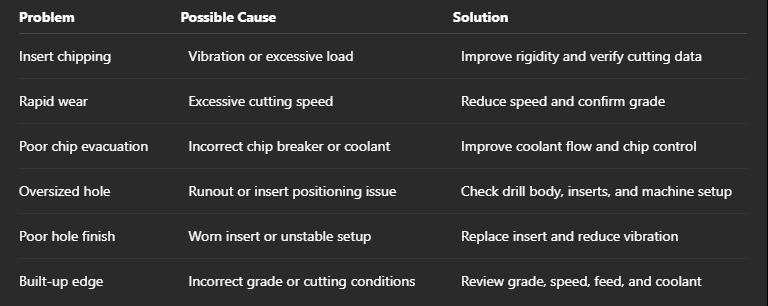
For irregular or uneven entry surfaces, manufacturers recommend controlling feed and reducing vibration because uneven forces can cause premature edge wear.
Tips for Better Drilling Performance
-
Use the shortest practical drill setup.
-
Verify center and peripheral insert positions before installation.
-
Follow manufacturer-recommended cutting speed and feed.
-
Maintain adequate coolant pressure and flow.
-
Replace damaged or excessively worn inserts promptly.
-
Avoid excessive tool overhang.
-
Check drill-body runout and insert seating.
-
Match the chip breaker to the workpiece and cutting conditions.
-
For deep holes, prioritize reliable chip evacuation.
Why Choose MakeYouEasy?
MakeYouEasy provides CNC cutting tools, drilling inserts, drill bodies, turning inserts, milling tools, tool holders, and machining accessories for manufacturing applications.
Choosing the correct drilling insert type, grade, chip breaker, and drill position can simplify tooling selection and support consistent hole-making performance.
Conclusion
Drilling head inserts play an important role in productive CNC hole making. Center and peripheral inserts perform different cutting functions, while carbide grades and chip breakers must be matched to the workpiece material and machining conditions.
For reliable results, verify the insert position, drill diameter, depth capability, grade, coolant requirements, and recommended cutting parameters before purchasing. A correctly matched drilling insert can help improve tool life, chip evacuation, hole quality, and overall machining efficiency.
Frequently Asked Questions
1. What are drilling head inserts used for?
They are replaceable carbide cutting components used in indexable or exchangeable-head drilling systems.
2. What is the difference between center and peripheral drilling inserts?
The center insert cuts near the drill axis, while the peripheral insert machines the outside diameter of the hole.
3. How do I choose a drilling insert grade?
Select the grade based on the workpiece material, cutting conditions, insert position, and the manufacturer’s recommendations.
4. Can drilling inserts be used for stainless steel?
Yes, provided the insert geometry, chip breaker, and carbide grade are specifically suitable for stainless steel.
5. How can I improve drilling insert tool life?
Use correct cutting parameters, maintain rigidity and coolant flow, control chip evacuation, and replace worn inserts before severe damage occurs.
Popular Search Keywords
drilling head inserts, drilling inserts, indexable drilling inserts, CNC drilling inserts, carbide drilling inserts, drill head inserts, center drilling inserts, peripheral drilling inserts, U drill inserts, SPMG drilling inserts, indexable drill insert grades
