Do You Really Need an Expensive Heat Press to Start a Sublimation Business?
Author : Edi Jiang | Published On : 21 Jul 2026
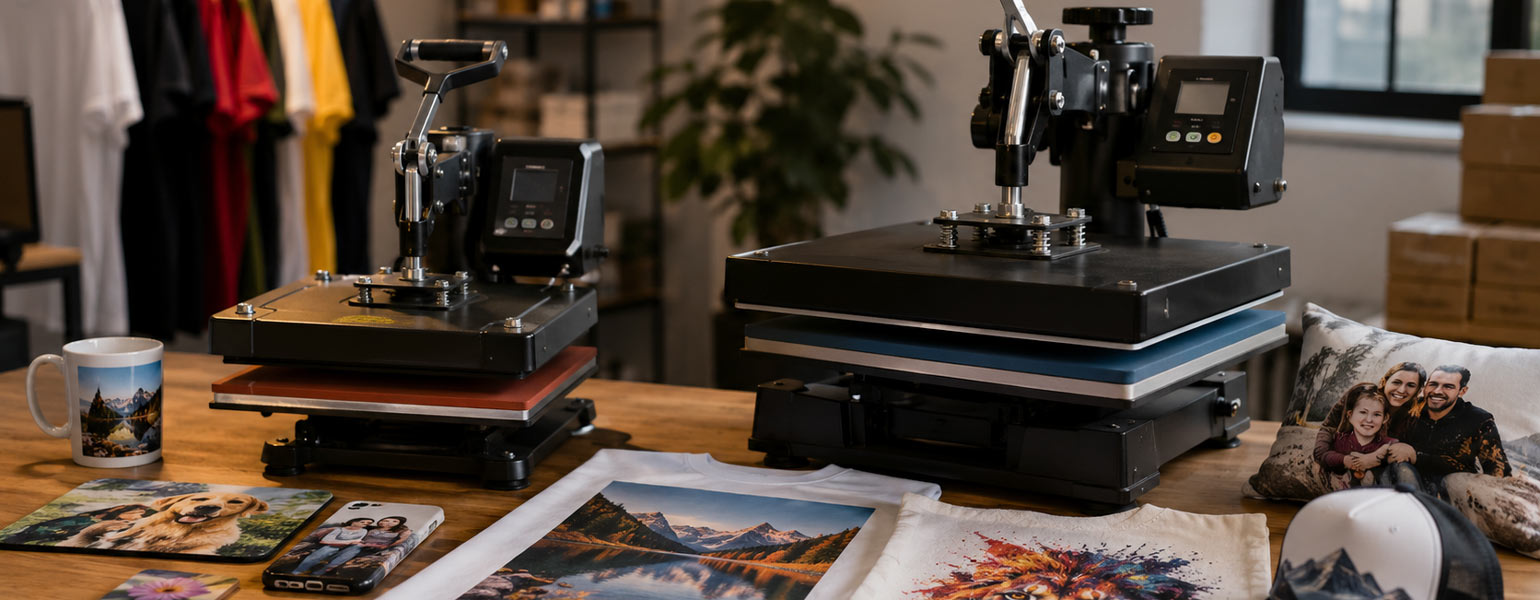
Starting a sublimation business in the UK can feel like an expensive exercise before you've even made your first sale.
There's the printer to think about, along with sublimation ink, paper, blanks, design software and packaging. Then comes the heat press, which is often where the spending gets serious. A quick look around the market can leave you wondering whether you need to spend several hundred pounds, or even more than £1,000, just to produce products that customers will actually be happy to buy.
It's a reasonable question.
The heat press is one of the most important pieces of equipment in a sublimation setup, but that doesn't automatically mean the most expensive machine is the right one for everyone. A beginner making a handful of personalised gifts at home has very different requirements from a business pressing hundreds of garments every week.
The more useful question isn't really whether an expensive heat press is better.
It's whether you actually need what you're paying for.
That distinction matters. A professional heat press may offer better temperature consistency, more even pressure, faster recovery and a much more comfortable production workflow. Those are genuine advantages. But if you're only making a few mugs or tote bags in the evening, you may not benefit enough from those features to justify the additional investment.
On the other hand, buying the cheapest machine you can find isn't necessarily a smart way to save money either.
The trick is finding the point where the equipment matches the work.
Your First Heat Press Doesn't Need to Be Your Forever Machine
One of the most common mistakes new sublimation sellers make is trying to choose equipment for a business they haven't built yet.
It's understandable. When you're investing your own money, you naturally want to avoid buying something twice. So you start thinking about everything that might happen in the future.
Perhaps you'll start selling on Etsy.
Then you might pick up some local business.
Maybe a school asks you to produce sportswear.
Then you could start supplying a football club.
Before long, you're imagining a busy workshop with hundreds of orders going out every week.
The problem is that none of those things have happened yet.
There is nothing wrong with having ambitious plans, but your first equipment purchase should usually be based on what you can realistically expect to produce in the next six to twelve months, rather than the business you hope to have one day.
For many people, the first stage is much smaller than they expect.
It might be ten mugs a week.
A few personalised tote bags.
The occasional cushion cover.
Perhaps a handful of T-shirts for friends, family or local customers.
At this point, a straightforward heat press can be perfectly adequate. You don't necessarily need an industrial machine sitting in the corner of a spare bedroom just in case your business suddenly takes off.
If that growth does happen, that's when you can look at upgrading.
In fact, needing a better heat press because your existing one can't keep up is a much nicer problem to have than spending £1,500 on equipment that spends most of its life switched off.
What Are You Actually Paying For With an Expensive Heat Press?
The biggest misconception about expensive heat presses is that they somehow produce completely different results simply because they cost more.
That's not quite how it works.
At the most basic level, every heat press has the same job. It needs to deliver the right combination of heat, pressure and time. Get those three things right, and sublimation can work extremely well, even on a relatively affordable machine.
So why do professional presses cost so much more?
The answer is consistency.
A more expensive machine isn't necessarily going to make a good design look dramatically better on the first press. Where it starts to earn its money is when you repeat that same process over and over again.
Imagine pressing 100 T-shirts.
You don't just want the first one to look good.
You want the 25th to look the same.
And the 50th.
And the 100th.
You also want the process to remain predictable as the day goes on.
This is where better machines begin to separate themselves from entry-level equipment. Better construction, more stable heating systems and improved pressure distribution can all help reduce variation between products.
For a hobbyist, that difference might not matter much.
For a business, it can become extremely important.
Temperature Accuracy Is More Complicated Than the Display Suggests
A heat press displaying 190°C doesn't necessarily mean that every part of the platen is sitting at exactly 190°C.
This is one of those details that beginners often don't think about until something goes wrong.
The controller measures temperature at a particular point, but the heat across the entire platen may not always be perfectly uniform. On a cheaper or poorly designed machine, one area can potentially run cooler or hotter than another.
That doesn't mean every inexpensive heat press has terrible temperature control. Far from it.
It simply means that build quality and heating design can affect how evenly the temperature is distributed.
For a small design, this may not create an obvious problem.
Pressing a small logo onto a tote bag is very different from pressing a large photographic image across an adult hoodie.
The larger the design, the more of the platen you're using. If there is a significant difference in temperature between one area and another, the chances of seeing inconsistent results increase.
You might notice slightly different colour intensity.
One section may appear less vibrant.
A detailed gradient may not look quite as smooth.
These problems can be frustrating because they're easy to blame on the wrong part of the process. People often start checking their printer settings, colour profiles, ink or sublimation paper when the real issue could be happening during pressing.
This is why temperature consistency becomes more valuable as your products become larger and more demanding.
Pressure Matters Just as Much as Heat
Temperature tends to get most of the attention in sublimation discussions, but pressure is just as important.
The transfer needs to make proper contact with the substrate. If the pressure isn't consistent across the working area, the result may not be uniform.
This becomes particularly noticeable with larger products.
A small mug or coaster doesn't place the same demands on a heat press as a large T-shirt design covering most of the front.
With a smaller product, you're working within a relatively limited area. The press has less opportunity to show inconsistencies.
Large garments are different.
If the centre of a design receives slightly different pressure from one edge, the finished result can sometimes reflect that. You may end up with an area that looks softer or less vibrant than the rest.
This is one reason experienced printers often become more particular about their equipment as their business grows.
It isn't necessarily because their old press suddenly became useless.
It's because their work changed.
A machine that was perfectly acceptable for small personalised gifts may become much less convenient when you're producing large-format garments every day.
The Products You Sell Should Influence Your Decision
If you're trying to decide how much to spend on a heat press, start with your product range.
This is probably more useful than starting with your budget.
Different sublimation products place very different demands on your equipment.
Mugs and Small Personalised Gifts
If you're mainly interested in personalised mugs, coasters, mouse mats and similar products, you may not need an expensive commercial heat press.
A dedicated mug press or a suitable multifunction machine can handle a lot of this work without requiring a huge investment.
The designs are relatively small, production cycles are manageable, and the pressure requirements are generally less demanding than large garments.
For someone testing the waters with an Etsy shop or selling personalised gifts alongside another job, this can be a sensible place to begin.
Tote Bags and Cushion Covers
Tote bags and polyester cushion covers are also popular starting points.
They offer plenty of room for creative designs without necessarily requiring the same level of precision as large commercial garment production.
If you're producing a modest number each week, an affordable press may be more than capable.
The important thing is to test your equipment properly rather than assuming that the price tells you everything you need to know.
T-Shirts
T-shirts are where things start to become more complicated.
A small logo on the chest is relatively straightforward.
A full-front design covering most of an adult shirt is another matter entirely.
Larger transfers demand more consistent heat and pressure across the platen. If your designs are becoming increasingly large, you may eventually notice limitations that weren't obvious when you were making smaller products.
This is often the point where people start considering an upgrade.
Sportswear and Performance Garments
Sportswear can be particularly demanding.
Customers ordering team shirts or club clothing usually expect consistent results across an entire batch. If you're producing 30 or 50 garments for the same organisation, there isn't much room for variation.
The first shirt and the last shirt need to look like they belong to the same order.
This is where reliable equipment starts to have a much more direct commercial value.
A small inconsistency on one personal gift might be disappointing.
A batch of inconsistent sports shirts can become a genuine business problem.
The Real Turning Point Is Often Production Volume
There's a point where the question changes.
When you're making five products a week, your biggest concern is probably whether the finished product looks good.
When you're making 100 products a week, you're thinking about something else.
How long does each cycle take?
How quickly does the machine recover?
How many failed transfers are you producing?
How much time are you spending adjusting pressure?
How often do you need to stop and wait?
This is where a commercial heat press can start making financial sense.
Imagine a machine that saves you just a few minutes per order.
If you're producing ten items a week, that saving is barely noticeable.
If you're producing 500 items a month, those minutes start adding up.
The same applies to failed products.
One ruined blank isn't a disaster.
Twenty ruined garments in a large customer order is a different story.
At higher production volumes, reliability isn't just a quality issue. It's a business expense.
The cost of slower production, wasted blanks, reprints and downtime can eventually exceed the money you saved by buying cheaper equipment in the first place.
Don't Confuse More Features With Better Equipment
Another trap when shopping for a heat press is becoming distracted by features.
Modern machines can come with digital displays, timers, preset programmes, pressure indicators and all sorts of additional controls.
Some are genuinely useful.
Others are simply nice to have.
For most sublimation work, the fundamentals still matter more.
Can the machine maintain a stable temperature?
Is the heat reasonably even across the platen?
Can you apply consistent pressure?
Is the machine built well enough for the amount of work you're asking it to do?
Can you get spare parts if something eventually wears out?
Is there decent after-sales support?
Those questions are usually more important than whether the machine has the most impressive-looking control panel.
A heat press doesn't need to be complicated to be useful.
In many cases, the best machine is simply the one you can trust to do the same job repeatedly.
Your Blanks Can Matter More Than Your Heat Press
It's easy to focus so heavily on the machine that you forget about the rest of the production process.
But a heat press is only one part of sublimation.
The quality of your blank can have a huge impact on the final product.
You can have a very expensive heat press, a high-end printer and excellent ink, but if the polyester coating on your blank is inconsistent, the finished result may still disappoint.
This is particularly noticeable with products such as mugs and hard substrates.
Different blanks can react differently to the same settings. Some produce bright, vibrant colours. Others may appear dull or uneven even when your pressing process seems correct.
That's why testing matters.
Before committing to a large order of blanks, it's worth checking how they perform with your particular printer, paper and heat press.
The same principle applies to sublimation paper and ink.
A well-balanced workflow is more important than spending the majority of your budget on one piece of equipment.
A sensible heat press combined with good materials and a well-tested process can often produce excellent results.
A £200 Machine Can Be a Sensible Investment
There's sometimes an assumption that starting with a cheaper heat press means you're cutting corners.
I don't think that's necessarily true.
If you're starting a small business with limited funds, keeping your initial investment under control can actually be a sensible business decision.
The money you don't spend on a premium machine can be used elsewhere.
You could invest in better blanks.
Buy more sublimation paper.
Build up a wider product range.
Improve your packaging.
Put some money towards marketing.
Or simply keep a larger cash buffer while you're waiting for the business to generate consistent revenue.
The important thing is to understand what your machine can realistically handle.
If you're using an affordable heat press to produce a few mugs and personalised gifts each week, that's not a compromise. It's simply matching your equipment to your current workload.
Problems tend to appear when people buy a budget machine and expect it to perform like a commercial production unit.
That's when frustration begins.
When Does It Make Sense to Upgrade?
There isn't one magic number of orders that tells you it's time to buy a better heat press.
Instead, look for signs that your current machine is becoming a bottleneck.
Perhaps you're constantly waiting for the temperature to recover.
Maybe you're spending too much time adjusting pressure between products.
You may be getting inconsistent results on larger designs.
Perhaps your production schedule is becoming difficult to manage because the press simply takes too long.
Or maybe you're turning away orders because you know your current setup can't handle them.
Those are all more meaningful reasons to upgrade than simply deciding that you've been in business for six months and therefore "should" have a professional machine.
If your current equipment is still producing reliable results and you're happy with your production speed, there may be no urgent reason to replace it.
On the other hand, if the machine is limiting your ability to accept profitable work, the calculation changes.
At that point, an upgrade isn't just another expense.
It's an investment in capacity.
Think About the Cost of Your Time
One of the easiest things to overlook when choosing equipment is your own time.
When you're starting, you may be happy to spend an entire evening making a handful of products.
That's part of learning.
As the business grows, your time becomes more valuable.
If you're spending hours waiting for a machine to recover, repeatedly checking temperatures or dealing with inconsistent results, those hours have a cost.
The question isn't simply how much the new machine costs.
It's what the machine allows you to do.
If a more capable heat press lets you produce twice as many orders in the same working day, reduces waste and gives you more confidence in large orders, the additional cost may be justified.
This is why a machine that seems expensive to a beginner can look surprisingly reasonable to an established business.
The circumstances are completely different.
A Better Way to Choose Your First Heat Press
Rather than asking, "What's the best heat press?"
I'd ask a slightly different set of questions.
What products will I actually sell?
How many do I realistically expect to produce each week?
How large will my designs be?
Am I doing this as a hobby, a side business or a full-time operation?
How much space do I have?
What happens if my order volume doubles?
And perhaps most importantly, how much money can I comfortably invest without putting unnecessary pressure on the rest of the business?
The answers will usually point you towards the right category of machine.
If you're making a few personalised gifts each week, a reliable entry-level press may be all you need.
If you're building a growing Etsy business with regular orders, a better-built mid-range machine could offer a useful balance between cost and performance.
If you're supplying schools, clubs, businesses or wholesale customers every day, professional equipment starts to make much more sense.
There isn't one correct answer for everyone.
The Best Heat Press Is the One That Fits Your Business
The biggest lesson from comparing cheap and expensive heat presses is that price alone doesn't tell you whether a machine is right for you.
An affordable machine can be an excellent starting point.
A professional machine can be an excellent investment.
Both statements can be true at the same time.
What matters is whether the equipment matches the work you're asking it to do.
A beginner doesn't necessarily need commercial-grade equipment to make good products and start generating sales. In fact, keeping the initial investment sensible can give a new business more breathing room while it finds its customers.
But as the workload increases, the advantages of better temperature stability, more even pressure, faster recovery and stronger construction become increasingly difficult to ignore.
The smartest approach is probably not to buy the cheapest machine you can find, nor is it to automatically buy the most expensive one.
Instead, look at the stage your business is actually at.
Buy something reliable.
Learn how your equipment behaves.
Test your materials.
Pay attention to the quality of your finished products.
Then watch what happens as your orders increase.
If your heat press eventually becomes the slowest part of your workflow, that's the moment to start looking at something better.
And when that day comes, you'll have something far more useful than a long list of specifications.
You'll have real experience of what your business needs.
