Divorce Decree Translation in Singapore: What You Actually Need for ICA and ROM (2026 Guide)
Author : Letter crafts | Published On : 07 Aug 2026
If you're planning to remarry in Singapore, apply for Permanent Residency, or update your civil status after a divorce that took place overseas, there's a good chance your foreign divorce decree will need to be translated into English before any government authority will accept it. What trips most people up isn't whether translation is required — it's how the translation needs to be done, because the standards differ sharply depending on which agency is reviewing your paperwork.
A stamp from a translation agency is often not enough on its own, especially for immigration purposes. This guide breaks down exactly what the Registry of Marriages (ROM), the Registry of Muslim Marriages (ROMM), and the Immigration & Checkpoints Authority (ICA) each expect, so your documents have the best chance of clearing on the first submission.
What Counts as a Divorce Decree
A divorce decree is simply the court order that legally ends a marriage, and Singapore authorities rely on it to confirm your current marital status and your eligibility to remarry. Depending on where the divorce was granted, this document goes by different names — a Decree Absolute in England, Wales, and various Commonwealth jurisdictions; a Final Judgment of Divorce in the United States; or a Divorce Certificate in many civil-law countries. The name doesn't matter as much as the substance: the document must clearly and finally state that the marriage has been dissolved. A provisional order — such as a decree nisi that was never made absolute — won't be accepted as proof of divorce.
When You'll Need a Translated Decree
Several situations call for a translated divorce decree in Singapore: remarrying under civil law through ROM, remarrying under Muslim marriage law through ROMM, applying for Permanent Residency or Citizenship through ICA, sponsoring a spouse or step-children on a Long-Term Visit Pass, or updating your NRIC to reflect a changed marital status or name. In every one of these cases, a foreign-language decree cannot simply be handed over as-is — what changes from agency to agency is exactly how strict the translation and authentication process needs to be.
Certified, Notarised, Apostilled, Legalised — These Are Not the Same Thing
A lot of confusion (and wasted money) comes from treating these four terms as interchangeable. They're not:
- Certified translation means a professional translator or agency has signed and dated a Certificate of Accuracy, confirming the English version faithfully and completely reflects the original. This is enough for some purposes, like certain Ministry of Manpower work pass applications, but it is not enough on its own for ICA's PR or Citizenship applications.
- Notarisation means a Singapore Notary Public — typically a senior lawyer — witnesses the translator signing their certification and issues a Notarial Certificate. This confirms the translator is legitimate.
- SAL authentication is required to make that notarisation valid. Since Singapore joined the Apostille Convention on 16 September 2021, this authentication from the Singapore Academy of Law is issued in the form of an Apostille, and the notary typically arranges this on your behalf as part of the notarisation process.
- Consular legalisation is the older, multi-step embassy route used only when a document is travelling to or from a country that isn't part of the Apostille Convention.
In short: certification proves the translation is accurate, notarisation proves the translator is legitimate, SAL authentication makes that notarisation officially valid, and legalisation is a fallback only needed for non-Apostille countries.
What ICA Requires for PR and Citizenship
ICA has the strictest standard of any Singapore agency. It will accept a non-English document translated through one of three routes: a translation from the embassy of the issuing country, a translation from a notary public in Singapore or the issuing country, or a privately produced translation that's subsequently attested by the embassy or notarised. In practice, the cleanest and most reliable path is a certified translation, notarised by a Singapore Notary Public, and authenticated by SAL.
Critically, ICA requires translation for any non-English document, regardless of the source language — even Mandarin, Malay, or Tamil decrees need to go through this process. The only exception is a document issued directly by a Singapore government agency in one of those languages. This makes ICA's requirement stricter than ROM's and stricter than nearly every other Singapore agency.
What ROM and ROMM Require for Remarriage
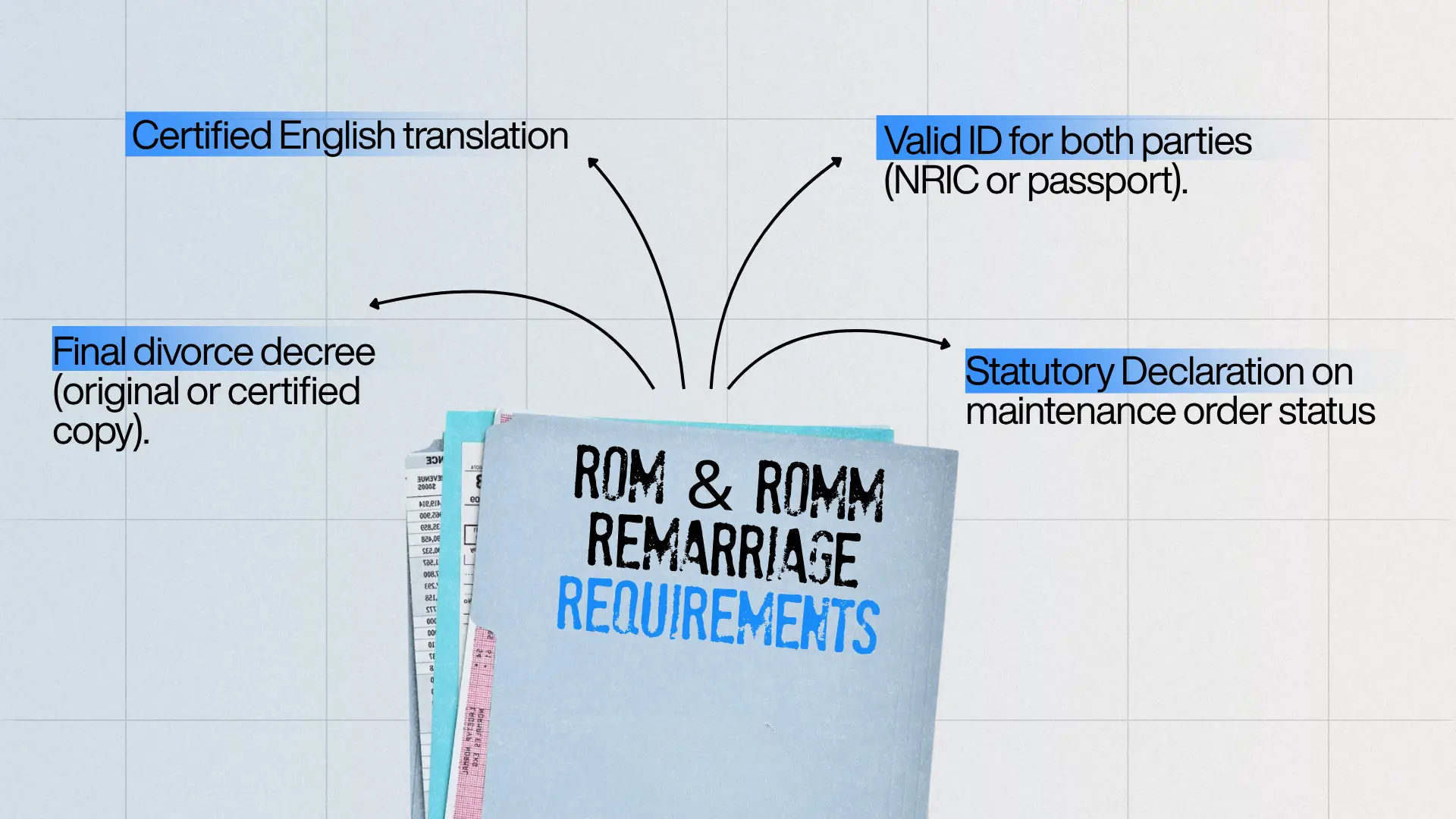
ROM's standard is somewhat more relaxed, and importantly, an English translation is only required if the decree is not already in English, Mandarin, Malay, or Tamil — those four languages are accepted as-is. Beyond translation, ROM generally requires the original divorce decree or a Certified True Copy clearly showing the marriage was permanently dissolved, valid identification for both parties (NRIC for citizens and PRs, passport for foreigners), and a Statutory Declaration confirming whether any maintenance orders exist and whether payments are current. ROMM follows the same logic for Muslim marriages, though applicants on short-term visit passes may need additional documents like a Letter of No Impediment to Marriage, and in some cases further authentication by the home country's foreign ministry or Singapore mission. Requirements can vary by case, so it's worth confirming directly with ROM when in doubt.
Do You Need an Apostille on the Decree Itself?
Usually not. An apostille authenticates a document for cross-border use, but for most PR, Citizenship, and ROM submissions, your decree is being used within Singapore, so ICA typically doesn't ask for an apostille on the foreign document itself. The apostille that actually matters is the one applied to your Singapore notarisation. Exceptions can arise if your home country requires it, if the document comes from a non-Apostille country and legalisation is requested instead, or in rare cases where ICA asks for extra authentication — so it's worth confirming before paying for a step you may not need.
Costs and Timelines
Standard divorce decree translations are typically completed within one to three working days, though longer documents covering custody and asset division take more time. Notarisation is charged per document by the notary's firm, and SAL authentication costs around S$87.20 (including GST) per document as of 2026 — a mandatory step in the ICA chain, not optional. ICA's PR application fee is S$100 per applicant, plus a S$20 entry permit fee for successful applicants, and ICA aims to process complete applications within six months. Foreign decrees also trigger extra verification checks at ROM/ROMM, so it's wise to build in buffer time and avoid locking in a wedding date until approval comes through.
Common Mistakes That Cause Delays or Rejection
The most frequent errors include using machine or self-translation (rejected outright by every agency), skipping notarisation and SAL authentication, paying for an unnecessary apostille on the foreign decree, translating only the final "divorced" page instead of the complete document with all stamps and annexures, omitting the translator's Certificate of Accuracy, mismatched names or dates between the decree and your passport (which triggers manual review), and submitting only your most recent decree when you've been divorced more than once.
The Bottom Line
Whether you're remarrying through ROM or ROMM, or applying for PR or Citizenship through ICA, a correctly prepared divorce decree translation is what keeps your application moving without delays. Get the complete document translated and certified, follow the notarisation and SAL authentication chain where required, and double-check every name and date against your other identity documents before you submit.
