Dental Implants After Tooth Loss: A Practical Guide to Choosing the Right Treatment Time
Author : Dr Mrunal SEO | Published On : 13 Aug 2026
Dental Implants After Tooth Loss: A Practical Guide to Choosing the Right Treatment Time
A missing tooth can affect much more than appearance. It can change how you chew, influence neighbouring teeth and gradually alter the jawbone that once supported the natural tooth.
Dental implants offer a long-term option for replacing missing teeth, but an important question remains: when should the implant be placed?
There is no single answer for every patient.
Some people may be suitable for immediate implant placement after extraction. Others may need to wait for healing or undergo additional procedures before the implant can be placed safely and predictably.
For anyone considering dental implants in Pune or Pimpri Chinchwad, understanding the factors behind implant timing can make the treatment journey easier to understand.
At Burute Dental — Full Mouth Dental Implant Center & Dental Clinic, treatment planning is based on the patient’s individual bone, gum, oral and general health conditions.
What Happens When a Tooth Is Lost?
The jawbone is influenced by the presence of natural tooth roots.
When a tooth is removed, the bone around the empty socket can gradually remodel. The amount of change varies from one patient to another.
Over time, tooth loss may be associated with:
- Reduction in jawbone volume
- Changes in the gum shape
- Movement of neighbouring teeth
- Altered bite
- Increased complexity of future implant placement
This does not mean that every missing tooth must be replaced immediately. However, an early dental evaluation can provide useful information about the condition of the area.
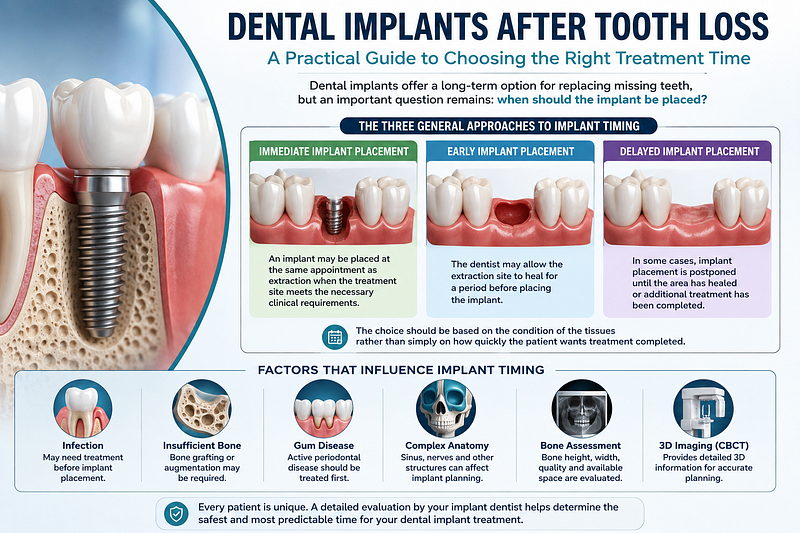
The Three General Approaches to Implant Timing
Dental implant placement can broadly be considered at different stages depending on the patient’s condition.
Immediate Implant Placement
An implant may be placed at the same appointment as extraction when the treatment site meets the necessary clinical requirements.
Early Implant Placement
The dentist may allow the extraction site to heal for a period before placing the implant.
Delayed Implant Placement
In some cases, implant placement is postponed until the area has healed or additional treatment has been completed.
The choice should be based on the condition of the tissues rather than simply on how quickly the patient wants treatment completed.
When May Immediate Implant Placement Be Possible?
Immediate placement can be considered in selected cases.
The dentist needs to determine whether:
- Suitable bone remains around the extraction site
- Adequate initial implant stability can be achieved
- The surrounding gum tissues are appropriate
- Infection is absent or appropriately managed
- The implant can be positioned correctly
- Important anatomical structures can be safely considered
If these factors are favourable, immediate implant treatment may be an option.
Why Some Patients Need to Wait
Immediate treatment is not appropriate for every patient.
A delay may be recommended when the treatment site requires further preparation.
Infection
An infected tooth or surrounding tissue may require treatment before implant placement.
Insufficient Bone
An implant requires adequate bone support. If the jawbone has reduced significantly, bone grafting or another augmentation procedure may be considered.
Gum Disease
Active periodontal disease may need to be treated before implant surgery.
Complex Anatomy
The position of the sinus, nerves and other anatomical structures can influence implant planning.
In such situations, additional imaging and careful planning may be required before treatment.
What If You Lost Your Tooth Several Years Ago?
A long-standing missing tooth does not automatically mean that dental implants are no longer an option.
The dentist first needs to evaluate the condition of the remaining bone and surrounding tissues.
If bone loss has occurred, treatment may sometimes include:
- Bone grafting
- Ridge preservation or augmentation
- Guided bone regeneration
- Other site-development procedures
The need for these procedures depends on the patient’s individual anatomy.
Why Bone Assessment Is Essential
A dental implant is placed into the jawbone, so the available bone is an important part of treatment planning.
Your dentist may assess:
- Bone height
- Bone width
- Bone quality
- Available space
- Adjacent teeth
- Nearby anatomical structures
This assessment helps determine whether the implant can be placed directly or whether preparation is needed first.
The Role of 3D Imaging
CBCT imaging can provide three-dimensional information about the jaw and surrounding structures when it is clinically indicated.
It may help the dentist evaluate:
- Bone dimensions
- Nerve pathways
- Sinus position
- Implant site anatomy
- Adjacent structures
This information can be particularly helpful in cases where the available bone is limited or the anatomy is complex.
Healthy Gums Are Important
Implant treatment does not begin with the implant alone.
The surrounding gums and supporting tissues also need to be evaluated.
If active gum disease is present, treatment may be recommended before implant placement.
Patients should also maintain good oral hygiene after implant treatment and attend regular dental examinations.
Can Your General Health Affect Treatment?
Your dentist will usually consider your medical history before recommending implant treatment.
Relevant factors may include:
- Existing medical conditions
- Current medications
- Smoking
- Diabetes
- Previous surgeries
- Healing-related concerns
Some medical conditions may require appropriate management before treatment.
Providing accurate medical information helps the dental team plan treatment more safely.
Does Age Matter for Dental Implants?
Age alone is not generally the deciding factor.
The dentist is more likely to consider:
- Bone condition
- Gum health
- General health
- Healing ability
- Oral hygiene
- Ability to maintain regular dental care
Therefore, older adults may also be considered for dental implants when their individual clinical condition is suitable.
Can Implants Replace More Than One Tooth?
Yes.
Dental implants can be used in different tooth-replacement situations.
Treatment may involve:
Single Tooth Implant
One implant can support a crown when one tooth is missing.
Multiple Tooth Replacement
Several implants can support multiple restorations or an implant-supported bridge.
Full-Mouth Rehabilitation
Patients with extensive tooth loss may be evaluated for full-mouth implant treatment.
Full-Arch Implant Concepts
Depending on the patient’s anatomy and treatment requirements, options such as All-on-4, All-on-5, All-on-6 or All-on-X may be considered.
The appropriate solution depends on clinical evaluation and restoration planning.
Can Dental Implants Help With Loose Dentures?
Patients who experience movement or instability with removable dentures may be evaluated for implant-supported treatment.
In suitable cases, implants can help provide greater support for a denture or full-arch restoration.
Potential advantages can include:
- Improved stability
- Better chewing function
- Greater comfort
- Improved confidence while speaking
The number of implants required depends on the individual treatment plan.
How Long Does Dental Implant Treatment Take?
The treatment duration varies considerably from one patient to another.
A straightforward case may involve fewer stages, while a more complex case may require:
- Extraction
- Bone grafting
- Gum treatment
- Multiple implants
- Full-mouth rehabilitation
The surgical placement of the implant may be relatively quick, but the surrounding bone needs time to heal and integrate with the implant.
The final restoration is generally provided after the dentist determines that the implant has healed adequately.
Understanding Osseointegration
After implant placement, the surrounding bone gradually develops a stable connection with the implant surface.
This biological process is known as osseointegration.
It is an important part of implant treatment because the implant needs sufficient stability before the final restoration is completed.
The healing period can vary depending on the patient, treatment location and bone condition.
What Can Patients Do to Support Healing?
Following your dentist’s instructions is important after implant treatment.
Patients may be advised to:
- Maintain appropriate oral hygiene
- Follow the recommended diet during initial healing
- Avoid unnecessary pressure on the treatment area
- Attend scheduled follow-ups
- Avoid smoking when advised
- Take prescribed medication as directed
Individual aftercare instructions may vary according to the procedure performed.
Why Implant Planning Should Look Beyond the Missing Tooth
A successful implant treatment plan considers more than the empty space.
The dentist must think about:
- The underlying bone
- Gum condition
- Implant position
- Bite forces
- Adjacent teeth
- Final crown or prosthesis
- Long-term maintenance
This comprehensive approach helps connect the surgical and restorative stages of treatment.
Dental Implant Treatment at Burute Dental
Burute Dental — Full Mouth Dental Implant Center & Dental Clinic provides implant treatment based on individual clinical requirements.
Treatment options may include:
- Single-tooth dental implants
- Immediate dental implants
- Same-day dental implant treatment where clinically appropriate
- Multiple dental implants
- Full-mouth dental implants
- All-on-4
- All-on-5
- All-on-6
- All-on-X
- Bone grafting for dental implants
The appropriate treatment is determined after examination and necessary diagnostic imaging.
When Should You Schedule an Evaluation?
If you have recently lost a tooth, an early consultation can help you understand the condition of the area.
An evaluation may determine:
- Whether immediate implant placement is possible
- Whether the extraction site needs time to heal
- Whether bone preservation may be beneficial
- Whether bone grafting is required
- Whether gum treatment is needed
- Which restoration may be appropriate
If the tooth has been missing for a long time, evaluation can still be worthwhile.
Final Thoughts
There is no universal timetable for dental implant placement.
The appropriate timing depends on your bone, gums, extraction site, general health and treatment requirements.
For some patients, an implant may be placed immediately after extraction. Others may benefit from waiting for healing or completing procedures such as gum treatment or bone grafting first.
The important point is that implant treatment should be planned around your biological and clinical needs rather than a fixed timeline.
If you are considering dental implants in Pimpri Chinchwad or Pune, a professional evaluation can help you understand your treatment options and determine the most appropriate next step.
Burute Dental — Full Mouth Dental Implant Center & Dental Clinic
🌐 Website: https://burutedental.in/
📞 Phone: 7020968702
📍 Google Business Profile: https://share.google/lXuzN2bF9MED6RlRM
#AllOn4 #AllOn5 #DentalImplants #AllOn4CostIndia #DentalImplantCost #FullMouthDentalImplants #DentalImplantPune #DentalImplantPCMC #DentalImplantSpecialist #SameDayDentalImplants #AllOnX #ToothReplacement #BuruteDental #PimpriChinchwad #Wakad #Nigdi #Ravet #Akurdi #Pune
All-on-4 Dental Implants Cost in India, All-on-4 Cost India, Full Mouth Dental Implants Cost, Dental Implant Cost in Pune, Dental Implant in Pimpri Chinchwad, Dental Implant Near Me, All-on-5 Dental Implants, All-on-6 Dental Implants, All-on-X, Same-Day Dental Implants, Immediate Dental Implants, Single Tooth Implant, Implant Dentistry, Burute Dental, Dr. Mrunal Burute.
