Decorative Lights for Home: A Diwali Styling Guide
Author : Aakriti Art Creations | Published On : 23 Oct 2026
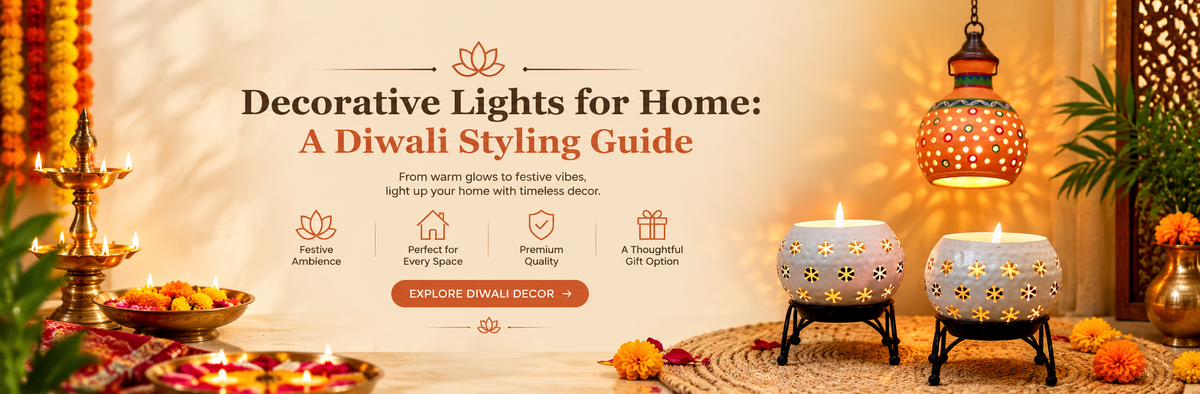
There's a moment, just after dusk in the days before Diwali, when the first lights come on and the whole house seems to take a breath. The marigolds look warmer, the brass begins to glow, and even a familiar corner feels new. That's the quiet magic of good Diwali decoration lights.
If you're looking for decorative lights for home this season, this guide will help you plan them in layers, the way a good lighting designer would. We look at chandeliers, tealights at the entrance, pendant lamps over the dining table and the quiet lamps of the puja corner, all with Indian homes and Diwali evenings in mind.
The Lighting Hierarchy of a Diwali Home
Think of festive lighting in three layers. Ambient light fills the room softly, usually from a chandelier or ceiling fixtures. Task light sits where you cook, read or arrange the puja thali. Accent light is the sparkle: tealights, lamps and candle stands that carry the feeling of celebration. Most homes already have the first two layers, so Diwali is really about adding the third with care, which is where lighting for home decor does its best work.
A useful habit is to dim before you add. Turn down the brightest ceiling lights in the evening and let the small warm points of light do the work. A room lit gently by many small flames looks richer than one lit brightly by a few.
A Chandelier as the Statement Piece
A chandelier gives a living room or foyer a centre of gravity. For a ceiling of around ten feet, choose a fixture that hangs with its lowest point at least seven feet above the floor, so that no one needs to duck beneath it. As a loose guide to size, add the width and length of the room in feet and read the total as the diameter in inches. A room of 12 by 14 feet, for example, suits a chandelier of about 26 inches.
Before the festival, switch off the power and dust the fixture with a soft, dry cloth. Replace any tired bulbs with warm white ones. Handcrafted metalwork catches the glow beautifully, and a good chandelier will keep lighting your evenings long after Diwali is over. If you buy lighting online, check the drop length and weight against your ceiling height before ordering.
Tealights and Candle Stands for the Entrance
The entrance is where guests first read your home. A pair of candle stands on either side of the door, or a row of tealights along a console, says welcome before a word is spoken. Stands lift the flame to eye level, which looks far better than a light left on the floor.
Keep every flame away from curtains, garlands and dry flowers, and never leave it unattended, especially with children and pets about. If your entrance is breezy, glass holders will keep the flames steady and the evening calm.
Pendant Lamps over the Dining Table
Pendant lamps turn the dining table into the heart of the festival. Hang them about 30 to 36 inches above the tabletop, so the light falls warmly on food and faces without blocking the view across the table. For a long table, two or three smaller pendants usually look better than one large one.
Choose a warm bulb of around 2700K. It flatters sweets, silk and skin alike, and it keeps the table feeling like a gathering rather than a showroom.
Wall Lamps in the Puja Corner
The puja corner asks for a gentler kind of light. A wall lamp on either side of the mandir, or a single soft lamp above it, frames the deity without glare. Avoid bright white light here, because warm light is calmer and sits better with brass and wood.
If you light an oil diya or an akhand jyoti, keep electric fixtures and cables a safe distance away, and leave a clear gap around the flame.
Which Bulb Colour Suits a Diwali Home?
Warm white, between 2700K and 3000K, is the most natural choice for Diwali. It echoes the colour of a flame and makes metal, wood and flowers look their best. Cool white bulbs, at 5000K and above, flatten the mood and make festive colours look harsh.
If your fixtures allow it, add a dimmer. Being able to lower the light as guests arrive is one of the quietest luxuries a home can have.
Pairing Lights with Rangoli and Flowers
Light a rangoli from the side rather than from above, so the colours glow and the pattern casts no heavy shadow. Place a pair of tealights at the edge, and keep them clear of the powder and petals.
Marigold and jasmine strands look lovely beside a warm light, because the flowers catch it and seem to shine. A single strand draped near a candle stand, kept at a safe distance from the flame, is often all an entrance needs.
Frequently Asked Questions
How many lights are enough for Diwali?
There is no fixed number. Aim for light at three heights: low (table lamps and tealights), middle (wall lamps and candle stands) and high (chandeliers and pendants). Five to seven separate points of light usually give a living room a festive glow without crowding it.
Tealights or diyas: which is safer?
Both are safe with care. A tealight in a holder is more contained, while an oil diya has a larger open flame and can tip more easily. Flameless LED tealights are a good choice around small children, pets or flowing curtains.
What chandelier suits a 10-foot ceiling?
A fixture that hangs no lower than seven feet from the floor, and that is not too heavy visually. Choose a slimmer, shorter drop and a diameter that suits the room.
Can I mix brass and copper?
Yes. Both are warm metals and sit well together. Let one lead and the other accent, and try to keep the finish consistent, either antique or polished.
Where do I place pendant lamps?
Over the dining table, a kitchen counter or beside a bed. Over a table, hang them 30 to 36 inches above the surface, and keep them clear of the walking path.
Light your Diwali home with Aakriti Art Creations. Explore our decorative lighting, the chandeliers that anchor the room, the tealight candle stands for the entrance and the pendant lamps for the dining table, each handcrafted to bring warmth to many festivals to come.
