DCMT11T308 Turning Insert: Complete Guide to Grade, Geometry & Applications
Author : Surya makeyoueasy | Published On : 06 Oct 2026
Introduction
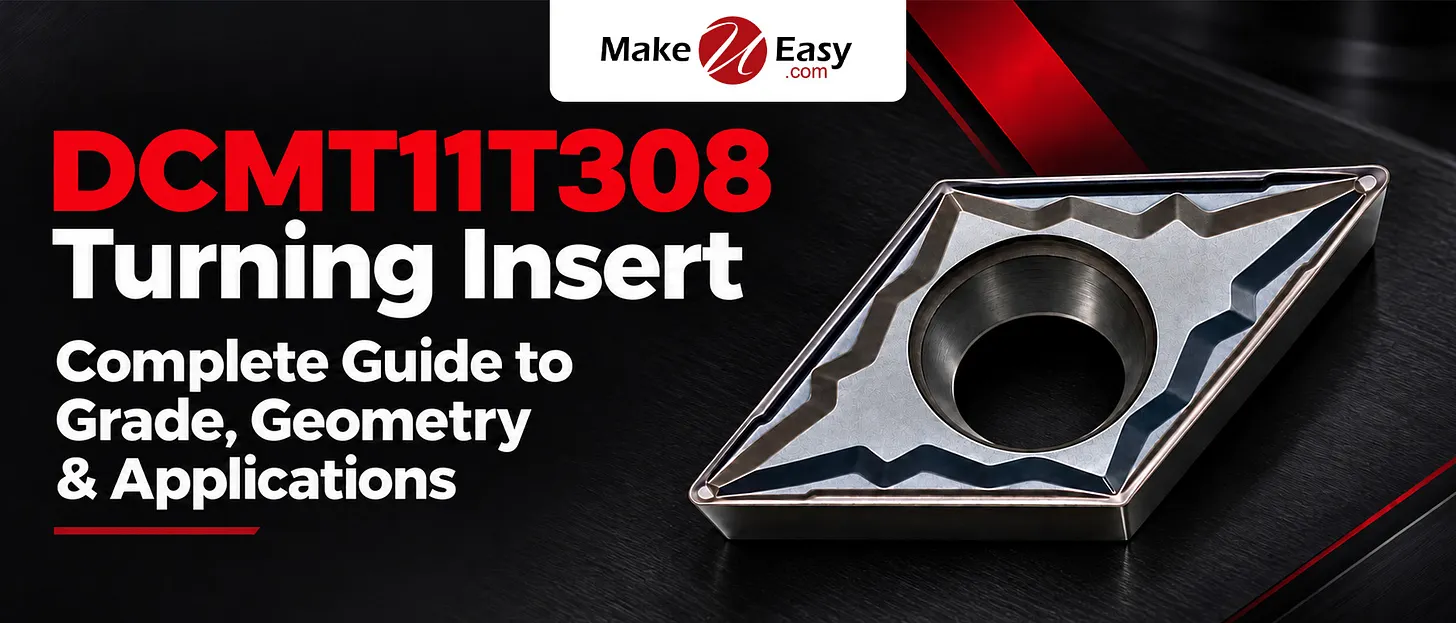
The DCMT11T308 is a positive-rake carbide turning insert widely used for precision turning, profiling, and finishing operations. Its 55° diamond geometry, 7° clearance angle, and 0.8 mm nose radius make it suitable for a range of external and internal machining tasks. Understanding its specifications and grade options helps machinists select the right insert for better surface finish, dimensional accuracy, and tool life.
What Is a DCMT11T308 Turning Insert?
DCMT11T308 is an ISO designation for a rhombic carbide insert used in CNC turning and compatible lathe operations. Its positive geometry reduces cutting forces, making it useful for applications where lower machining resistance and good surface finish are important.
The insert is available in various carbide grades and chip-breaker configurations. The correct choice depends on the workpiece material, cutting conditions, and whether the operation involves finishing or medium machining.
DCMT11T308 Insert Specifications
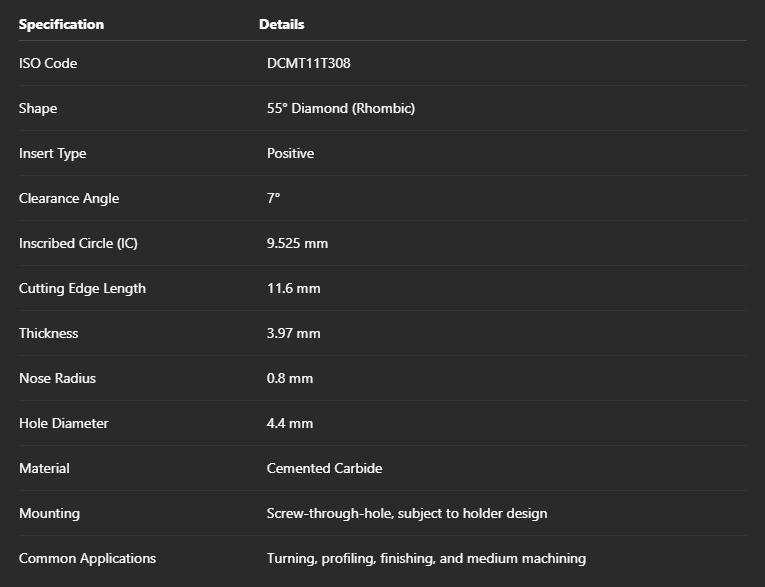
Always confirm the insert dimensions and mounting compatibility against the manufacturer’s catalogue before ordering.
Understanding DCMT11T308 Geometry
1. 55° Diamond Shape
The D-shaped insert has a 55° included angle, making it suitable for profiling and machining contours that require access to angled features. Its geometry supports both external and internal turning when paired with a compatible tool holder.
2. Positive Rake and 7° Clearance
The positive cutting geometry helps reduce cutting forces and can improve performance on machines or components where rigidity is limited. The 7° clearance angle helps prevent the insert flank from rubbing against the machined surface.
3. 0.8 mm Nose Radius
The 0.8 mm nose radius provides a balance between surface finish and cutting-edge strength. A smaller radius may help with fine finishing and profiling, while a larger radius can support higher feed rates when the setup is sufficiently rigid.
4. Indexable Carbide Construction
The carbide substrate provides wear resistance and cutting-edge strength. Once an edge wears, the insert can be indexed or replaced according to its design, reducing the need to replace the entire tool holder.
How to Choose the Right DCMT11T308 Grade
The ISO code identifies the insert geometry and dimensions, but it does not specify the carbide grade. Grade selection is essential because different coatings and substrates are designed for different materials and cutting conditions.
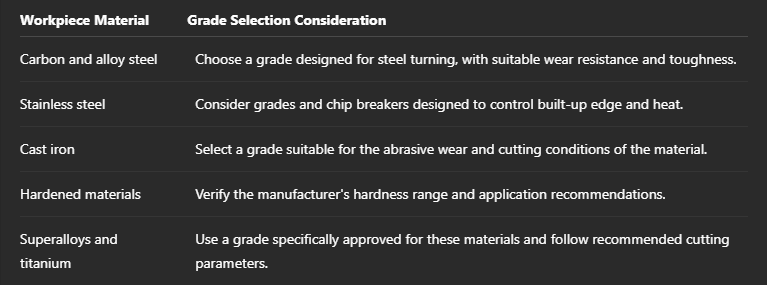
For example, Kennametal’s KT315 is a coated cermet grade intended for high-speed finishing to medium machining of carbon and alloy steels, stainless steels, and certain cast iron applications. Other manufacturers offer grades with different substrates, coatings, and application ranges.
Important: Grades are not automatically interchangeable across brands. Check the manufacturer’s material recommendations, chip breaker design, and cutting data before selecting an equivalent.
Main Applications of DCMT11T308 Inserts
External Turning
Used for machining cylindrical surfaces, shafts, and other external profiles on CNC lathes.
Internal Boring
Compatible DCMT holders allow the insert to machine internal diameters and bores, provided the tool has sufficient clearance and rigidity.
Profiling and Contouring
The 55° geometry supports machining angled surfaces, shoulders, and contours that require access to detailed profiles.
Finishing and Semi-Finishing
Positive geometry and a suitable nose radius can help achieve a consistent surface finish when cutting conditions and machine stability are properly controlled.
Medium Machining
Certain grades and chip breaker configurations are designed for medium-duty cuts. Confirm the recommended depth of cut and feed rate for the specific insert.
DCMT vs. Other Common Turning Inserts
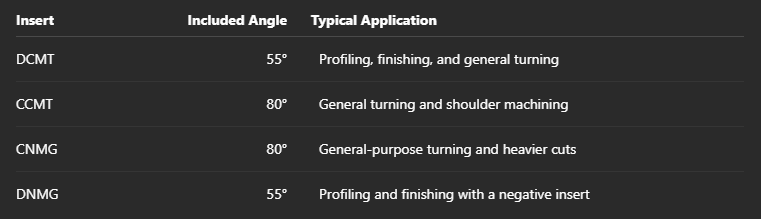
The best insert depends on the component geometry, tool-holder approach angle, cutting forces, and machining objective. Geometry alone does not determine performance.
Tips for Better Machining Performance
-
Use a compatible holder: Confirm insert size, clamping method, and holder designation.
-
Select the correct grade: Match the substrate and coating to the workpiece material.
-
Follow the recommended cutting data: Start with the manufacturer’s recommendations for speed, feed, and depth of cut.
-
Maintain tool rigidity: Minimise tool overhang and ensure secure workpiece clamping.
-
Monitor chip formation: Use a suitable chip breaker and adjust feed or depth of cut if chips become difficult to control.
-
Replace worn edges promptly: Excessive wear can affect surface finish, dimensional accuracy, and cutting stability.
-
Check coolant requirements: Apply coolant or use dry machining only as recommended for the selected grade and operation.
Why Choose MakeYouEasy?
MakeYouEasy provides CNC cutting tools and machining accessories for workshops, manufacturers, and machining professionals. Choosing compatible tools and reliable product specifications helps simplify procurement and support consistent machining operations.
Conclusion
The DCMT11T308 turning insert is a versatile option for profiling, external turning, internal boring, and finishing applications. Its 55° diamond geometry, positive clearance, and 0.8 mm nose radius offer useful flexibility across compatible CNC turning setups.
For reliable performance, select the correct carbide grade and chipbreaker for the workpiece material, verify holder compatibility, and follow the manufacturer’s cutting recommendations. A well-matched insert can help improve surface quality, maintain dimensional accuracy, and support efficient machining.
Frequently Asked Questions
1. What does DCMT11T308 mean?
It identifies a 55° positive rhombic turning insert with a 9.525 mm inscribed circle, 3.97 mm thickness, and 0.8 mm nose radius.
2. What materials can the DCMT11T308 inserts machine?
Depending on the grade, they can be used for steel, stainless steel, cast iron, and other materials approved by the manufacturer.
3. Is DCMT11T308 suitable for finishing?
Yes, suitable grades and cutting conditions can make it effective for finishing and semi-finishing operations.
4. What is the nose radius of DCMT11T308?
The standard designation indicates a 0.8 mm nose radius.
5. Can DCMT11T308 inserts be used with any DCMT tool holder?
No, verify the insert size, clamping arrangement, and holder compatibility before installation.
Popular Search Keywords
DCMT11T308 turning insert, DCMT11T308 specifications, DCMT carbide insert, DCMT11T308 grade, DCMT 11T308 insert applications, 55-degree diamond turning insert, positive rake carbide insert, CNC turning insert, DCMT insert for steel, DCMT insert for stainless steel, carbide turning insert for finishing, CNC lathe insert selection
