Data Lake Solutions for Scalable Data Storage and Analytics
Author : 10petabyte 10PB | Published On : 12 Oct 2026
Data has become an important resource for organizations across industries. Businesses collect information from customer interactions, internal applications, websites, connected devices, transactions, and operational systems. Although this information can support better planning and decision-making, managing it effectively becomes more challenging as the number of sources increases.
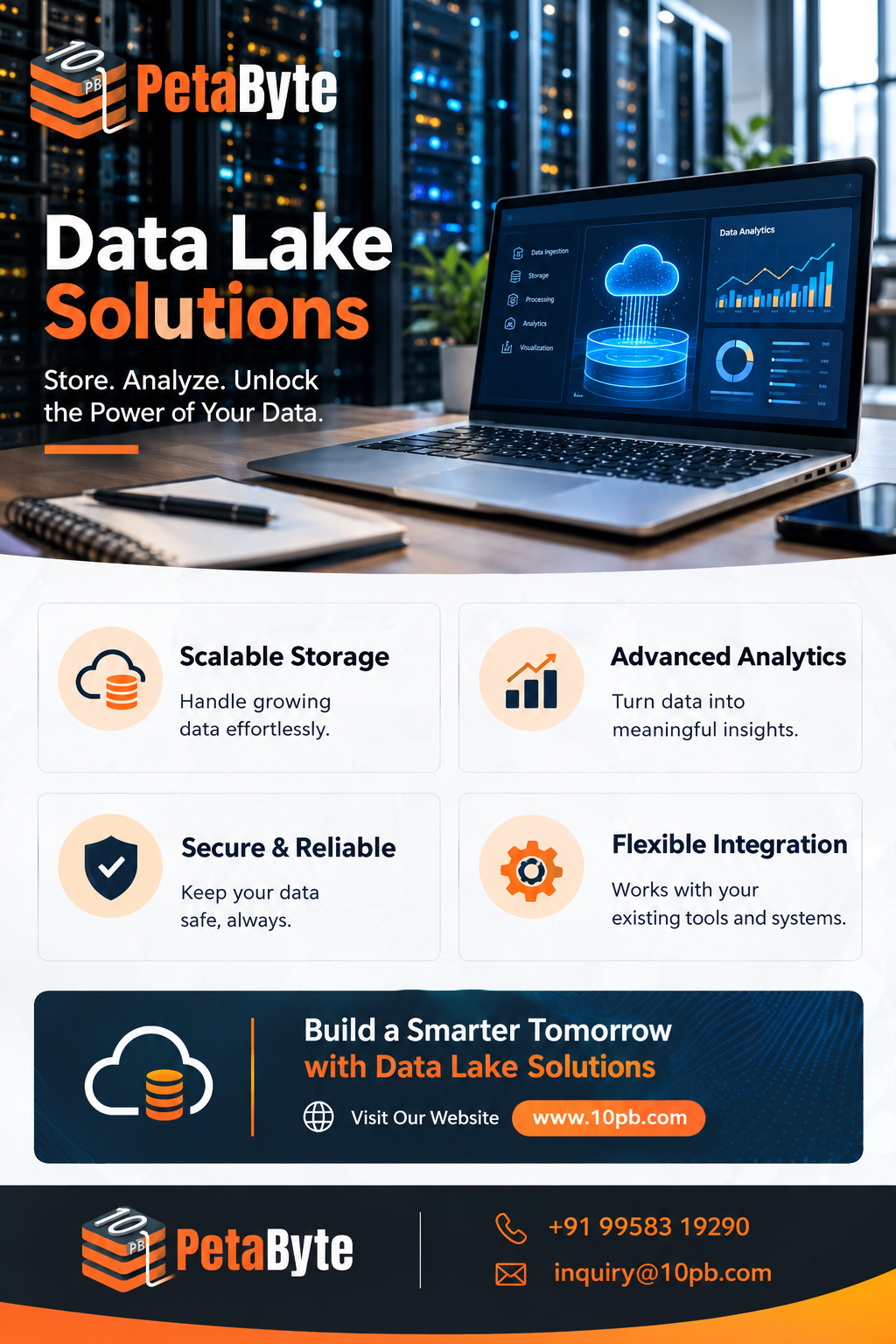
Data lake solutions offer a flexible way to store and manage information from different sources within a centralized environment. They allow organizations to retain structured, semi-structured, and unstructured data for different analytical purposes. With appropriate planning, this approach can help businesses improve data accessibility and create a foundation for future analytics projects.
A successful data lake strategy requires more than storage capacity. Organizations must also consider how information is collected, organized, protected, processed, and made available to authorized users.
What Is a Data Lake?
A data lake is a storage environment designed to accommodate large collections of information in their original or minimally processed formats. Unlike systems that require data to follow a predefined structure before it is stored, a data lake can preserve information for different future requirements.
For example, a business might store transaction records, application logs, customer feedback, documents, and sensor data within the same broader environment. Different teams can then prepare and process relevant datasets according to their analytical objectives.
This flexibility can be useful when organizations do not know every question they will want to answer in the future. Preserving information allows analysts to investigate new business problems without necessarily collecting the same data again.
However, a data lake should not become an unorganized collection of files. Cataloging, metadata, governance, and clear ownership are essential for making stored information discoverable and trustworthy.
Why Organizations Need Flexible Data Storage
Business information often remains distributed across separate applications and departments. Finance systems, customer relationship platforms, inventory tools, and operational applications may each maintain their own records.
When teams need to combine these records, they may face inconsistent formats, duplicated information, and lengthy preparation processes. A well-designed data environment can help simplify this process by providing a shared foundation for selected datasets.
Consider a retail company that wants to understand changes in customer demand. Its analysts may need to examine order histories, website activity, product details, and inventory levels together. Access to these different datasets can help reveal relationships that are difficult to identify when information remains isolated.
Flexible storage also helps organizations accommodate new data sources as their operations evolve. Rather than designing a separate storage environment for every new requirement, teams can evaluate whether existing infrastructure can support additional workloads.
Key Benefits of Data Lake Solutions
1. Centralized Data Access
A centralized environment can make it easier for authorized teams to locate and work with information from different sources. With suitable cataloging and access controls, users can better understand what datasets are available and whether they meet their needs.
Centralization can also encourage collaboration between departments by providing a shared foundation for analysis.
2. Support for Multiple Data Formats
Organizations work with more than conventional database records. They may also need to preserve log files, documents, event streams, images, and other forms of information.
A data lake can accommodate diverse formats, allowing organizations to retain information that might be difficult to manage within a single rigid structure.
3. Greater Analytical Flexibility
Business requirements change over time. Information collected for operational purposes today may support forecasting, performance analysis, or machine learning in the future.
Retaining relevant historical information can give analytical teams more opportunities to explore emerging questions. The usefulness of that information still depends on its quality, accessibility, and suitability for the intended analysis.
4. Support for Data Growth
As organizations expand their digital operations, the amount of information they generate can grow considerably. Infrastructure should therefore be designed with future capacity, performance, and operating costs in mind.
A scalable architecture can help businesses respond to changing requirements without unnecessary disruption. Capacity planning and monitoring remain important to prevent resource shortages or avoidable expenditure.
5. Improved Business Insights
When relevant datasets can be analyzed together, organizations may gain a broader view of their operations. For example, combining delivery records with warehouse activity may help identify recurring delays. Examining customer interactions alongside sales information may help teams understand purchasing patterns.
The platform provides the foundation, while sound analytical methods and business expertise turn information into useful insights.
Essential Features to Evaluate
Choosing a suitable data platform requires a careful assessment of technical and operational requirements.
Scalability: Evaluate how the infrastructure will handle increasing data volumes, additional users, and different workloads.
Security: Review identity management, permissions, encryption, monitoring, and protection for sensitive information.
Data governance: Establish policies for ownership, classification, cataloging, retention, and responsible use.
Integration: Consider compatibility with existing databases, applications, ingestion pipelines, and analytics tools.
Performance: Understand how data will be processed and retrieved for the organization's most important workloads.
Cost management: Assess storage consumption, data movement, processing requirements, maintenance, and other operational expenses.
Reliability: Define appropriate backup, recovery, monitoring, and service continuity practices.
Evaluating these areas helps organizations select an approach that fits their real requirements rather than focusing on individual features in isolation.
Data Quality and Governance Matter
One common challenge in data lake environments is maintaining consistent information quality. Datasets collected from different systems may use different naming conventions, contain missing values, or represent similar information in incompatible ways.
Without suitable controls, users may struggle to determine which dataset is reliable. Duplicate records and outdated information can also affect analytical results.
Organizations should establish data quality checks and document important datasets. Metadata should describe the source, structure, ownership, update frequency, and intended use of information where appropriate.
Access policies are equally important. Not every user needs access to every dataset. Role-based permissions and monitoring can help ensure that information is available to the right people while protecting confidential records.
Good governance makes a data lake easier to maintain as more teams and datasets are added.
How to Build a Practical Data Lake Strategy
Organizations can begin with a focused plan rather than attempting to centralize all their information at once.
First, identify the business problem the data environment should address. This might involve improving operational reporting, analyzing customer activity, or consolidating information from selected applications.
Next, identify the relevant datasets and assess their formats, quality, ownership, and access requirements. This discovery process helps determine what needs to be collected and how it should be managed.
Then, design the architecture around ingestion, storage, processing, security, and integration. Governance policies should be established before the environment expands significantly.
A pilot project can help validate the approach. Teams should measure whether information is easier to access, whether processing workflows operate reliably, and whether the environment supports the intended business outcome.
After the pilot demonstrates value, the organization can introduce additional sources and analytical use cases gradually. Regular reviews help identify changing requirements and opportunities for improvement.
Exploring Data Lake and Analytics Infrastructure
Businesses evaluating their data strategy should consider both current needs and future opportunities. The right approach depends on data volume, application requirements, security obligations, analytical workloads, and available resources.
10PB provides information about data lake and analytics infrastructure for organizations exploring ways to manage and use their data. Reviewing the available options can help businesses understand how centralized data environments may fit into their broader storage and analytics strategy.
Ultimately, effective data lake solutions combine flexible storage with reliable data pipelines, strong governance, appropriate security, and clearly defined business goals. When these elements work together, organizations can make their information easier to manage and better prepared for future analytical needs.
