Dairy 4.0: Why Connectivity Defines Modern Barn Efficiency
Author : Alyssa Miller | Published On : 10 Aug 2026
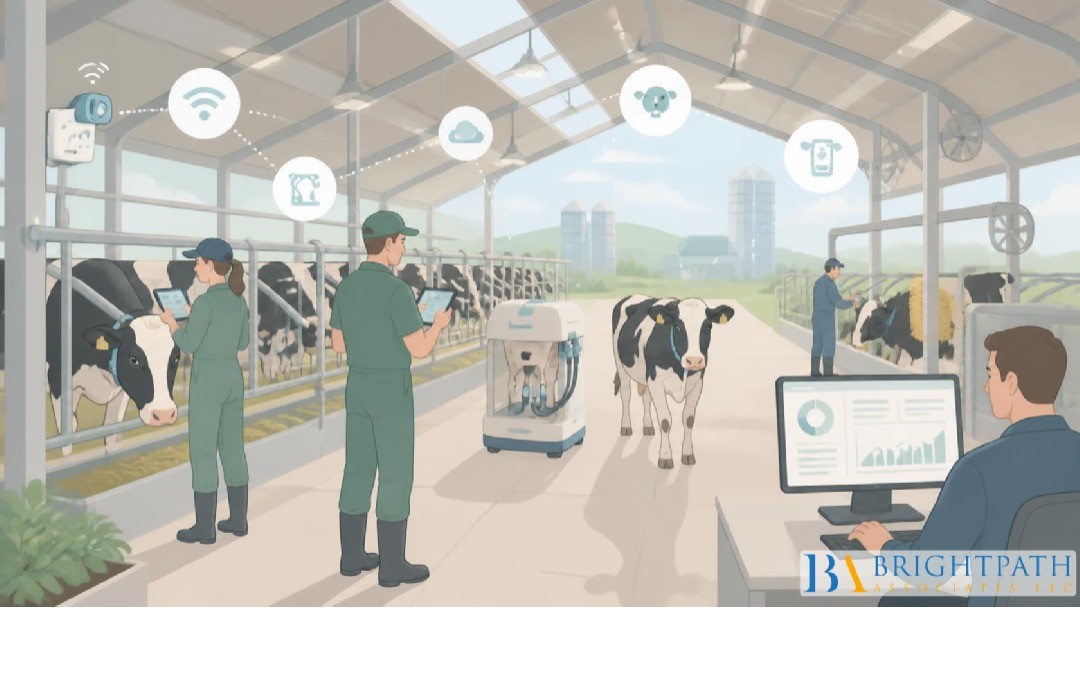
The dairy industry is undergoing a transformation that goes far beyond automated milking systems and advanced farm equipment. Modern dairy operations are increasingly becoming connected environments where sensors, software, analytics, automation, and people work together to improve productivity and animal care. This shift, often described as Dairy 4.0, reflects the broader movement toward data-driven agriculture and connected production systems. For dairy businesses across the United States, the competitive advantage may no longer come simply from owning advanced hardware. Instead, the ability to connect different technologies and turn the resulting data into actionable decisions is becoming increasingly important.
For decades, dairy producers have invested in equipment designed to make individual tasks faster, safer, or more consistent. Automated milking systems, feeding equipment, climate-control systems, activity monitors, and refrigeration technologies have all improved farm operations. However, when these systems operate independently, much of their potential remains unused. A modern dairy may generate enormous amounts of information every day, but disconnected systems can make it difficult for managers to understand the relationship between feed intake, animal activity, milk production, health indicators, environmental conditions, and equipment performance.
Connectivity changes that equation. When equipment and software platforms can communicate with each other, dairy managers can move from isolated measurements toward a more complete operational picture. A change in an animal's activity, for example, may be analyzed alongside feeding patterns, milk production, temperature, and other indicators. Instead of waiting for a visible problem, managers can potentially identify unusual patterns earlier and investigate them before they become larger operational or animal-health concerns.
One of the most important applications of connectivity is precision monitoring. Sensors and wearable devices can collect information continuously, providing insights that would be difficult to obtain through manual observation alone. Activity levels, rumination, temperature, location, and feeding behavior can all contribute to a better understanding of animal health and productivity. The value does not come from collecting data simply for the sake of having more information. The real benefit comes when data is organized and translated into decisions that farm employees can act upon.
Connected systems can also transform herd management. Traditional dairy management often depends heavily on the experience and observational skills of farm personnel. That expertise remains essential, but digital tools can provide another layer of information. Analytics platforms can help identify animals that display unusual behavior, changes in production, or other patterns that may warrant closer attention. This can help employees prioritize their time and focus their attention where it is most needed. In a large operation, even small improvements in early detection can potentially translate into meaningful improvements in efficiency.
Barn environmental conditions represent another area where connectivity can create significant value. Temperature, humidity, ventilation, air quality, and other environmental factors can affect both animal comfort and operational performance. Connected sensors can continuously monitor these conditions and communicate with ventilation or climate-control systems. Instead of relying entirely on fixed schedules or manual adjustments, farms can create more responsive environments based on real-time conditions. This can improve consistency while potentially reducing unnecessary energy consumption.
The same principle applies to feed management. Feed represents one of the most significant operating expenses for dairy producers, making efficient utilization essential. Connected feeding systems can provide information about consumption patterns, ration delivery, and feed availability. When combined with production and herd data, this information can help managers identify opportunities to improve feeding efficiency. Better visibility can also help reduce waste and support more informed decisions about feed inventory and purchasing.
Connectivity can extend beyond individual barns as well. Dairy operations increasingly need visibility across multiple locations, particularly when companies operate several facilities or maintain complex supply and production networks. Centralized dashboards can give leadership teams a broader understanding of performance across farms. This can make it easier to compare facilities, identify unusual trends, allocate resources, and establish consistent operating practices. For growing dairy companies, centralized visibility can become particularly valuable as operational complexity increases.
However, Dairy 4.0 also introduces new challenges. Connecting more devices creates greater cybersecurity risks and increases the importance of data governance. Dairy operators must consider who has access to operational information, how data is stored, and how different systems communicate. Technology investments also require ongoing maintenance, software updates, employee training, and vendor management. A connected operation is not simply a collection of devices; it is an evolving digital ecosystem that requires appropriate oversight.
The human element remains just as important. Advanced technology cannot replace experienced dairy professionals who understand animals, production processes, equipment, and farm operations. Instead, the future workforce will increasingly need to combine traditional dairy expertise with digital capabilities. Managers may need to interpret dashboards and analytics, maintenance teams may need experience with connected equipment, and technology specialists may need to understand agricultural operations. This convergence of skills is creating new talent requirements throughout the dairy industry.
Dairy businesses looking to strengthen their leadership and technical workforce can explore the Dairy Industry from BrightPath Associates. Specialized recruitment can help organizations identify professionals who understand both operational realities and the technologies shaping modern dairy production.
Connectivity also creates opportunities for better sustainability. Energy monitoring can identify inefficient equipment, water sensors can help detect excessive consumption or leaks, and automated systems can improve resource utilization. When sustainability data is integrated with operational information, dairy businesses can move beyond broad environmental goals toward measurable performance improvements. This is increasingly important as customers, regulators, investors, and business partners pay greater attention to environmental performance and resource efficiency.
The transition to Dairy 4.0 does not mean that every dairy operation needs to purchase the most expensive technology available. A more practical approach is to begin with specific operational challenges. A farm might first connect environmental sensors, improve herd monitoring, or integrate feeding data. Once the organization understands how to use the information effectively, additional technologies can be introduced. This phased strategy can reduce implementation risk and ensure that investments are tied to measurable business outcomes.
Dairy leaders interested in exploring this transformation in greater detail can also read Dairy 4.0: Why Connectivity Defines Modern Barn Efficiency. The article provides additional perspective on how connected systems can change the way modern dairy operations approach efficiency, monitoring, and decision-making.
Ultimately, the future of dairy technology will not be determined simply by how much equipment an operation owns. The greater opportunity lies in how effectively that equipment communicates, how accurately data is interpreted, and how quickly insights are converted into action. A connected dairy can provide managers with greater visibility, help employees prioritize their work, support more consistent animal care, and create new opportunities for operational efficiency.
Dairy 4.0 is therefore less about replacing traditional farming expertise and more about strengthening it with better information. Companies that successfully combine experienced people with connected technology will be better positioned to improve productivity, manage costs, respond to changing market conditions, and build resilient operations.
