Couplings for CNC Machines: Complete Guide to Types, Applications & Selection
Author : Surya makeyoueasy | Published On : 12 Oct 2026
Introduction
Couplings for CNC machines connect rotating shafts and transmit torque between components such as servo motors, ball screws, and drive systems. The right coupling helps accommodate shaft misalignment while maintaining the rigidity and precision required for controlled motion. Understanding coupling types, applications, and selection criteria helps manufacturers reduce vibration, prevent premature wear, and maintain reliable machine performance.
What Is a CNC Machine Coupling?
A CNC coupling is a mechanical component that connects two shafts while transmitting rotational power. In CNC feed axes, it commonly connects a servo or stepper motor to a ball screw, converting motor rotation into precise linear movement.
Depending on its design, a coupling can accommodate limited angular, parallel, or axial misalignment. For precision positioning, backlash, torsional stiffness, and rotational inertia are also important selection factors.
Types of Couplings for CNC Machines
1. Jaw Couplings
Jaw couplings use two metal hubs with an elastomeric insert, often called a spider, between them. They can absorb vibration and shock while accommodating limited misalignment.
Applications: General motion systems, stepper motors, and suitable light- to medium-duty drives.
2. Bellows Couplings
Bellows couplings use a thin metallic bellows to transmit torque while accommodating small shaft misalignments. They offer high torsional stiffness and low backlash, making them useful for precision motion systems.
Applications: Servo drives, ball-screw axes, encoders, and precision positioning equipment.
3. Disc or Diaphragm Couplings
These couplings transmit torque through flexible metal discs or diaphragms. They provide high torsional stiffness and can suit demanding servo and high-speed applications when correctly specified.
Applications: CNC feed drives, precision machinery, and selected spindle-drive systems.
4. Oldham Couplings
Oldham couplings use two hubs and an intermediate sliding disc. Their design is useful for accommodating parallel shaft offset within the manufacturer’s limits.
Applications: Compact automation equipment, positioning systems, and selected motor-to-screw drives.
5. Helical or Beam Couplings
Machined from a single piece of metal with spiral cuts, these couplings combine flexibility with a compact structure. Their torque capacity and stiffness depend on the design.
Applications: Encoders, small motors, instrumentation, and light-duty motion systems.
6. Rigid Couplings
Rigid couplings connect shafts without intentionally accommodating misalignment. They provide a direct connection but require accurate shaft alignment and careful installation.
Applications: Suitable for aligned shafts and specialized machine assemblies where flexibility is unnecessary.
Comparison of CNC Coupling Types
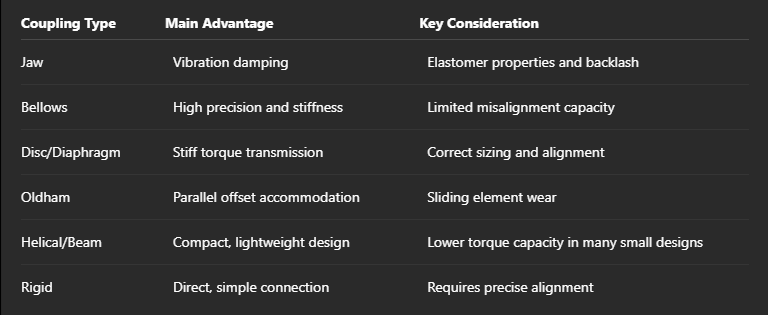
Actual torque, speed, backlash, and misalignment ratings vary by model. Always consult the manufacturer’s specifications.
Main Applications of CNC Machine Couplings
1. Servo Motor to Ball Screw
Couplings transmit motor torque to the ball screw, enabling controlled movement along CNC machine axes. Low backlash and high torsional stiffness are especially important where positioning accuracy matters.
2. CNC Milling Machines and Lathes
Couplings support drive connections in feed systems and other compatible rotating assemblies. The correct design depends on the machine architecture and operating conditions.
3. CNC Routers and Automation Equipment
Suitable couplings connect motors to ball screws or other motion components in routers, linear modules, and automated positioning systems.
4. Encoder and Measurement Systems
Compact, low-inertia couplings can connect encoders and other measuring devices to rotating shafts without unnecessarily affecting the system’s response.
How to Select the Right CNC Coupling
1. Shaft Diameter: Confirm both shaft diameters, bore sizes, keyways, and the required clamping or fastening method.
2. Torque Requirement: Check continuous and peak torque, including acceleration, deceleration, and reversing loads.
3. Backlash and Torsional Stiffness: Precision servo axes generally require low backlash and adequate stiffness to minimize positioning errors.
4. Misalignment: Identify angular, parallel, and axial misalignment, then select a coupling that accommodates the measured values within its rated limits.
5. Operating Speed: Verify the maximum permitted RPM and any balancing requirements.
6. Space and Inertia: Check the coupling’s outer diameter, length, and rotational inertia against the available installation space and motor dynamics.
7. Environment: Consider temperature, oil, coolant, dust, and other conditions that may affect elastomeric or metallic components.
8. Manufacturer Compatibility: Verify the model’s torque, bore, speed, stiffness, and backlash ratings rather than assuming couplings of similar dimensions are interchangeable.
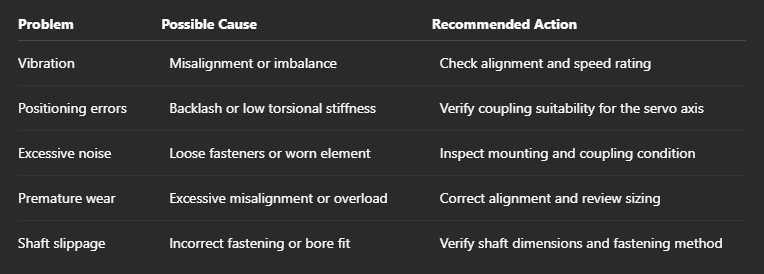
Common Coupling Problems and Solutions
Tips for Reliable Coupling Performance
-
Align shafts within the coupling manufacturer’s specified limits.
-
Use the correct bore size and fastening method.
-
Avoid exceeding rated torque, speed, or misalignment.
-
Inspect elastomeric elements for wear and deterioration.
-
Check for loose fasteners, vibration, and unusual noise.
-
Follow the manufacturer’s installation and maintenance instructions.
Why Choose MakeYouEasy?
MakeYouEasy provides CNC tooling, machining accessories, and industrial solutions for manufacturing applications. Choosing compatible components and verifying specifications helps support reliable machine operation and maintenance planning.
Conclusion
CNC machine couplings are essential for transmitting torque between motors, ball screws, encoders, and other drive components. Jaw, bellows, disc, Oldham, helical, and rigid couplings each serve different operating requirements.
For the best results, match the coupling to the required torque, shaft dimensions, speed, backlash, stiffness, and misalignment. Correct selection and installation help maintain motion accuracy, reduce unnecessary wear, and improve machine reliability.
Frequently Asked Questions
1. What is a coupling used for in a CNC machine?
It connects rotating shafts and transmits torque between compatible drive components.
2. Which coupling is suitable for a CNC servo motor?
Bellows or disc couplings are common precision options, but the final choice depends on torque, speed, stiffness, and misalignment.
3. What is the difference between a jaw coupling and a bellows coupling?
Jaw couplings use an elastomeric element for damping, while bellows couplings use a metallic flexible element for precise torque transmission.
4. Can a rigid coupling handle shaft misalignment?
No, rigid couplings generally require accurate shaft alignment and do not intentionally compensate for misalignment.
5. How do I choose the correct CNC coupling size?
Check shaft diameters, torque, speed, misalignment limits, backlash requirements, and the manufacturer’s sizing data.
Popular Search Keywords
CNC machine couplings, CNC coupling types, servo motor coupling, ball screw coupling, flexible shaft coupling, jaw coupling, bellows coupling, disc coupling, diaphragm coupling, Oldham coupling, CNC coupling selection, precision coupling for CNC machines, CNC machine accessories
