Copper Declines as Expectations of a US-Iran Peace Agreement Fade | Zarea Limited
Author : Zarea Limited | Published On : 11 Jun 2026
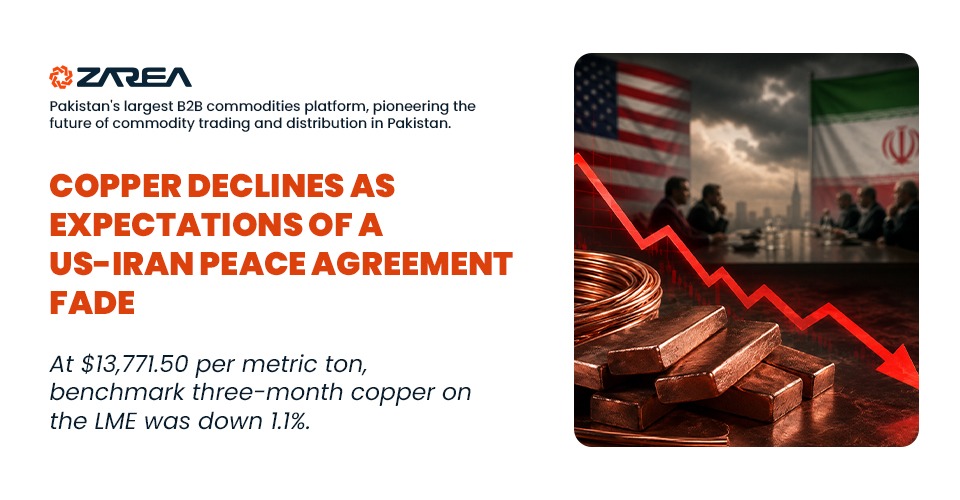
Copper Price Drop:
A stronger US currency and worries about inflation have caused copper prices to decline. Additionally, the strong employment figures raised the likelihood that the Federal Reserve will raise interest rates. Additionally, after these economic reports, both US COMEX futures and the London Metal Exchange (LME) saw sharp declines.
Friday saw a decline in copper prices as prospects for a peace agreement between the United States and Iran dwindled and risk sentiment in growth-dependent commodities was impacted by fresh concerns about inflation.
At 0953 GMT, benchmark three-month copper on the London Metal Exchange was down 1.1% at $13,771.50 per metric ton, finding support above its 21-day moving average, which is now at $13,728.
After reaching a record high of $14,527.5 in January, copper, which is used in building and electricity, has increased 11% so far this year. This week, analysts at a number of investment firms raised their price projections; Citi anticipated $15,000 in six to twelve months.
Current Market Drivers:
1) Rate Hike Fears: Investors have placed bets on more monetary tightening in response to better-than-expected US employment statistics. However, it reduces the need for industrial metals.
2) Stronger Dollar: The US dollar has been strengthened by ongoing tensions in the Middle East. International customers are paying more for dollar-priced commodities like copper as a result of this circumstance.
3) Geopolitical Uncertainty: The markets have seen significant volatility due to escalating Middle East crises and possible US import tariff hikes ahead of trade deadlines.
Premium Copper Prices Dropped to 9%:
Ole Hansen, director of Saxo Bank's commodities strategy, stated that "high prices will inevitably test demand elasticity, particularly in China where buyers have historically shown sensitivity to elevated prices."
A measure of China's need for imported copper, the Yangshan copper premium dropped 9% this week to a five-week low of $64 per ton.
Prior to the U.S. Department of Commerce's proposal on potential import taxes, which the market anticipates by the end of June, supporting copper is a premium of COMEX copper futures over the LME benchmark.
Daily LME Data:
The United States' COMEX copper stockpiles, which are already at a record high of 583,055 tons, are seeing inflows due to this premium. While the availability of visible inventory abroad is becoming more constrained.
Daily LME data shows that available stocks in LME-registered warehouses are at 240,050 tons, the lowest level since February 24, with canceled stocks accounting for 37% of the total.
The LME cash copper contract's discount to the benchmark finished Thursday at $11.5 a ton, down from $58 a month earlier, indicating less availability for short-term supply.
Tin stocks increased 49% to 12,358 tons this week, while copper inventory in warehouses tracked by the Shanghai Futures Exchange dropped 4% to 169,512 tons, the lowest since the end of December.
Aluminum dropped 0.4% to $3,651.50, zinc down 0.2% to $3,578.50, lead dropped 0.1% to $2,014, and tin dropped 2.5% to $54,255 in other LME metals.
Nickel Prices:
At $18,690, nickel remained stable.
Whether you are keeping an eye on regional Shanghai Futures Exchange (SHFE) rates or the London Metal Exchange (LME) benchmark has a significant impact on tracking global nickel prices. The market is significantly impacted by the present supply glut and Indonesian production restrictions.
The Bottom Line:
A stronger US dollar and worries about inflation caused copper prices to fall 1.1% to $13,771.50 per metric ton on the LME. The Federal Reserve is expected to raise interest rates in response to strong job reports. Despite this downturn, there is less hope for a peace agreement between the US and Iran. However, copper is still up 11% year over year. According to Citi, this will increase to $15,000 in six to twelve months.
